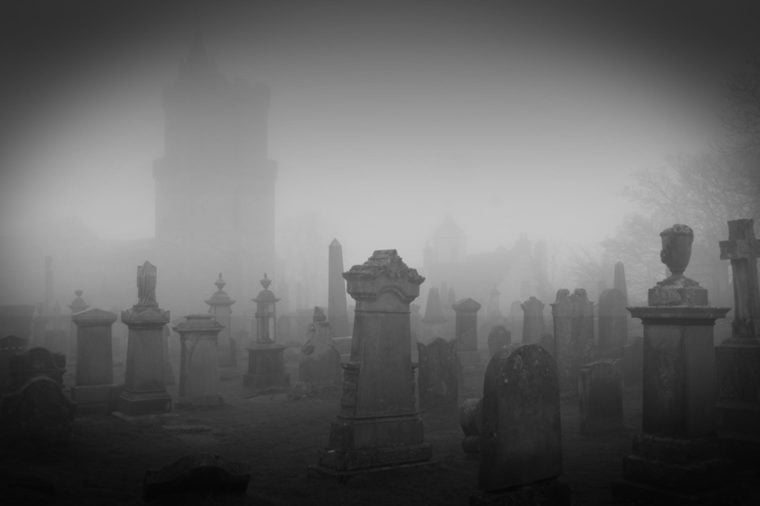
Kisiljevo, Serbia

Ghost Town Ghosts in Bannack, Montana
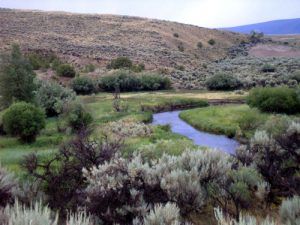
Grasshopper Creek, near Bannack, Montana
Bannack, Montana was born in 1862 when gold was found along Grasshopper Creek. Like other gold rushes, miners rushed to the settlement in search of their fortunes and before long the hills around Bannack were filled with as many as 10,000 miners. With that many men during the era of the rough and tumble days of the Old West, there was bound to be violence.
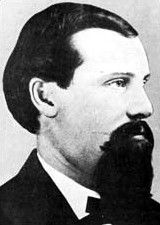
Henry Plummer
Not long after the settlement was formed, in walked a man named Henry Plummer. Handsome, well dressed and charismatic, he gained the trust of the area miners and was soon elected sheriff of the burgeoning community. However, little did the unsuspecting citizens of Bannack know, but their new sheriff led a secret band of road agents called the “Innocents”, who began to terrorize the travelers between Bannack and Virginia City, robbing and killing more than 100 men over the next several months.
In December 1863 the miners formed the Montana Vigilantes and during the next forty-two days, the Vigilantes hanged 24 of the gang members, including Henry Plummer. Later, historians questioned the authenticity of the outlaw tale, suggesting that the whole story was only a cover for the ruthless vigilantes themselves. Today, many say that the ghost of Henry Plummer haunts this old settlement, which has long since become a ghost town. Perhaps he wants to avenge his name.
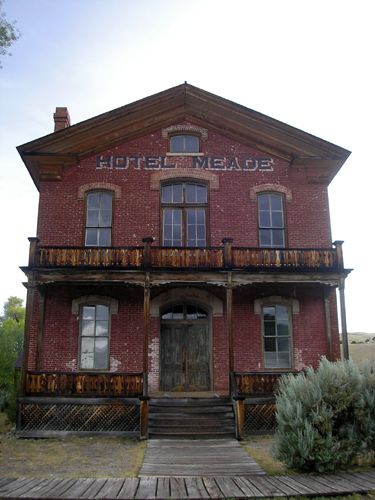
After Bannack lost the county seat, the courthouse became the Hotel Meade
At the Hotel Meade, which was originally built as a courthouse in 1875, there are numerous stories of ghostly activity. When Bannack lost its county seat status to nearby Dillon in 1881, the building sat vacant until 1890 when it was remodeled into a plush hotel. The hotel opened and closed sporadically through the years with the ebb and flow of mining activity. At one time the building acted in the capacity of a hospital.
Cold spots, the apparition of a teenage girl, and sounds of crying children are often reported by those who visit this old building. The first sighting of a young girl was well over a hundred years ago. The teen is said to be that of a girl named Dorothy Dunn who drowned in a dredge pond along the creek long ago. Shortly after her death, she made her first appearance to her best friend, who was with her at the time of her death.
Since then there have been multiple sightings of the teenage girl wearing a long blue dress on the second story of the old hotel. These reports often come from children, one of which reportedly stated that the ghost of Dorothy Dunn tried to talk to her. The seven-year-old could see Dorothy’s mouth moving but no sound came out. Dorothy has also been sighted standing in an upstairs window by passersby on the street below.
Yet more sightings have been reported throughout the town of ghostly women dressed in their best finery.
When mining played out, Bannack became a ghost town in the 1940s. However, the Montana Department of Fish, Wildlife, and Parks saved the town from the elements and vandalism by making it a state park on August 15, 1954.
Today, over sixty structures remain standing, most of which can be explored. The staff preserve, rather than restore the buildings of this old town allowing visitors an opportunity to relive the American West.
The Legend of Blackbird Hill, Nebraska
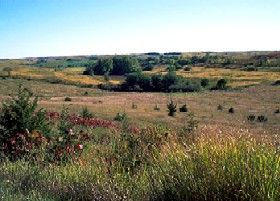
Blackbird Hill, Nebraska
Eight miles north of Decatur, Nebraska, on the Omaha Indian Reservation, is a hill overlooking the Missouri River. At its summit is a mound of dirt nearly 45 feet high marking the burial place of the great Omaha Indian Chief Blackbird. The honored Indian Chief was buried here sitting upright on his favorite horse. Back in 1804, Lewis and Clark visited this gravesite, leaving behind decorations to commemorate him.
Blackbird Hill is said to be haunted and every year dozens of people gather at the site, on October 17th. However, it is not the ghost of Chief Blackbird who lingers here, but rather, that of a young woman who was murdered upon this hill more than a century and a half ago.
The story begins with a young couple back east who had fallen in love in the early 1840s. When the boy finished his schooling, his plans were to travel abroad for a time and then return to marry the young girl.
However, the boy never returned from his trip abroad. The devastated young girl waited for several years, but she finally gave him up for dead and married another man. Soon, the newlyweds headed west, eventually settling in northeast Nebraska, atop Blackbird Hill.
On October 17, 1849, the young girl was astounded when she saw her old fiancé walking up the winding path from the Missouri River to her small cabin. He too was surprised, having no idea that she lived there.
Overjoyed to see him, she confessed that she had never stopped loving him and only married the other man because she thought he was dead. He then began to convey the tale of his previous years. When traveling abroad, he was shipwrecked but managed to survive. However, it took him almost five years to get back to America. When he arrived home he was saddened to find that his mother had died and his fiancée had married another man and moved west. Setting out to find her, he joined a wagon train and headed for California, searching everywhere along the way for his long lost love.
By the time he reached the west coast he had failed to find her and heartbroken, he began the long journey home traveling along the Missouri River. Landing one day at the foot of Blackbird Hill, he saw the winding path up the slope and decided to follow it. That’s when fate intervened and brought the long-lost pair back together.
The girl told him that when her husband returned home, she would tell him that she wished to be released from her marriage vows so they could leave together the next morning. Giving the couple time to discuss the situation the young man hid in the nearby woods. When the woman’s husband returned home, she explained the situation but he did not want her to leave and at first, begged her to stay. When she refused, he began to get angry and soon ended up attacking her with his hunting knife. Screaming, she fell to the floor. The husband then dropped the knife and gathered up his bleeding wife. With her in his arms, he ran to the cliff at the top of the hill and jumped with her into the river far below.
Giving chase, the young man arrived at the hill just in time to see the man leap from the summit and to hear the woman’s final scream of agony. Collapsing with grief, the young man began to wander the hills aimlessly until he was finally found ragged and half-starved by a group of Omaha Indians. Delirious and unable to speak, the Indians carried the man back to their village, where he stayed until he could recover enough to travel.
Today, the path from the cabin to the cliff edge is barren. Even more than 150 years later, no plant life will grow on the path that led to the woman’s death. And, according to the legend, each year on October 17th, the woman’s chilling screams can be heard at the top of the hill. Over the years, dozens of people have reportedly heard her cries of terror.
The Omaha Indian Reservation is located in northeastern Nebraska, just west of Highway 75. Blackbird Hill is eight miles north of Decatur along the Missouri River. The hill itself is inside the Omaha reservation and not open to the public, but you can climb a nearby scenic overlook to view the river below.
Goldfield Hotel – Luxury in the Nevada Desert
In the almost ghost town of Goldfield, Nevada is the historic and reportedly very haunted Goldfield Hotel. The town of Goldfield was born when gold was discovered in 1902 and within just a few short years, it became the largest city in Nevada, as millions of dollars in ore were extracted from area mines. Like other cities, whose only reason for being was its mining industry, when the ore played out, so did the town. In addition to its numerous saloons, the city once boasted three newspapers, five banks, a mining stock exchange, and a population of nearly 35,000.
However, just eight years after Goldfield was founded, the volume of ore began to decrease and many of its residents began to move on to more prosperous claims.
By 1920, the gold was almost gone and the town was reduced to just about 1,500 people. Three years later, a devastating fire wiped out 27 blocks of homes and businesses. Today, this once-thriving city supports a population of less than 500, but still provides a number of views of its prosperous past, with its centerpiece being the Goldfield Hotel.
In 1908, the Goldfield Hotel, designed by Architect George E. Holesworth, opened amidst an array of fanfare. Built on the former site of the Nevada Hotel, which had burned down in a fire in 1905, the hotel was first owned by J. Franklin Douglas and several other investors. The four-story building of stone and brick cost over $300,000 to build and included 154 rooms with telephones, electric lights, and heated steam. The lobby was paneled with mahogany and furnished in black leather upholstery, beneath gold-leaf ceilings and crystal chandeliers. The hotel imported chefs from Europe and boasted one of the first Otis elevators west of the Mississippi River. Considered to be the most luxurious hotel between Chicago and San Francisco, it appealed to society’s upper crust, making it an immediate success.
However, shortly after the hotel was built, it was sold to mining magnate, George Wingfield, the primary owner of the Goldfield Consolidated Mines Company, and hotel entrepreneur, Casey McDannell, who created a new hotel corporation called Bonanza Hotel Company. After paying $200,000 cash and stock valued at around $250,000 for the hotel, the Goldfield property was merged with existing hotels owned by McDannell into the new Bonanza Hotel Company.
Though George Wingfield owned a majority interest in the Bonanza Hotel Company, his principle partner, Casey McDannell, managed and operated the hotel. As the owner of the Goldfield Consolidated Mines Company, Wingfield was a multi-millionaire by the age of 30 and became a political powerhouse in the State of Nevada. After making his fortune in the goldfields, he went on to own a chain of banks, numerous ranches, and several Reno hotels, in addition to his interest in the Goldfield Hotel and the Bonanza Hotel Company. Active in political party circles in the 1920s, he became the reputed boss of both the Democratic and Republican parties. George Wingfield’s power was legendary in his own time and was publicly demonstrated when the collapse of his twelve banks in 1932 almost led to the economic ruin of the state.
In 1923, the Goldfield Hotel was sold to Newton Crumley, another hotel entrepreneur who owned the Commercial Hotel in Elko, Nevada. Crumley, who evidently also aspired to make to profit from the gold in the area, dug two mine shafts beneath the hotel in 1925. However, both resulted in “dry holes.”
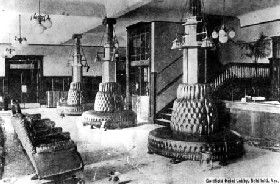
Vintage Goldfield Hotel Lobby
When Goldfield was in its heyday, the hotel entertained all manner of affluent guests. However, as the gold began to play out and Goldfield’s population diminished, the Goldfield Hotel began a gradual decline. By the 1930s, when the town supported fewer than 1,000 souls, it had become little more than a flophouse for cowboys and undiscriminating travelers. During World War II, it housed Army Air Corp personnel assigned to the Tonopah Air Base 25 miles north of Goldfield. After the soldiers checked out the hotel in 1945, the hotel closed its doors forever. It was listed on the National Register of Historic Places in 1982 as a contributing property in the Goldfield Historic District.
Over the years, the hotel has changed hands numerous times, with each new owner promising to restore and reopen the old property. In 1985, the building was bought by a San Francisco investor named Lester O’Shea whose plans looked as if they might really come through. However, after a few years when his restoration project was about 85% complete, his company went bankrupt and the property reverted back to the county. In 2003, the county auctioned off the old hotel, as well as nearly ninety other parcels of historic land. A rancher from Carson City named Edgar “Red” Roberts was the only bidder and bought the hotel for $360,000.
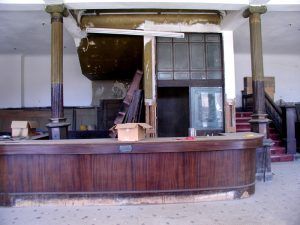
Goldfield Hotel Interior
Reportedly, Roberts has plans to finish the refurbishing of the bottom two floors, spending an estimated $1 million, to reopen the historic hotel to the public. The restoration project would include 40 guest rooms, a casino and a café. The dying town of Goldfield is pinning its hopes on Roberts, knowing that the reopening could revitalize the town with new jobs and tourism. However, they’ve heard it so many times, they’re not holding their breath until they see it complete. When updating this story in September of 2015, we couldn’t find any indication of major progress. What we did find is that work has been hampered by vandalism over the past few years, and that is likely due to it’s spooky history and attention it has attracted.
Reportedly there are several ghosts at the old hotel, the most famous of which is a woman named Elizabeth*. According to the legend, Elizabeth was a prostitute that George Wingfield visited frequently. When she turned up pregnant, she claimed the child was Wingfield’s, who for a while paid her to stay away, fearful of how the scandal might affect his business affairs. However, when she could no longer hide the pregnancy, Wingfield was said to have lured her into room 109 of the hotel, where he chained her to a radiator. Supplied with food and water, she was left there until her child could be born. Reportedly she cried out over and over for mercy, only to be met with silence. Some say that Elizabeth died in childbirth, but others contend that Wingfield murdered her after the child was born. Her baby was then thrown into an old mining shaft. Afterward, rumors abounded that Elizabeth continued to visit Wingfield and the sound of a crying child could sometimes be heard coming from the depths of the hotel.
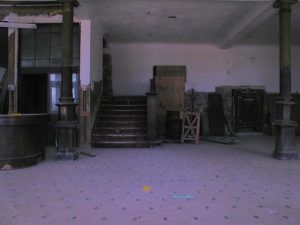
Goldfield Hotel Interior
This legend; however, has a few problems that don’t “mesh” with the history of the old building. The legend actually asserts that Elizabeth died sometime in the 1930s, at which time Wingfield no longer owned the hotel. It also alleges that the baby was thrown into one of the mining shafts beneath the hotel, which were built by Newton Crumley some two years after he purchased the property from Wingfield in 1923.
Is the legend confusing Wingfield and Crumley, or did it occur years earlier? Of this, we will never know.
In any event, the legend persists and when the apparition of Elizabeth has been sighted, she has been described as having long flowing hair, wearing a white gown, and looking terribly sad as she paces the hallways, calling out to her child. Others have reported her being sighted in Room 109, which is often described as being intensely cold, and on one occasion a ghostly figure appeared in a photograph of the room. However, most people report that while their cameras function normally everywhere else in the hotel, they refuse to work in room 109.
Two more ghosts who reportedly committed suicide in third-floor rooms of the hotel have been sighted by more than a dozen people. While their identities are unknown, one is said to be a woman who hanged herself, while the other is said to be a man who jumped to his death from the hotel.
In what was once the main dining room, called the Gold Room, a malevolent spirit, familiarly named “The Stabber,” is said to randomly attack those who cross the threshold with a large kitchen knife. Though the Stabber has never harmed anyone, he is said to have frightened many before immediately disappearing after the “attack.”
Near the lobby staircase, linger three small spirits including two children and a midget that are said to be pranksters, sneaking up behind people and tapping their backs before giggling and dancing away.
Finally, George Wingfield himself is said to haunt his old hotel, making his presence known by his cigar smoke. Others have reported finding fresh cigar ashes in his first-floor room. His presence has also been sensed near the giant lobby staircase. This legend too, has some problems with the history of the old hotel, as Wingfield was not known to frequent the hotel, as it was managed by his partner, Casey McDannell, and Wingfield’s interest was only as an investor. Additionally, Wingfield died in Reno, Nevada in 1959. Why would his spirit continue to linger at the Goldfield Hotel?
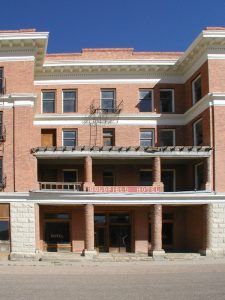
Front of the Goldfield Hotel in Goldfield, Nevada
Many psychics who have visited the old hotel claim that it is a gateway into another world. The old hotel has been featured on a number of paranormal investigation television shows.
However, just eight years after Goldfield was founded, the volume of ore began to decrease and many of its residents began to move on to more prosperous claims.
By 1920, the gold was almost gone and the town was reduced to just about 1,500 people. Three years later, a devastating fire wiped out 27 blocks of homes and businesses. Today, this once-thriving city supports a population of less than 500, but still provides a number of views of its prosperous past, with its centerpiece being the Goldfield Hotel.
In 1908, the Goldfield Hotel, designed by Architect George E. Holesworth, opened amidst an array of fanfare. Built on the former site of the Nevada Hotel, which had burned down in a fire in 1905, the hotel was first owned by J. Franklin Douglas and several other investors. The four-story building of stone and brick cost over $300,000 to build and included 154 rooms with telephones, electric lights, and heated steam. The lobby was paneled with mahogany and furnished in black leather upholstery, beneath gold-leaf ceilings and crystal chandeliers. The hotel imported chefs from Europe and boasted one of the first Otis elevators west of the Mississippi River. Considered to be the most luxurious hotel between Chicago and San Francisco, it appealed to society’s upper crust, making it an immediate success.
However, shortly after the hotel was built, it was sold to mining magnate, George Wingfield, the primary owner of the Goldfield Consolidated Mines Company, and hotel entrepreneur, Casey McDannell, who created a new hotel corporation called Bonanza Hotel Company. After paying $200,000 cash and stock valued at around $250,000 for the hotel, the Goldfield property was merged with existing hotels owned by McDannell into the new Bonanza Hotel Company.
Though George Wingfield owned a majority interest in the Bonanza Hotel Company, his principle partner, Casey McDannell, managed and operated the hotel. As the owner of the Goldfield Consolidated Mines Company, Wingfield was a multi-millionaire by the age of 30 and became a political powerhouse in the State of Nevada. After making his fortune in the goldfields, he went on to own a chain of banks, numerous ranches, and several Reno hotels, in addition to his interest in the Goldfield Hotel and the Bonanza Hotel Company. Active in political party circles in the 1920s, he became the reputed boss of both the Democratic and Republican parties. George Wingfield’s power was legendary in his own time and was publicly demonstrated when the collapse of his twelve banks in 1932 almost led to the economic ruin of the state.
In 1923, the Goldfield Hotel was sold to Newton Crumley, another hotel entrepreneur who owned the Commercial Hotel in Elko, Nevada. Crumley, who evidently also aspired to make to profit from the gold in the area, dug two mine shafts beneath the hotel in 1925. However, both resulted in “dry holes.”
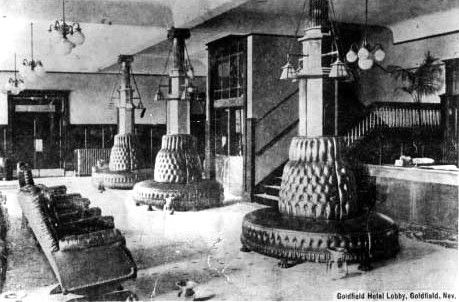
Vintage Goldfield Hotel Lobby
When Goldfield was in its heyday, the hotel entertained all manner of affluent guests. However, as the gold began to play out and Goldfield’s population diminished, the Goldfield Hotel began a gradual decline. By the 1930s, when the town supported fewer than 1,000 souls, it had become little more than a flophouse for cowboys and undiscriminating travelers. During World War II, it housed Army Air Corp personnel assigned to the Tonopah Air Base 25 miles north of Goldfield. After the soldiers checked out the hotel in 1945, the hotel closed its doors forever. It was listed on the National Register of Historic Places in 1982 as a contributing property in the Goldfield Historic District.
Over the years, the hotel has changed hands numerous times, with each new owner promising to restore and reopen the old property. In 1985, the building was bought by a San Francisco investor named Lester O’Shea whose plans looked as if they might really come through. However, after a few years when his restoration project was about 85% complete, his company went bankrupt and the property reverted back to the county. In 2003, the county auctioned off the old hotel, as well as nearly ninety other parcels of historic land. A rancher from Carson City named Edgar “Red” Roberts was the only bidder and bought the hotel for $360,000.
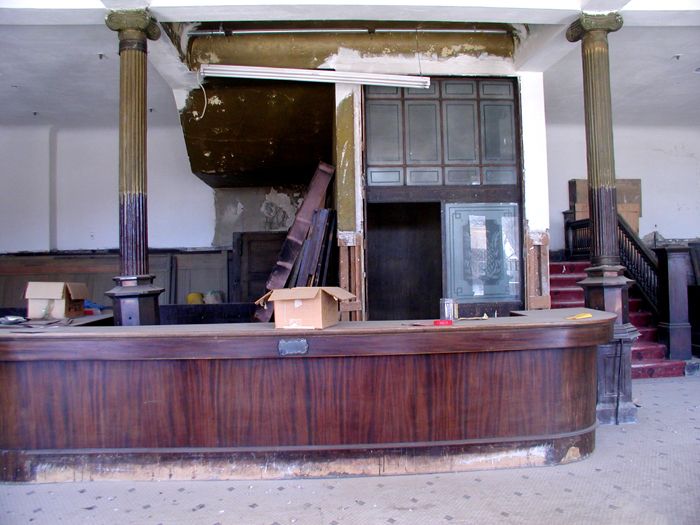
Goldfield Hotel Interior
Reportedly, Roberts has plans to finish the refurbishing of the bottom two floors, spending an estimated $1 million, to reopen the historic hotel to the public. The restoration project would include 40 guest rooms, a casino and a café. The dying town of Goldfield is pinning its hopes on Roberts, knowing that the reopening could revitalize the town with new jobs and tourism. However, they’ve heard it so many times, they’re not holding their breath until they see it complete. When updating this story in September of 2015, we couldn’t find any indication of major progress. What we did find is that work has been hampered by vandalism over the past few years, and that is likely due to it’s spooky history and attention it has attracted.
Reportedly there are several ghosts at the old hotel, the most famous of which is a woman named Elizabeth*. According to the legend, Elizabeth was a prostitute that George Wingfield visited frequently. When she turned up pregnant, she claimed the child was Wingfield’s, who for a while paid her to stay away, fearful of how the scandal might affect his business affairs. However, when she could no longer hide the pregnancy, Wingfield was said to have lured her into room 109 of the hotel, where he chained her to a radiator. Supplied with food and water, she was left there until her child could be born. Reportedly she cried out over and over for mercy, only to be met with silence. Some say that Elizabeth died in childbirth, but others contend that Wingfield murdered her after the child was born. Her baby was then thrown into an old mining shaft. Afterward, rumors abounded that Elizabeth continued to visit Wingfield and the sound of a crying child could sometimes be heard coming from the depths of the hotel.
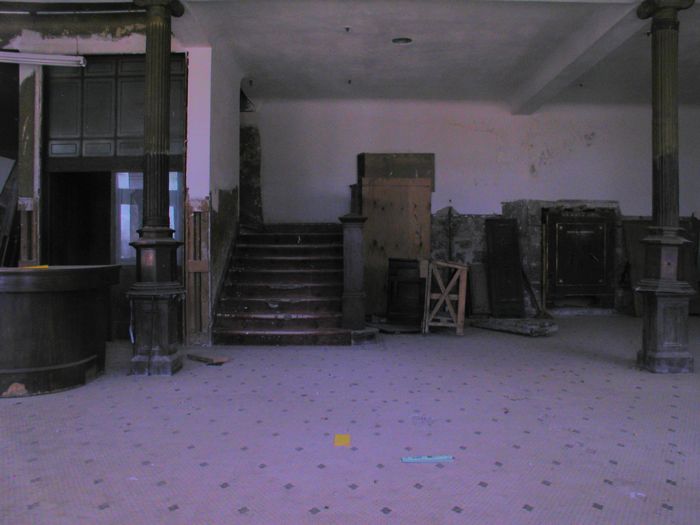
Goldfield Hotel Interior
This legend; however, has a few problems that don’t “mesh” with the history of the old building. The legend actually asserts that Elizabeth died sometime in the 1930s, at which time Wingfield no longer owned the hotel. It also alleges that the baby was thrown into one of the mining shafts beneath the hotel, which were built by Newton Crumley some two years after he purchased the property from Wingfield in 1923.
Is the legend confusing Wingfield and Crumley, or did it occur years earlier? Of this, we will never know.
In any event, the legend persists and when the apparition of Elizabeth has been sighted, she has been described as having long flowing hair, wearing a white gown, and looking terribly sad as she paces the hallways, calling out to her child. Others have reported her being sighted in Room 109, which is often described as being intensely cold, and on one occasion a ghostly figure appeared in a photograph of the room. However, most people report that while their cameras function normally everywhere else in the hotel, they refuse to work in room 109.
Two more ghosts who reportedly committed suicide in third-floor rooms of the hotel have been sighted by more than a dozen people. While their identities are unknown, one is said to be a woman who hanged herself, while the other is said to be a man who jumped to his death from the hotel.
In what was once the main dining room, called the Gold Room, a malevolent spirit, familiarly named “The Stabber,” is said to randomly attack those who cross the threshold with a large kitchen knife. Though the Stabber has never harmed anyone, he is said to have frightened many before immediately disappearing after the “attack.”
Near the lobby staircase, linger three small spirits including two children and a midget that are said to be pranksters, sneaking up behind people and tapping their backs before giggling and dancing away.
Finally, George Wingfield himself is said to haunt his old hotel, making his presence known by his cigar smoke. Others have reported finding fresh cigar ashes in his first-floor room. His presence has also been sensed near the giant lobby staircase. This legend too, has some problems with the history of the old hotel, as Wingfield was not known to frequent the hotel, as it was managed by his partner, Casey McDannell, and Wingfield’s interest was only as an investor. Additionally, Wingfield died in Reno, Nevada in 1959. Why would his spirit continue to linger at the Goldfield Hotel?
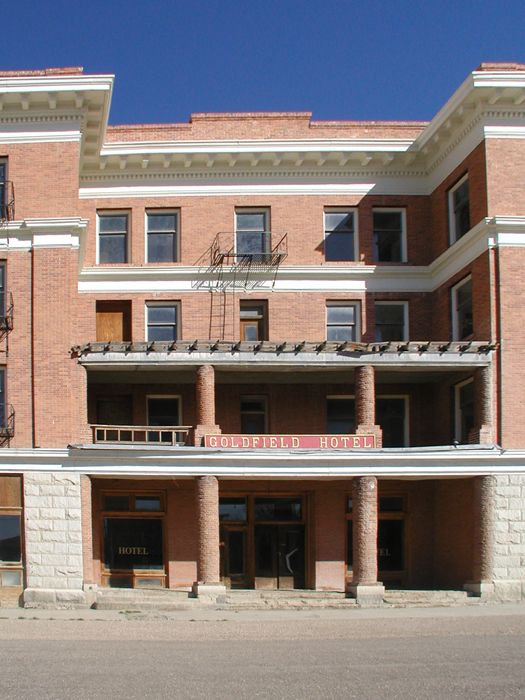
Front of the Goldfield Hotel in Goldfield, Nevada
Many psychics who have visited the old hotel claim that it is a gateway into another world. The old hotel has been featured on a number of paranormal investigation television shows.
Subscribe to:
Posts (Atom)