This blog is the best for google chrome.
Download
Website Online Counter

Showing posts with label Kansas. Show all posts

The Haunting of St. Jacob’s Well: The Bottomless Pool of Clark County, Kansas

Deep within the vast, sun-baked prairies of Clark County, Kansas, lies a site that has fascinated folklorists, geologists, and paranormal enthusiasts for well over a century. Hidden inside Little Basin—a natural depression in the Big Basin Prairie Preserve near Ashland—St. Jacob’s Well is a permanent pool fed by a deep artesian spring. To the untrained eye, it appears to be a calm, quiet waterhole nestled beneath rugged limestone bluffs. But ask the locals or dig into pioneer lore, and you will quickly discover that St. Jacob's Well is widely regarded as one of the most mysterious and hauntingly eerie locations in the Great Plains.

The Geological Anomaly That Defied Explanation

Before examining the hauntings, it helps to understand why St. Jacob's Well gained such a formidable reputation. Formed thousands of years ago when underground salt deposits dissolved and caused the earth above to collapse, this karst sinkhole measures roughly 84 feet across.

What unsettled early settlers was the fact that the well has never gone dry. Through brutal summer droughts, bitter winter freezes, and the historic catastrophe of the 1930s Dust Bowl, the water level remained unchanged.

Early attempts to sound the pool's depth only added to the dread. Settlers tied heavy weights to long ropes and dropped them into the dark center, yet they repeatedly failed to hit a solid floor. Because subterranean currents and soft silt interfered with line measurements, a persistent belief took root: St. Jacob’s Well was bottomless, extending down into an uncharted, dark abyss.

The Haunted Legends of St. Jacob’s Well

Where there is a mysterious, "bottomless" body of water, ghostly tales inevitably follow. The local folklore surrounding St. Jacob’s Well features three primary hauntings and eerie legends:

  • The Phantom Cowboy & Lost Cattle: During the cattle drive era of the late 1800s, cowboys driving herds along the Western Trail frequently watered their stock at Little Basin. According to legend, a cowboy lost his footing—or was pulled under—while trying to rescue a stray calf. Neither his body nor his horse was ever recovered. Visitors report hearing faint, disembodied whistles, the thud of phantom hooves, and hushed cries echoing out of the basin on still nights.

  • The Vanishing Wagon: Another widely circulated piece of regional lore tells of a pioneer family attempting to cross the basin during a storm. The wagon slipped into the pool's steep rim and plunged into the murky depths. Search parties found no trace of the wagon, horses, or passengers, feeding the theory that the well's underwater caverns drag everything into an inescapable subterranean current.

  • The "Unnatural Silence": Parapsychologists and dark tourists often comment on the unsettling atmosphere immediately surrounding the water. Tucked deep inside the sinkhole, the pool is naturally shielded from prairie winds. Yet visitors frequently describe a complete drop in ambient noise—no birds singing, no insects chirping, and an overwhelming sensation of being watched from beneath the dark surface.

What Science Says

Modern hydrological studies have debunked the "bottomless" myth, revealing that St. Jacob’s Well is approximately 58 feet deep, feeding into a complex network of flooded limestone caverns. The constant water level is sustained by a high-pressure artesian aquifer that steadily replenishes the pool from below.

However, scientific explanations haven't dulled the eerie allure of the site. The dark, murky water, combined with the isolated landscape of the Big Basin Prairie Preserve—where wild bison still roam free—creates an atmosphere that feels frozen in time.

Visitor Guide: Exploring the Haunted Sinkhole

If you want to experience the eerie tranquility of St. Jacob’s Well yourself, here is what you need to know:

DetailInformation
LocationBig Basin Prairie Preserve, U.S. Hwy 283, Clark County, KS
Nearest TownAshland, Kansas (~15 miles southeast)
AccessibilityShort, unpaved trail leading down into Little Basin
Safety WarningNo swimming or diving. Steep bank drops and deep underwater silt pose genuine hazards.
Best Time to VisitDusk or early morning for atmospheric lighting and wildlife viewing

Whether you come looking for geological wonders, historic cattle trail lore, or a brush with the paranormal, St. Jacob’s Well remains one of the quietest, most unsettling hidden gems in western Kansas.

Read more >>

Burlington, Kansas: The Quiet Heart of Coffey County with a Lingering Spirit


Located along the banks of the Neosho River, Burlington, Kansas, serves as the historic seat of Coffey County. Known for its limestone architecture and friendly faces, this town seems like the definition of "Kansas Quiet."

However, beneath the calm exterior of this agricultural hub lies a history of frontier struggles, devastating floods, and grand buildings that some say are still occupied by those who built them.


1. The Coffey County Courthouse: A Limestone Sentinel

The centerpiece of Burlington is the magnificent Coffey County Courthouse. Built with sturdy Kansas limestone, it stands as a symbol of law and order.

  • The Atmosphere: At night, the tall windows and shadowed porticos take on a gothic feel.

  • The Legend: Local whispers suggest that late-night workers have heard the sound of heavy footsteps and rustling papers in empty courtrooms, as if a long-dead judge is still presiding over a final case.

2. The Neosho River: Echoes of the Flood

The Neosho River gave life to Burlington, but it also brought tragedy through historic floods.

  • The Paranormal: Near the riverbanks, where the old mills once stood, fishermen have reported hearing faint cries or seeing "water-logged" apparitions drifting through the morning mist.

  • The Hook: These stories tap into the "Elemental Ghost" niche, which attracts high engagement from paranormal enthusiasts.

3. Wolf Creek: Modern Myths near Burlington

Just a short drive away is the Wolf Creek Generating Station.

  • The Mystery: Like many nuclear sites, it has become a magnet for "UFO sightings" and "electronic voice phenomena (EVP)" reported by locals in the surrounding fields.

  • If you enjoy the quiet dread of the Midwest, compare it to the humid mysteries of [Fort Pickens] in Florida.


Read more >>

Kansas Ghost Towns

Kansas is home to many ghost towns, remnants of a time when the state was a frontier outpost. These towns were once bustling communities, but they have since been abandoned due to factors such as economic decline, natural disasters, and changes in transportation routes. Today, these ghost towns offer a glimpse into the past, with their crumbling buildings and deserted streets serving as reminders of a bygone era.

Here are some of the most notable ghost towns in Kansas:
Alcove, Marshall County – Now a well-preserved park. This was never an official town but was a stop on the Oregon Trail. Numerous carvings in the spring’s rocks feature travelers’ initials and other things. A member of the Donner Party is buried nearby.


Alexander, Rush County – Post Office 1869-present – Estimated population of 54.


Amy, Lane County – Post Office 1887-1954 – Only a grain elevator, an old school, and agricultural buildings remain.


Arrington, Atchison County – Post Office 1879-1973 – Today, were it not for the sign indicating the town and the few scattered homes about, it would be difficult to know that a town had ever existed. It is located about 26 miles southwest of Atchison on Kansas Highway 119.


Arvonia, Osage County – Post Office 1869-1901 – Arvoinia is still called home to a historic one-room school, an old church, and a few area homes.


Asherville, Mitchell County – Post Office 1869-1980 – A small population still exists.


Auburndale, Shawnee County – Post Office 1888-1899 – Auburndale is currently a neighborhood in Topeka and is commemorated by Auburndale Park.


Aulne, Marion County – Post Office 1887-1954 – Located in Wilson Township, it was a station on the Chicago, Rock Island & Pacific Railroad six miles south of Marion. Today, the town still has a few buildings and an active church.


Bala, Riley County – Post Office 1870-1966 – Fort Riley has expanded into much of the area where Bala once stood. Today, there is very little left of Bala except for a few hardscrabble houses and the old deteriorating Presbyterian Church.


Barnard, Lincoln County – Post Office 1888-present – Though there are a few remaining businesses today, and the post office is still in operation, the population of this once prosperous community has dropped to just about 63 people.


Bavaria/Honek, Saline County – Post Office 1867-1986 – First called Honek, the name changed to Bavaria in 1880. Though located on the mainline of the Union Pacific Railroad, Bavaria did not grow. By 1910, its population had dropped to 110. Today, just a handful of people live in the old town, where several buildings sit abandoned and deteriorating in the elements.

Bazaar, Chase County – Post Office 1860-1874. One of the county’s oldest towns, the settlement started in March 1856. Bazaar peaked in about 1921, with a population of 100. That year, it was the largest railroad cattle shipping point in the state, hauling about 1,800 to 2,000 cars of stock annually. Today, it has a historic school, a still-active Methodist Church, and a few scattered homes.

Beaumont, Butler County – Post Office 1880-1997 – An unincorporated community and semi-ghost town in Glencoe Township. Several area homes, vacant business buildings, and a population of about 30.


Beaver, Barton County – Post Office 1919-1992 – A small population remains.


Belvidere/Glick, Kiowa County – Post Office 1883-1996 – Originally founded as Glick, the name changed to Belvidere in 1890. A small population remains.


Bendena, Doniphan County – Post Office 1886-present – A small community remains along K-20.


Big Springs, Douglas County – Post Office 1856-1903 -A small population remains along U.S. 40.


Blackjack, Douglas County – Post Office 1858-1895 – Santa Fe Trail wagon swales, a roadside park, cemetery, and the well-preserved battlefield site remain open to the public.


Black Wolf, Ellsworth County – Post Office 1879-1953 – A grain elevator and other buildings remain. Black Wolf is currently on private property.


Blaine, Pottawatomie County – Post Office 1874-1976 – St. Columbkille Catholic Church and former Catholic School still stand at the intersection of K-99 and K-16.


Blakeman, Rawlins County – Post Office 1887-1952 – Little remains of the townsite.


Bloom, Ford County – Post Office 1885-1891 & 1908-1992 – Several buildings and a few residents, but no open businesses.


Bluff City, Harper County – Post Office 1887-present – 2008 estimated population of 73. Bluff City was initially founded as a fraud in 1873 to swindle money from the Kansas legislature. The first settlers in the area didn’t arrive until 1876.


Boyd/Maherville, Barton County – Post Office 1874-1937 – Some abandoned buildings and ruins remain. Known initially as Maherville. The name changed to Boyd in 1904.


Brookville, Saline County – Post Office 1870-present – 2010 population of 262. The population was once near 2,000 in the 1870s, but the population began to decline after the turn of the century.


Burdick, Morris CountyPost Office 1887-present – A very small population and a few buildings.


Bushong, Lyon County – Post Office 1887-1976. The small town has an estimated population of about 30. Several ruins of the downtown and old consolidated school remain.


Byers, Pratt County – Post Office 1915-present. The small town has an estimated population of 33.


Cadmus, Linn CountyA ghost town located in the north-central part of Linn County on Elm Creek. It got its start as an agricultural community.


Calista, Kingman County – Post Office 1886-1896 & 1902-1955 – An old grain elevator and a couple of houses remain.


Canada, Marion County – Post Office 1884-1954 – A small population of approximately 40 remains.


Carlton, Dickinson County – Post office 1872-1995 – Once a busy station and shipping point on the Kansas Pacific Railroad. As of the 2020 census, its population was 40.


Carneiro, Ellsworth County – Post Office 1882-1953 – A small population remains north of Mushroom Rock State Park.


Castleton, Reno County – Post Office 1872-1957 – A few homes and abandoned buildings remain. Castleton was used as the setting of Sevillinois for the 1952 movie Wait Till the Sun Shines, Nellie.


Cato, Crawford CountyPost Office 1858-1905 – The Cato Historical Preservation Association meets at 6:30 pm on the fourth Tuesday of each month at Arcadia Community Center, Arcadia, Kansas. The old school has been restored. Cato Christian Church is in good repair but closed. A community reunion is held yearly.|


Cedar Point, Chase County – Post Office 1862-Present – Today, it is a semi-ghost town with several remaining buildings and a historic flour mill.


Centropolis, Franklin County – Post Office 1854-1930 – A small population remains on a county road about ten miles northwest of Ottawa. The Christian Church and Baptist Church remain open.


Clayton, Norton County – Post office 1879-19?? – Semi-ghost town located primarily in Norton County but also in Decatur County. Building ruins and a small population remain.


Clements, Chase County – Post office 1884-1988 – First called Crawfordsville. Little remains except for a beautiful stone arch bridge, ruins, a couple of old buildings, and an old store.


Coolidge, Hamilton County – Post Office 1873-1875 & 1881-present – 2008 estimated population of 86. The original town was called Sargent but it changed to Coolidge in 1881.


Croft, Pratt County – Post Office 1907-1961 – Two vacant grain elevators, two vacant houses, an old school, and a few ruins remain in this town.


Croweburg, Crawford County – Post Office 1908-1972 – A small population remains with some shotgun houses and some building ruins.


Defiance, Woodson County – Post Office 1873-1886 – Only a hotel remains used as a residence.


Delavan, Morris County – Post Office 1886-1992 – A few area people, old school, community center.


Denmark, Lincoln County – Post Office 1872-1904, 1917-1954 – One of the first permanent settlements in Lincoln County, it was settled about 1869 by Danish Lutherans who laid the cornerstone for a stone church in 1876. The church and several other buildings still stand.


Dubuque, Russell & Barton Counties – Post Office 1879-1909 – A beautiful Catholic church and cemetery are all that remain.


Diamond Springs, Morris CountyPost Office 1825-1863 – A Santa Fe Trail stop. Few remains exist, but a monument to Diamond Springs was erected in Diamond Springs Cemetery.


Dispatch, Smith County – Post Office 1891-1904 – A church, some houses, and a cemetery remain.


Doniphan, Doniphan CountyPost Office 1854-1943 – Still on maps but little remains. A trading post was established on the site in 1852.


Dunlap, Morris CountyPost Office 1874-1988 – Estimated population of 27.


Drury, Sumner County – Post Office 1884-1921 – A small population (approx. 20) remains, along with a dam built in 1882.


Dry Creek, Saline County – Post Office 1877-1887 – An old blacksmith shop still stands, but nothing else remains.


Eagle Springs, Doniphan County – Post Office 1883-?? – The townsite was abandoned, and only ruins remain. It was a health resort that lasted into the 1930s.


Elgin, Chautauqua County – Post Office 1871-1976 – 2008 estimated population of 71. Also known as New Elgin.


Elk Falls, Elk County – Post Office 1870-present – A small town of about 100 now, home of the annual “Outhouse Tour,” claimed to be Outhouse Capital and home of historic Elk Falls Bridge.


Elmo, Dickinson County – Post Office 1866-1966 – A few buildings and a small population remain.


Empire City, Cherokee County – Post Office 1877-1907 – Several buildings and a small population. Empire City was annexed to Galena, Kansas, in 1907.


Englewood, Clark County – Post Office 1885-present – Estimated population of 69.


Fairport, Russell County – Post Office 1881-1959 – A small population remains.


Farlington, Crawford County – Post Office 1870-present – A small population remains in the area. Farlington is located just southwest of Crawford State Park on K-7.


Franklin, Douglas County – Post Office 1853-1867 – An early stage stop near Lawrence, Kansas. Nothing remains of the town except two small neglected cemeteries and Franklin Road off of K-10.


Freeport, Harper County – Post Office 1885-present – With a population of just about four people, Freeport was the smallest incorporated town in Kansas until November 2017, when a vote of 4–0 dissolved the city. It still supports a church, a grain elevator, and a post office.


Frederick, Rice County -Post Office 1887-1954 – Frederick is the smallest incorporated town in Kansas and today has just a population of about 18.


Fulton, Bourbon County – Post Office 1869-1998. The town was established in 1869 near the site of old Fort Lincoln. Fulton’s population peaked in 1890 at 506 and dropped afterward. It still has several old business buildings, including a school and gymnasium. It is still called home to about 112 people.


Galatia, Barton County – Post Office 1889-1966 – 2020 estimated population of 36.


Gem, Thomas County – Post Office 1885-2014 – Semi ghost town, no open business, but retains a small population and several homes.


Granada/Pleasant Spring, Nemaha County – Post Office 1856-1906 – Some ruins and abandoned buildings remain on what used to be Main Street. Originally known as Pleasant Spring. Changed to Granada in 1864.


Guittard Station, Marshall County – Post Office 1861-1900 – Some abandoned buildings remain. Guittard Station was a major stop for the Pony Express.


Harlan/Thompson, Smith County – Post Office 1873-1995 – A small population remains as well as the ruins of Main Street and a high school gymnasium. Harlan was home to Gould College, which lasted from 1881 until 1891. The settlement was first named Thompson but was changed to Harlan in 1877.


Havana, Osage County – Post Office 1858-Early 1870s – Ruins of the Havana Stage Station and hotel remain, and a sign has been posted on the site. Not to be confused with Havana in Montgomery County.


Hawkeye, Decatur County – Post Office 1879-1896 – Little remains of the townsite.


Heizer, Barton CountyPost office 1891-1954. Several homes and a small population remains.


Hewins, Chautauqua County – Post Office 1887-1966 – A small population remains.


Hitschmann, Barton County – No post office. Some old buildings remain. All of Hitschmann is currently on private property.


Holland, Dickinson County – Post Office 1872-1875 & 1884-1906 – A church, now used as a town hall and a few houses, remain.


Hopewell/Fravel, Pratt County – Post Office 1904-1908 & 1916-1973 – A small population (approx. 10) remains. The name changed to Fravel in 1916 but changed back to Hopewell in 1921.


Horace, Greeley County – A semi-ghost town in central Greeley County. Its post office lasted from 1886 to 1965. Though the nearby town of Tribune tried to annex Horace in 2007, Horace citizens decided against consolidation. The City of Horace maintains a separate city council to manage its affairs. Today, Horace is home to only about 65 people with no open retail businesses.


Hunnewell, Sumner County – Post Office 1880-1960 – 2020 estimated population of 64. In the 1880s, Hunnewell flourished as a busy shipping point for Texas cattle and, like other Kansas Cowtowns, had a bawdy reputation for a time.


Huron, Atchison County Post Office 1882-1992 – Several remaining homes and buildings. 2010 population of 54. Located about 17 miles northwest of Atchison on U.S. Highway 73.


Hunter, Mitchell County – Post Office 1895-present – Semi-ghost town with a population of 57. It still retains its post office and just a few businesses.


Industry, Dickinson & Clay County – Post Office 1876-1906 – A small population of fewer than 20 remains.


Irving, Marshall County – Post Office 1859-1960 – Located on Corps land and is easily accessible. Abandoned for the construction of Tuttle Creek Lake.


Jerome, Gove County – Post Office 1886-1943 – Little remains of the townsite.


Kackley, Republic County – Post Office 1888-1968. It started as a station on the Atchison, Topeka & Santa Fe Railroad and did well until the early 1900s. Its population peaked in 1910 at about 250 and fell afterward.


Kanona, Decatur County – Post Office 1887-1955 – Some ruins and abandoned buildings remain. The site of Kanona is currently on private property.


Kendall/Zamora, Hamilton County – Post Office 1879-present – A small population remains. Originally called Zamora when a post office opened in 1879. It was changed to Kendall in 1885.


Kickapoo City, Leavenworth County – Post Office 1854-1920 – A small population remains in the area.


Kingsdown, Ford CountyPost Office 1888-1891, 1892-1893 & 1904-1998 – Several remaining homes & buildings. A small population remains in the area.


Kipp, Saline County – Post Office 1890-1957 – A small population remains.


Lake City, Barber County – Post Office 1873-1993 – A small population (approx. 30) remains. The United Methodist Church is open.


Latimer, Morris County – Post Office 1887-1961 – A small population of about 20 people. The Lutheran Church remains open.


LeHunt, Montgomery County – Post Office 1905-Early 1930s – Some ruins remain east of Elk City Lake. The town was bustling thanks to a central cement factory in the center of town being the biggest employer. During the Great Depression, cement sales dropped significantly, and the company went out of business, so the town died.


Lone Elm, Anderson County – Post Office 1879-1956. Located in Lone Elm Township of southeast Anderson County, it is officially an extinct town because it no longer has a post office. However, as of the 2020 census, its population was 27.


Lone Star, Douglas County – Post Office 1899-1953 – A small population remains just south of Clinton Lake near Lone Star Lake. A community existed in the area before Lone Star was organized. A post office was formed in 1875 under the name of Bond, then Gideon. The name Lone Star was chosen in the 1890s.


Ludell, Rawlins County – Post Office 1881-present – A small resident population remains along with some ruins and abandoned buildings.


Lyona, Dickinson County – Post Office 1869-1888 – Nothing remains of the townsite except for a church & the old Lyona School built in 1870.


Marietta, Marshall County – Post Office 1890-1959 – A small population and a few buildings remain.


McAllaster, Logan County – Post Office 1887-1897, 1903-1903 & 1906-1953 – A small population exists, and several buildings remain.


Medora, Reno County – Post Office 1887-1988 – Little remains of the townsite except for a small population.


Midian, Butler County – Post Office 1916-1950 – The townsite is now on private property.


Mildred, Allen County – Post Office 1907-1973 – 2020 estimated population of 25.


Millbrook, Graham County – Post Office 1878-1889 – The ruins of a schoolhouse remain in the area.


Miller, Lyon County – Post Office 1887-1905 & 1912-1958 – A small population and some abandoned businesses remain in the area.


Monmouth, Crawford County – Post Office 1857-1955 – Very little remains of the townsite.


Monticello, Johnson CountyPost Office 1857-1905 – The old schoolhouse, cemetery, and a few houses from the 1940s remain south of Shawnee Mission Parkway in west Shawnee and Lenexa.


Monument, Logan County – Post Office 1880-1997 – Though Monument is officially an extinct town today, the railroad still runs through the town and the grain elevators still operate serving area farmers. Throughout the community are numerous old buildings and homes in various states of disrepair.


Morton City, Hodgeman County – Post Office 1877-1880s – Some ruins of old stone houses remain. The townsite is now a part of the Hanna Hereford Ranch.


Muscota, Atchison County Post Office 1861-present – Like other small Kansas towns, Muscotah declined in the 20th century. Though it still maintains a post office and about 167 people, the village is filled with abandoned buildings. It is located about 26 miles west of Atchison on U.S. Highway 159.


Nekoma,Rush County –Post Office 1960-2008. A few remaining buildings and residents.


Neosho Falls, Woodson County – Post Office 1857-present – 2020 estimated population of 137.


Neuchatel, Nemaha County – Post Office 1864-1901 – The cemetery, church, town hall, and schoolhouse have all been restored and well-kept.


Newbury, Wabaunsee County – Post Office 1870-1888 – A small population and a large Catholic church remain three miles north of Paxico.


Nicodemus, Graham County – Post Office 1877-1918 & 1920-1953 – See full article about this black pioneer town here. National Historic site.


Oil Hill, Butler County – Post Office 1918-1969 – The townsite is on private property, but the Kansas Turnpike does pass under Oil Hill Road just outside of El Dorado.


Ottumwa, Coffey County – Post Office 1857-1906 – A small population remains on the north edge of the John Redmond Reservoir.


Palermo, Doniphan County – Post Office 1855-1904 – A small population remains eight miles southeast of Troy near the Missouri River.


Parkerville, Morris County – Post Office 1892-1953 – A population of about 60. Only the Baptist Church remains open.


Pawnee, Riley County – Post Office 1854-1855 – The old territorial capitol building still stands is well-preserved. Was the territorial capital until 1855 when it was moved to Shawnee Mission.


Peoria, Franklin County – Post Office 1857-1934 – A small population remains, and Peoria Township is named for it.


Peterton, Osage County – Post Office 1876-1904 – There is still a small population in the area.


Pfeifer, Ellis County – Post Office 1887-present – Home to the beautiful Holy Cross Church, voted as one of the 8 Wonders of Kansas Architecture, and only about 80 people.


Pierceville, Finney County – Post Office 1873-1874 & 1878-1992 – A small population remains along U.S. 50.


Potter, Atchison County – Post Office 1888-present – Like so many other flourishing agricultural and railroad towns that flourished a century ago, Potter declined over the years. The town is unincorporated today and very small, but it still maintains a post office and one open business.


Potwin Place, Shawnee County – Post Office 1869-1899 – The site is well-preserved off of SW 6th Avenue in Topeka and is listed on the National Register of Historic Places. Potwin was annexed to Topeka in 1899.


Prairie City, Douglas County – Post Office 1857-1883 – A cemetery, ruins of an old church, and an abandoned stone house are all that remain of the town.


Ransomville, Franklin County – Post Office 1878-1914 -The Ransom house still stands, as do some other houses and buildings.


Quindaro, Wyandotte County – Post Office 1857-1909 & 1921-1954 – Some remains of Quindaro are now in the city limits of Kansas City in Quindaro Park.


Ravanna, Finney County – Post Office 1882-1922 – Only foundations remain. Battled with Eminence for the county seat of Garfield County. In 1893, Garfield County was annexed to Finney County, and the feud was over.


Raymond, Rice County – Post Office 1872-? – Estimated population of 76 in 2020.


Reamsville/Beaver, Smith County – Post Office 1878-1941 – A small population remains. An Old Dutch Mill, built in 1882, was moved to Smith Center in 1938. Originally called Beaver. The name changed to Reamsville in 1882.


Richland, Shawnee County – Post Office 1857-1960s – Nothing remains of the townsite except some ruins and the cemetery.


Rollin, Neosho County – Post Office 1890-1921 – Nothing remains of the townsite except Delos Johnson’s (the town founder) house and a neglected cemetery.


Rosalia, Butler County – Post Office 1870-present – A small population (approximately 100) still exists.


Roxbury, McPherson County – Post Office 1872-present – A small population of about 70 remains in the area.


Russell Springs, Logan CountyPost Office 1887-1997 – Though Russell Springs, Kansas, is a semi-ghost town today, it served as the Logan County seat for 76 years before losing the seat to Oakley. It had a population of about 24 in 2020.


Saxman, Rice County -Post Office 1891-1952 – A small population (approx. 30) remains.


Shields, Lane County – Post Office 1887-1994 – A small population and numerous buildings remain, but no open businesses.


Sidney, Ness County – Post Office 1877-1888 – Only foundations remain.


Silkville, Franklin County – Post Office 1870-1892 – Several buildings remain, including an old house and a stone school southwest of Williamsburg.


Sitka, Clark County – Post Office 1909-1964 – A small population and some abandoned buildings and ruins still remain.


Skiddy/Camden, Morris County – Post Office – 1869-1953 – A small population (approx. 20) remains in the area. In 1879, the town’s name was changed to Camden, and in 1883, it was changed back to Skiddy.


Smileyberg, Butler County – Post Office 1904-Early 1920s – Some structures still remain. A transmission shop is open.


Springdale, Leavenworth County – Post Office 1860-1907 – The Kansas City Metro area has grown into the area of Springdale.


Stanton, Miami County – Post Office 1857-1903 – Several houses and businesses remain. William Quantrill lived in Stanton during the winter of 1859-60.


Stull, Douglas County – Post Office 1899-1903 – Just a few homes and a cemetery. Originally called Deer Creek until 1899, when the post office opened.


Sun City, Barber County – Post Office 1873-1894 & 1909-present – 2020 estimated population of 48.


Sunflower/Clearview City, Johnson County – Post Office 1943-1958 – Old residences, streets, and other buildings remain in and around Clearview City. Sunflower Village was established exclusively for the Sunflower Army Ammunition Plant, the plant and town remain just off of K-10 south of DeSoto.


Talmo, Republican County – An unincorporated ghost town in Republic County. It still has a few homes and a couple of business buildings.


Trading Post, Linn County – Trading Post, Kansas, the first permanent white settlement in Linn County and one of the first in the state, is situated on the Marais des Cygnes River. Though filled with history, the community is a ghost town today.


Vesper, Lincoln County – Post Office – 1872-1966 – It still has a small population and a few old homes and buildings.


Vinland, Douglas County – Post Office 1868-1954. An early settlement of Douglas County, Kansas, Vinland is situated along the Atchison, Topeka, & Santa Fe Railroad about seven miles south of Lawrence. The town has a very small population today.


Vliets, Marshall County – Vliets as officially platted and laid out in 1889 along the Central Branch Railroad and the Vermillion River. Once supporting as many as 350 people, all that is left today is a Co-op Elevator. Post Office 1887-1992.


Waterloo, Kingman County – Post Office 1878-1912. Though it is officially an “extinct” town because it no longer has a post office, it still displays several homes, buildings, and a small population.


Wheeler, Cheyenne County – Wheeler started when the Chicago, Burlington, and Quincy Railroad came through. Post office 1888-1988.


Willis, Brown County – In Mission Township of Brown County. Though it showed much promise in its early days, it is a shell of its former self today. Today, Willis still displays a couple of old business buildings, homes, a grain elevator, and several silos. The former high school is in a state of decay and has crumbled in on itself. The area is still called home to about 35 people.


Winifred, Marshall County – The town of Winifred was founded in 1907 and flourished in its early years but it has only a few buildings left today. Post Office 1858-1986.


Zeandale, Riley County Established in 1854 near Manhattan, this farming community never grew very large. Post Office dates 1857-1944. Still has several homes and an active church.


Zenith, Stafford County – Post Office 1902-1974 – A small population of about 20 remains.
Read more >>

Silkville, Kansas: The Utopian Ghost Town of the Prairies

In the middle of the Kansas prairies, near the town of Williamsburg in Franklin County, lies a fascinating remnant of a 19th-century dream. Silkville wasn't just a settlement; it was a grand experiment in utopian living and high-end industry that briefly turned the American Midwest into a hub for French silk production.

If you enjoy stories of abandoned history, utopian failures, and architectural ruins, Silkville is a hauntingly beautiful chapter of Kansas lore.


1. The Vision of Ernest de Boissière

The story of Silkville begins with Ernest Valeton de Boissière, a wealthy French aristocrat and philosopher with radical social views. Fleeing the political climate of France under Napoleon III, he arrived in Kansas in 1869 with a mission: to create a communal society based on the socialist theories of Charles Fourier.

  • The Silk Empire: De Boissière purchased 3,500 acres of land and planted thousands of mulberry trees. He brought over skilled silk weavers from France and established a massive silk-production facility.

  • The "Commune": He built a grand, three-story stone mansion (known as the Château) that housed up to 100 people. It featured a library of 2,500 volumes, a communal dining hall, and private rooms for all members.

2. The Rise and Fall of Kansas Silk

For a brief period, Silkville was a booming success.

  • Global Recognition: Silkville’s products were so high-quality they won first prize at the 1876 Centennial Exposition in Philadelphia. For a moment, it seemed Kansas would become the silk capital of the world.

  • The Collapse: The experiment eventually failed due to two main factors:

    1. Labor Costs: De Boissière couldn't compete with the low wages of silk factories in Asia and Europe.

    2. Social Friction: The communal living model struggled as members preferred individual land ownership over shared living.

  • The End: By 1892, de Boissière returned to France, and the property was eventually donated to the Independent Order of Odd Fellows to be used as an orphanage.


3. The Ruins Today: What’s Left?

Today, Silkville is largely a ghost town, but several original stone structures still stand as silent witnesses to the utopian dream:

  • The Silk Factory Building: One of the most prominent ruins, its sturdy stone walls still reflect the industrial ambition of the site.

  • The Schoolhouse: A small stone structure that served the children of the silk weavers.

  • The Main Gate & Outbuildings: Several limestone barns and smaller houses remain on the private property, visible from the road.


4. Tips for Visiting (and Folklore)

  • Location: Silkville is located southwest of Williamsburg, Kansas, along Highway 50.

  • Respect Private Property: Most of the surviving buildings are on private land. While they are visible from the public road, please be respectful and do not trespass.

  • The "Atmosphere": Local legends often describe Silkville as a "heavy" place. While not officially haunted in the traditional sense, visitors often report a profound sense of melancholy while viewing the ruins—a feeling of a "future that never happened."

  • Photography: The weathered limestone buildings against the vast Kansas sky make for incredible "ruin porn" photography, especially during sunset.


Final Thoughts

Silkville is a reminder that the American West wasn't just settled by cowboys and farmers, but also by dreamers and philosophers. It stands as a monument to a time when someone looked at the Kansas prairie and saw a French silk empire.

Have you ever explored the hidden ghost towns of the Midwest? Does the story of a "Kansas Silk Empire" sound like a movie plot to you?


Blogger’s Note: If you're interested in more Kansas mysteries, check out our post on the Stull Cemetery "Gateway to Hell"—another legendary spot just a short drive away!

Read more >>

Satan’s Tunnel - Hawk Point, Missouri

Ghostly figures inhabit the dark recesses of this old underpass, or so many locals believe. The railroad tracks that once ran over the tunnel are long gone, and its rail bed has been reclaimed by nature. The entrance to the tunnel is covered with moss and graffiti. According to legend, when the railroad was there, a train struck a man walking along the tracks and he fell to his death. Another legend tells of a man who was lynched in a tree near the entrance. Still another story involves a hobo who made his home in the tunnel. He was found dead, they say, with a look of fear frozen on his face. The ghosts of all three unfortunate men are believed to haunt this old underpass. All this negative energy has allegedly attracted a group of Devil worshipers, who perform rituals there. Any one of these stories is reason enough to stay away, but all four make Satan’s Tunnel one very creepy place to visit!
Read more >>

Black Tram Bridge - Blackwell, Missouri

Formerly located along Upper Blackwell Road over Big River, the area around this bridge has long been described as “ominous” and “creepy.” Visitors claim it gives off an evil vibe that matches the old, creaky steel bridge known as “Black Tram.” According to legend, there was a Judge named Blackwell who used to hang people from the bridge. If you can find it despite road signs that appear and disappear, you might be chased off by a ghost car. If you park your car on the bridge and flash your headlights three times, the ghost car will appear. Visitors have also seen a young couple wandering down the road. They vanish upon approach, and are said to have been killed in an accident in the 1950s. The area is also believed to be home to a group of Satanists attracted by its negative energy. Recently, the original steel suspension bridge was torn down and a concrete bridge built in its place.
Read more >>

Stull Cemetery - Stull, Kansas

A crumbling stone church and a lonely cemetery outside this tiny rural community are the focus of a terrifying legend. It is said that witches and occult groups use the old church for their dark rituals. A gnarled pine tree formerly stood in the cemetery until it was struck by lightning and cut down. The tree was allegedly used to hang witches in the 1800s. Stull reportedly has a strange history. Near a long-forgotten trail named “Devil’s Road,” a man accidentally set fire to his own son, killing him. Another man was found hanged from a tree by the side of the road. The main story, however, concerns a flight of stone stairs hidden in the woods near the church. According to legend, the entrance to the stairs opens up on Halloween and the Spring Equinox. Anyone unfortunate enough to locate and descend the stairs will find a gateway to Hell at the bottom. According to one bizarre report, “The devil reportedly makes a personal appearance in the cemetery on Halloween at midnight to visit the grave of a witch with whom the devil had a child. Their child is said to materialize in the surrounding woods, taking on the form of a werewolf.”
Read more >>

Hutchinson Public Library - Hutchinson, Kansas

The Hutchinson Public Library was established in 1901 and is allegedly haunted by a former librarian named Ida Day. In life, Ida Day was famous for her seriousness and stoic demeanor, qualities that followed her beyond the grave. She is mainly spotted in the basement, particularly in the southwest corner, where phantom footsteps, cold spots, and whispers are experienced. In one disturbing encounter described by author Lisa Hefner Heitz, a stern old woman confronted a new librarian from the shadows below the stairs. When the librarian replied, the ghost dissolved into the darkness. Not every sighting is as frightening. According to one local resident, “They say that if you are in that library alone you can sometimes see her walking around, or looking and/or sorting books. They say that she is not harmful and she won’t bother you.”
Read more >>

Theorosa’s Bridge - Valley Center, Kansas

Officially known as the 109th Street Bridge, this concrete bridge spans Jester Creek in a rural area about three miles north of Valley Center (itself just north of Wichita). It is an early example of a “crybaby bridge.” The original bridge was wood, with iron trestles. That bridge burnt twice in the 1970s, and for many years the crossing was closed and overtaken by weeds and partygoers. There are several versions of the legend of Theorosa’s Bridge. In one, a party of pioneers was ambushed by Indians. The Indians carried off a child named Theorosa, and her mother, driven mad with grief, wandered the creek crying out for her baby. In another version, a woman named Theorosa gave birth to an illegitimate child and drowned it in the creek under the bridge. The baby’s cries can be heard to this day. A new bridge was constructed over Jester Creek in 1991, but tales of cold spots, ghostly shapes, disembodied cries, and unexplained car trouble remain.
Read more >>

Fort Leavenworth National Cemetery - Leavenworth, Kansas

Fort Leavenworth is the oldest continually operating military post west of the Mississippi River, and its cemetery has been in use since at least 1844. Fort Leavenworth National Cemetery was officially established in 1862 and contains the remains of over 20,000 United States soldiers. Oddly, the ghosts said to haunt this hallowed ground are not service men. One of the oldest legends concerns Catherine Sutter, an early pioneer whose children became lost in a winter storm while looking for firewood. Catherine searched in vain all winter long, before succumbing to pneumonia. Her ghost has been seen wandering the cemetery grounds, wearing a calico dress and black shawl. Sometimes she is holding a lantern, and other times only her voice can be heard calling out for her children. The other ghost is that of an American Indian named Chief Joseph of the Nez Perce. He was incarcerated at the fort in 1877, and his apparition has been seen in the cemetery.
Read more >>

LeHunt, Kansas

LeHunt, Kansas was once a small town supported primarily by the United Kansas Portland Cement Company. Little is left of the town beyond a few old ruins of the cement plant and an old cemetery. Once a thriving community, now the town can only be discerned from overgrown avenues of trees, broken sidewalks and foundations hidden by grass and heavy brush.

In the 1920s the concrete factory was a thriving business but with the advent of the Great Depression, it shut its doors and the small town died with the plant.

The concrete plant lies about ½ miles to the west of what remains of the old town and can only be reached by hiking through the underbrush. While trees and weeds try to choke out where the town’s cement plant once stood, the walls, ovens and giant smokestack of the factory are still remarkably intact.

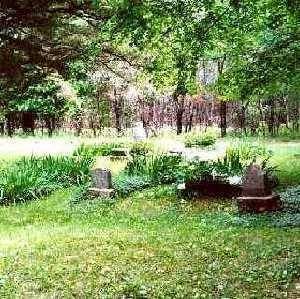
The old cemetery lies about ½ mile north of the factory site, with graves dating back to the late 1860s.

The old site of the cement plant is said to be haunted by the ghost of one of the workers by the name of Bohr, who died in a tragic accident at the plant. As the story goes, Bohr fell into a vat of concrete and his body was never recovered. After this disastrous event, his co-workers embedded his wheelbarrow, pick and shovel into a wall of concrete that was under construction at the time. His name, as well as his pickaxe, can still be seen at the factory ruins.


LeHunt, Kansas Cemetery

With the aid of a sturdy vehicle, visitors can make their way down the rutty, dirt paths. LeHunt is located northwest of Independence, immediately east of Elk Reservoir in Montgomery County, Kansas

The old town lies on a bend in the hard-surfaced road and where a few houses exist. The concrete factory is about ½ mile to the west of what remains of LeHunt.

From Independence take US-75/US-160 west .2 miles and turn right on Peter Pan Road traveling north for two miles. The road will change to county road 3525 and you will continue for one mile. then take a left on 5000 Road for ½ mile.
Read more >>

Haunted Hollenberg Station, Kansas

Five miles northeast of Hanover, Kansas is the only remaining Pony Express stop still standing in its original location. Built on Cottonwood Creek in 1857 by Gerat H. Hollenberg, this station was also the largest stop along the Pony Express route. Intending to capitalize on the many wagon trains passing his way on the Oregon-California Trail, Hollenberg’s six-room building initially served as a grocery store, tavern, and an unofficial post office. Three years later it became a Pony Express station and later a stagecoach station.

The Pony Express Route, which ran 2,000 miles from St Joseph, Missouri to Sacramento, California was in operation for only 18 months, from April 1860 through October 1861. Amazingly, these young riders carried approximately 35,000 pieces of mail over more than 650,000 miles during this time and it is said they only lost one sack of mail during this time.

Before the Pony Express, the railroads and telegraph lines extended no further west than St. Joseph, Missouri and mail traveled west by stagecoach and wagons, a trip that could take months if it arrived at all. The Pony Express alleviated this problem with riders who could dramatically reduce the amount of time it took for the mail to be delivered. But, it was a dangerous job, fraught with Indian attacks, rough terrain and severe weather.


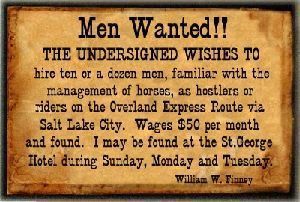
Pony Express Want Ad

For this reason, a Pony Express an 1860 advertisement in California read: “Wanted. Young, skinny, wiry fellows not over 18. Must be expert riders, willing to risk death daily. Orphans preferred.” Most of the riders were around 20, but there was one that was only 11 and the oldest rider was in his mid-40’s. Usually, they weighed about 120 pounds. One Hundred, eighty-three men rode for the Pony Express, each receiving $100 per month in pay. Riding in a relay fashion, each rider would cover about 75-100 miles before another rider took his place on the route. However, riders received fresh horses every 10-15 miles. The entire one-way trip would take about ten days.

While the Pony Express dramatically improved the communication between the east and west, it was a financial disaster for its owners. Hoping to gain a million-dollar government mail contract, the Central Overland California and Pikes Peak Express Company spent about $700,000 on the project, losing about $200,000 of their investment. The owners failed to gain the million-dollar contract and when the telegraph was completed in October 1861, the company declared bankruptcy and closed down.

Afterward, most of the 163 stations fell into ruins but somehow the Hollenberg Station managed to survive. In 1869, the town of Hanover was founded and its residents made every effort to preserve the old station. The building is now located on a state historical park and operates as a museum and visitor’s center.


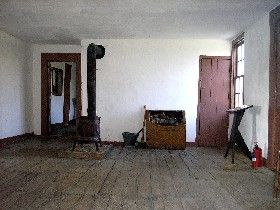
Hollenberg Station Interior

However, according to many visitors and staff members, some Pony Express riders have chosen to linger at the station long after the building ceased to serve the Pony Express. Many claim to have heard the sounds of pounding hoofs thundering through the night and the distant sounds of young men calling out as their phantom mounts near the station. Others have even claimed to have seen the riders. Witnesses also report the occurrence of many strange sounds and cold spots within the building.

Hollenberg Station is located four miles north of U.S. 36 on K-148, and one mile east on K-243 in Hanover, Kansas. Open seasonally.
Read more >>

Ghostly Theorosa Bridge - Kansas

About 12 miles north of Wichita, Kansas sits the small town of Valley Center. Now having a population of a little more than 5,000 residents, the settlement was born in 1872 on the banks of the Little Arkansas River. Located along the ever important railroad, the town grew to include a post office, three stores, two blacksmith shops, a grain elevator, and several homes by the early 1880’s.

Though now a bedroom community to nearby Wichita commuters, one of biggest attractions in this quiet town is that of the haunted Theorosa Bridge, also known as the 109th Street Bridge and the Crybaby Bridge.

On an old country road three miles north of town on Meridian Street, this old bridge spans Jester Creek at the intersection with 109thstreet.

There are several legends about the haunting of this bridge all based on a baby drowned in the creek below. Today, the bridge is a simple concrete bridge that normally no one would pay any attention to, except for the legends.

The first legend tells of settlers who were passing through the area in the late 19th century when they were attacked by Indians and a baby named Theorosa was kidnapped. Her grief-stricken mother was said to have left the wagon train to search for her missing daughter and reportedly continues to look today as her mournful cry can still be heard calling out for her child.

Another legend has it that a skirmish between the cavalry and an Indian tribe living by the creek occurred about this time. In this version, an Indian woman is stabbed and her baby is dropped into the creek and drowned.


Yet another tale suggests that a woman named Theorosa is a young woman who has an illegitimate baby and drowns it in Jester Creek to hide her shame. Later, overcome by guilt, she drowns herself in the creek as well.

Finally, another tells of an engaged woman who fell in love with another man and bore his child. Jealous with rage, her fiancé reportedly through the baby over the bridge into the creek and Theorosa jumped off the bridge to save her baby, but drowned herself, instead.

In any event, the bridge has reported to have been haunted for years and years. Many have reported seeing floating balls of light, eerie shapes, and the apparition of a woman in the area around the bridge. Cars are said to mysteriously stall as they cross, or if they should stop, will feel the entire vehicle begin to shake. Others report cold breezes which seemingly come from nowhere, and the sounds of mournful voices or the chilling cries of a baby.

Yet others say that the weather is consistently different at the bridge than it is in the rest of the area. Rumor has it that if you call out to Theorosa, telling her that you have her baby, she’ll come out of the water and attack you.

The original iron and wood bridge that first stood at Jester Creek for decades burned down in 1974, was rebuilt, and was destroyed by fire again in 1976. Afterwards, it was closed for the next fifteen years. However, in 1991, the road was reopened and the current concrete bridge was built that continues to serve travelers across the creek.
Read more >>

The Ghost of White Woman Creek, Kansas

Winding through Greeley, Wichita, and Scott Counties in western Kansas, White Woman Creek starts in Colorado and disappears into White Woman Basin. It flows underground from there into the Arkansas River. The abundant underground water was one of the features that made the area so attractive to early settlers.

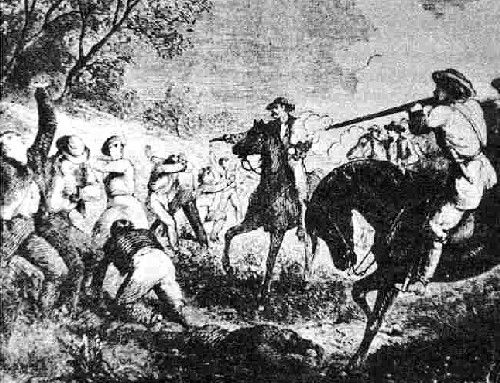
There are several versions of how the creek got its name. The first tells of a Cheyenne Indian attack in the late 1860s. The Cheyenne were said to have attacked a western settlement in retaliation for an earlier raid on their camp by white men. After several white men were killed, the Indians recaptured their stolen goods and kidnapped 12 white settlers — 10 men and two women. As time passed, the two white women decided to stay with the tribe and married Cheyenne men. One of the women, who the Indians called Anna-Wee, fell in love with Chief Tee-Wah-Nee, and bore him a son. Most of the white men also were accepted and remained with the Cheyenne. However, there was one man who was eager to leave.


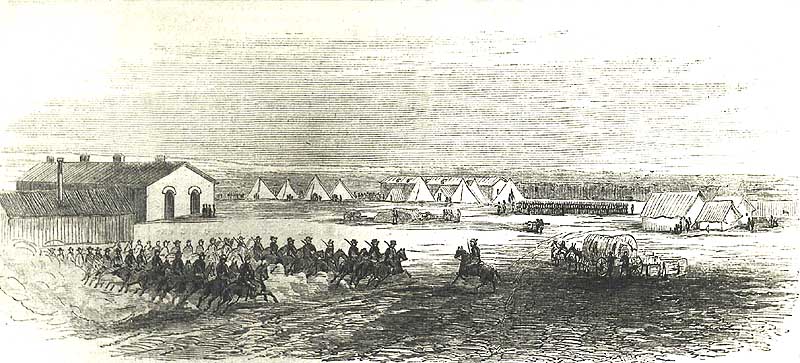
Fort Wallace, Kansas, 1867

After many months with the tribe, he was able to steal a horse and made his way to Fort Wallace in present-day Wallace County. Upon his arrival, he convinced the army that the remaining whites were being held against their will. The escaped man led a group of soldiers to the Indian camp and the soldiers attacked, killing the Chief and his infant son. As the battle continued, his wife, Anna-Wee retaliated by killing the man who had betrayed them. She then continued to defend the tribal village she had come to think of as home, and in the end, she too was slain.

Another story tells of an Indian war party that was raiding homesteads in the area in the 1870s. During the raid, they also attacked an Army ambulance, killed the guard and kidnapped a woman who was traveling with the ambulance. The warriors rode off with the woman and one night while camping along a creek, she was able to escape. One version of the tale says that in order to avoid the same tortures she had seen inflicted upon the ambulance driver, she stole a rope from the Indians while they camped, ran to a tree on the banks of the creek, and hanged herself before her captors could stop her. Another version says that the last that the Indians saw of her, she was running up the bed of the stream, and it is believed she perished on the prairies.


Ghostly woman along a creek.

Since the late 1800s, legend has it that on moonlight nights, the specter of woman has often been seen running along what is now a dry creek bed, or at other times, wandering slowly along the old stream. Others have heard her singing a mournful Indian song.
Read more >>

Fort Scott National Historic Site, Kansas


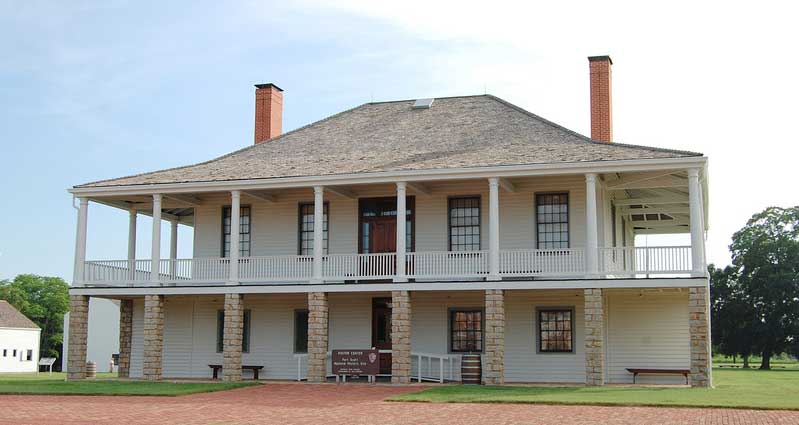
The old Fort Scott Hospital is now a Visitor’s Center by Kathy Weiser-Alexander.

Fort Scott, Kansas, initially called Camp Scott and named in honor of General Winfield Scott, was established on May 30, 1842, at the Marmaton River crossing of the Fort Leavenworth-Fort Gibson Military Road. It was among nine forts originally planned to line the area between the Great Lakes and New Orleans to separate proposed Indian lands and white settlements.

When the fort was established in 1842, the nation was still young and confined largely to the area east of the Mississippi River. Yet within a few years, Fort Scott’s soldiers became involved in events that would lead to tremendous spurts of growth and expansion. As the nation developed, tensions over slavery led to the conflict and turmoil of “Bleeding Kansas” and the Civil War.

As a young America grew, settlers hungry for land forced American Indians west of the Mississippi River. When they arrived in this area, tribes were guaranteed land where white settlement would be forbidden. Established in 1842, Fort Scott served as one of a line of forts from Minnesota to Louisiana that helped to enforce this promise of a “permanent Indian frontier.” Soldiers kept the peace between white settlers, native peoples like the Osage, and relocated Eastern tribes.

Positioned on a bluff overlooking the confluence of Mill Creek and the Marmaton River, Fort Scott filled a gap between Fort Leavenworth, Kansas to the north and Fort Gibson, Oklahoma 150 miles south. The fort was home to infantry soldiers and the dragoons, an elite unit of troops trained to fight both on horseback and on foot. The infantry performed many of the fatigue duties, including fort construction, while the dragoons went on numerous expeditions.


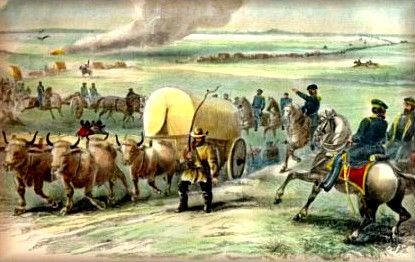
Army Train on the Santa Fe Trail

In the 1840s, settlers flocked westward to Oregon and California. When conflict arose along the Santa Fe and Oregon Trails dragoons were called on to keep the peace. Two expeditions rode escort on the Santa Fe Trail in 1843. The next year, dragoons from Scott and Leavenworth marched into Pawnee country to persuade that tribe to cease hostilities against the Sioux. In 1845, they patrolled the Oregon Trail as far west as South Pass, Wyoming parleying with Indian tribes as they went.

Both infantry and dragoons left Fort Scott to fight in the Mexican-American War (1846-48), which brought vast new lands into U.S. possession. Some Fort Scott dragoons marched with Stephen Kearney into New Mexico and California, while others served with Zachary Taylor at Buena Vista. Infantry soldiers from Fort Scott also fought with Taylor and participated in Winfield Scott’s overland march to Mexico City.

Westward expansion in the 1840s brought about a growth spurt that nearly doubled the country’s size and fulfilled “Manifest Destiny” – the idea that it was America’s divine right to stretch from coast to coast. As the frontier extended further westward, the idea of a “permanent” Indian territory died a quick death and the army abandoned Fort Scott in 1853. However, violent events in the region would soon bring soldiers back as the nation experienced growing pains over the issue of slavery.

Bleeding Kansas

Slavery divided the nation during its turbulent adolescent years. Conflict arose over whether to allow slavery in the new western territories. Under the Kansas-Nebraska Act (1854), Congress created Kansas and Nebraska Territories, opening these lands for settlement. It declared that the residents of these territories could decide by popular vote whether their state would be free or slave. In Kansas, people on both sides of this controversial issue flooded in, trying to influence the vote in their favor.


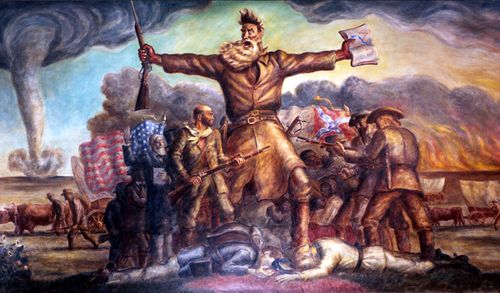
John Brown Painting

Three distinct political groups occupied Kansas-proslavers, free-staters, and abolitionists. Proslavery advocates, as the name implies, supported slavery, regardless of whether they personally owned slaves. Abolitionists wanted to rid the nation of “the peculiar institution”. Free staters didn’t particularly care about slavery where it already existed but were opposed to its extension westward. The conflict between these opposing factions soon turned violent. As a result, this era became forever known as “Bleeding Kansas,” an era when violence, destruction, and psychological warfare prevailed in the region.

Fort Scott and the surrounding area were not immune to the turmoil. Sold at auction in 1855, the buildings of the fort became the new town. The townspeople were primarily proslavery, while free-staters and abolitionists dominated the surrounding countryside. This division of opposing factions was illustrated on the grounds of the “old fort” by the existence of two hotels. One, a former officers’ quarters, became the Fort Scott Hotel, nicknamed the “Free State” Hotel, due to the political leanings of many of its guests. Directly across the square, an infantry barracks was now the Western Hotel, a headquarters for proslavery men.


Bleeding Kansas Fight

By 1858, radical elements from both factions converged on the area. James Montgomery, an ardent abolitionist, became a leader of free-state forces that invaded Fort Scott, a haven for Border Ruffians (extreme proslavery men). During one raid, Montgomery tried to burn the Western Hotel; another raid took the life of John Little, a former deputy marshal.

During this era, soldiers returned periodically to Fort Scott to restore law and order, staying each time until violence abated, only to have a conflict resume on their departure. By the time the strife waned in 1859, nearly 60 people had died and hundreds terrorized throughout Kansas Territory in the struggle over slavery. Anti-slavery forces finally prevailed. Kansas entered the Union as a free state on January 29, 1861, but by then, the fighting and violence once contained to Kansas threatened to engulf the entire country.


Civil War

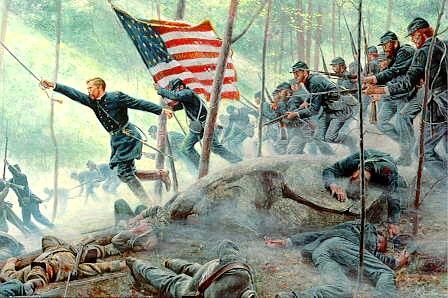
The struggles of an adolescent America became a full-fledged rebellion during the Civil War as the nation divided over the issues of slavery and self-determination. The war brought the U.S. Army back to Fort Scott. Union commanders viewed the town as a strategic point in southeast Kansas to establish a base of military operations, where the army could protect Kansas against a possible Confederate invasion. Troops reoccupied many of the old fort buildings, including the stables and hospital, and began construction on a variety of new buildings and over 40 miles of fortifications.

Fort Scott served as a major supply depot for Union armies in the West, a general hospital for soldiers in the region and a haven for people fleeing the war-displaced Indians, escaped slaves, and white farmers. Many of these refugees joined the Union Army, greatly diversifying its ranks. American Indian and African American regiments were recruited in the area, including the 1st Kansas Colored Infantry. Sworn in on the grounds of Fort Scott, this was the 1st African American regiment to engage the Confederates in combat.

Fort Scott’s military stores made it a target of Confederate General Sterling Price, who made two unsuccessful attempts to capture it during the war. Guerilla warfare, which plagued the region, also threatened the town. Intense fighting on the Kansas-Missouri border between the Jayhawkers and the Bushwhackers kept the military occupied. The Union presence likely spared Fort Scott from pillaging and destruction, a fate of other towns in the area.

Railroad Expansion

After the Civil War ended, the nation began to heal and to unify. Railroads built across the continent played a major role in tying the country together. Town leaders of Fort Scott saw a railroad line as a means to build prosperity by tapping into the trade of Eastern markets. By 1869, their efforts succeeded as the first railroad reached the city. As workers laid tracks south of town, they came into conflict with squatters who forcefully opposed the railroad. The military returned and established the Post of Southeast Kansas (1869-73) to protect the railroad workers. This set the stage for a rare instance when U.S. troops took up arms against American citizens to protect the country’s business interests.


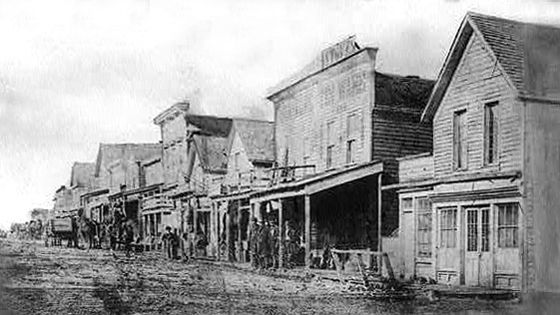
Early day Fort Scott, Kansas.

From 1842-73, Fort Scott evolved from an isolated frontier outpost into a bustling trade center and played a significant role in events that transformed the United States. During that time, America grew from a young divided republic through the growing pains of conflict and war into maturity as a united and powerful transcontinental nation.

Today, the city of Fort Scott is the only major town still existing in Kansas that developed from a U.S. Army fort established before Kansas became a territory and a state.

The fort itself is today restored and preserved as a National Historic site. The historic site is located in downtown Fort Scott ate the intersection of U.S. Highways 69 and 54.

Contact Information:

Fort Scott National Historic Site
P.O. Box 918
Fort Scott, Kansas 66701
620-223-0310

Fort Scott Hauntings


Officer Row, Fort Scott, Kansas

Fort Grounds – There have been several sightings of ghost-like Civil War soldiers looming on the lawn and around the courtyard. Officers have also been seen in the cell blocks and stables.

On one occasion a visitor to the fort made a comment to one of the staff about a nice conversation he had with a gentleman dressed in period costume. However, the staff person was somewhat confused as no one on staff was scheduled to be dressed in a costume that particular day. Inquiring at the office, this was confirmed. It appears that the Fort Scott tourist had the “pleasure” of meeting one of Fort’s many ghosts.

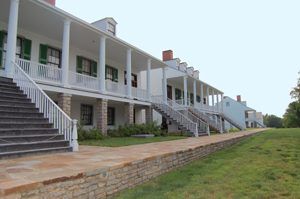
Officers Quarters – The Officer’s Quarters are said to be the most haunted. Long ago an officer accidentally shot himself when riding up to the building on the left. He had been showing off for his wife. The devastated woman held him in her arms as he died in front of the building. According to our reader Carol, she has felt the presence of the long-dead woman in the quarters on many occasions.

The building on the left once served as the Free State Hotel. However, when the fort was permanently closed, both buildings served as an orphanage home called Goodlander’s for many years. According to staff and guests, the sound of these long-ago orphan children are often heard playing in the two buildings.

Several sightings of fog-like apparitions have been reported sifting from the chimney in the officer’s quarters. It is said that at midnight every night a ghostly figure can be seen looking out of the window of the officer’s building formerly known as the Free State Hotel.
Read more >>
If these ghost stories kept you up at night, buy me a coffee to stay awake too!
Booking.com