This blog is the best for google chrome.
Download
Website Online Counter

Haunted Luna Mansion in Los Lunas, New Mexico

The Luna-Otero Mansion in Los Lunas, New Mexico is known for its great steaks, hot chili, and great deserts; but that’s not all it’s known for. Evidently, it’s also renowned for its resident ghosts.

In 1692 Domingo de Luna was granted land by the King of Spain in what would later become Los Lunas, New Mexico. A few years later, Don Pedro Otero arrived under similar circumstances. Over the years, the two families added to their fortunes through livestock and additional land acquisitions. Both families became extremely powerful and were involved in politics. The marriages of Solomon Luna to Adelaida Otero, and Manuel A. Otero to Eloisa Luna in the late 1800’s united these two families into what became known as the Luna-Otero Dynasty.

When the Santa Fe Railroad wanted a right-of-way through the Luna property in 1880, the proposed railroad tracks were planned directly through the Luna hacienda. In order to gain their right-of-way, the railroad agreed to build a new home for Antonio Jose Luna and his family according to their specifications. Before long, a southern colonial style mansion, built with adobe materials of the southwest was completed for the family. However, Antonio Jose died in 1881, the same year that the house was completed. As a result, his oldest son, Tranquilino and his family were the first to live in the luxurious home. When Tranquilino died in 1892, his younger brother Solomon took the reins of the empire and moved into the spacious mansion.


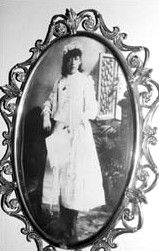
Josephita Otero as a young girl

In the early 1900s control passed to Soloman’s nephew, Eduardo Otero, because Soloman had not children. In the 1920s multiple improvements to the mansion were made, including the addition of a solarium, a front portico, and ironwork that surrounded the entire property. It was Eduardo’s wife, Josefita, more familiarly known as “Pepe,” that was largely responsible for these many efforts. The daughter of William R. Manderfield, founder of the Santa Fe New Mexican, Josefita lovingly spent her days caring for her magnificent gardens and improving her fine home.

Over the years the mansion changed hands several times before it was purchased and renovated as a fine dining establishment in the 1970s. It was then that the ghost of Josefita began to appear. Perhaps she didn’t like the renovations or maybe she just wants to stick around to make sure they were doing a good job on the home that she had spent so many years looking after.

Dressed in 1920s period clothing, she has been described by employees as appearing very real. Most often she is seen in two former bedrooms on the second floor, an attic storeroom, and at the top of the stairs leading to the second-floor bar.

At the top of the stairs sits an old rocking chair which she has often been seen sitting in and rocking slowly. On one occasion when an employee approached the ghostly apparition, she simply stood up then slowly vanished. More often she is seen walking up and down the stairs, a habit that has been so commonplace that employees barely notice anymore.

Where there’s one spirit, others seem to follow and more ghostly apparitions have been seen at the mansion. One of these is was a former servant named Cruz, who was thought to have been a groundskeeper. Most often seen on the main level, he is said to be particularly friendly to women and children and likes to play practical jokes on the employees and patrons. On one occasion he was seen sitting on a sofa as if waiting to be served. Dressed in vintage attire, the man was relaxing patiently when a waitress asked another staff member why he hadn’t been served. However, the response was “What man?” and when the waitress looked back to the sofa, the vintage spirit faded away.

Staff suggests that other spirits also roam this historic building.

The Luna-Otero Mansion, on the National Register of historic places, is located at 110 W. Main in Los Lunas, New Mexico just west of the junction of Highway 314 and Highway 6.
Read more >>

Madrid, A Ghost Town Reborn – New Mexico

Nestled on the northeast side of the Sandia Mountains is Madrid, New Mexico. Sitting midway along The Turquoise Trail National Scenic Byway, Madrid is categorized as a ghost town even though this small village of about 400 residents is bustling during the summer months with shops, restaurants, and galleries catering to the many visitors along this ancient path.

As many as 1,500 years ago the first Native American inhabitants mined the turquoise and lead deposits in the nearby hills. When the Spaniards first arrived in 1540, they largely ignored the Indians and their turquoise, more interested in finding the more valuable minerals of silver and gold.

However they returned almost a century later and finding silver, forced the natives to work in the mines until the Pueblo Revolt of 1680. Thirteen years later, in 1693, the Spanish Crown re-conquered the area.

Spaniards continued to look for gold but also began to establish farms and ranches in the area. However, the region remained fairly unpopulated until large amounts of coal were discovered around 1835. Just five years later, placer gold deposits were discovered in the San Pedro Mountains and the area that would become Madrid began to grow as more and more prospectors arrived in search of their fortunes.

The town of Madrid (pronounced with the accent on the first syllable: MAD-rid, not Ma-DRID) was founded in 1869, but it wasn’t until the 1880’s when the Santa Fe Railroad arrived in the area, that coal mining began on a large scale. By this time, the short lived gold had played out, and most of the solitary miners gave way to larger companies who moved in to develop large coal mining operations.

By 1892 the yield from a narrow valley known as “Coal Gulch” was large enough to warrant the construction of a 6.5 mile spur from the Santa Fe Railroad.

The rich coal mines upon which Madrid sat upon, covered some 30 square miles, connected by a network of tunnels that made up the Lucas & White Ash, the Peacock, and the Cooke mines. During this time over 3,000 people lived and worked in Madrid, exceeding Albuquerque in population.


Madrid Mining Operations

In 1906, all coal production in the area was consolidated at Madrid, with the Albuquerque and Cerrillos Coal Company creating a “company town” that supported about 3,000 people. Providing the residents with most all its needs, the company provided housing, brought in as much as 160,000 gallons of water daily in tank cars, and provided medical care for their employees.

In 1919, a man named Oscar Huber, who had worked for the company since 1910, was promoted by George Kaseman, as Superintendent of Mines for the Albuquerque and Cerrillos Coal Company in Madrid.

Though many miners working during this time suffered hazardous working conditions with little sympathy from mine owners and managers, Huber was a different sort. Under his direction, Madrid residents enjoyed paved streets, a hospital, a company store, schools, and unlimited electricity from the company owned power plant in their homes. During Prohibition, the company even furnished a place where people could distill illegal liquor. Of course, since commerce was controlled by the company, miners wages went right back to the owners pockets, but under Huber’s capable leadership Madrid became a model for other mining towns to follow. He also formed the Employees’ Club, athletic activities, and town events.

Huber also built the first illuminated baseball park west of the Mississippi in 1922. The stadium was home to the Madrid Miners, a farm team for the Brooklyn Dodgers, who played a game in the park in 1934. The baseball park is still utilized today.

Coal production peaked in 1928, when over 180,000 tons were shipped out of Madrid on coal cars. In 1936, when the owner was killed in a mine accident, Huber gained a controlling interest in the mine and continued to operate a friendly working environment for the employees. In fact, when the Mineshaft Tavern burned to the ground on Christmas Day, 1944, he rebuilt it. In 1947, Huber purchased the town of Madrid and the surrounding coal lands.


Old Company House, Madrid, New Mexico

But, the boom was not to last for Madrid. When natural gas began to be the more popular fuel for home heating, the demand for coal began to fall. The town of Madrid collapsed along with the coal market. In 1954, the Albuquerque and Cerrillos Coal Company ceased to operate and almost all of its residents moved away. In fact, in that same year, an ad in the Wall Street Journal listed the entire town for sale for $250,000. However, there were no takers.

By the early 1970’s Oscar Huber’s son, Joe, by then, the owner of the entire town site, began to rent or sell a few of the old company houses to a number artists, craftsmen, and other individuals wanting to make their homes in the mountains. Determined to breathe new life into the town, he succeeded as more and more people moved into the area and Madrid was reborn.

Today this unique and picturesque small town is a haven for day trippers and travelers along the historic Turquoise Trail Scenic Byway, as they stop to browse its many shops, cafes and bed & breakfast inns.

Inside the Mineshaft Tavern, a popular stop for motorcycle riders is the historic pine and oak bar from the original saloon and is still known as the “longest bar in the state.”

Madrid is best known for its annual Christmas lighting display, where virtually every building in the small town is decorated with an elaborate display of lights and nativity scenes. This tradition of beautiful lights began in the 1920s when the electric plant, owned by the town’s coal company, was providing free electricity to the many residents of the town. The miners were “required” to buy a tree for the lights, which is said to have cost about a weeks worth of pay, but since its inception, people from all over the area, including Albuquerque and Santa Fe, make the trip to Madrid to see this fascinating Christmas display.

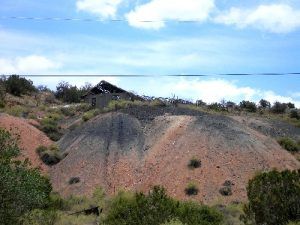
Today, most of Madrid’s remains have been restored or preserved, including the Miner’s Amusement Hall, the old Catholic Church, the Coal Mining Museum, most of the store fronts, and many of the wooden company houses. However, on the outskirts of town, you will still some of these tumbling down buildings in their original state.

For those that are looking for a different kind of experience, Madrid and the entire surrounding area is said to be haunted. Numerous ghost sightings have been reported in homes, in the old church, in the cemetery, and the Mine Shaft Tavern. Often reported wandering the arroyos surrounding the town, is the spirit of La Llorona. Though many believe that this ghostly Weeping Woman is nothing but a legend, their are many New Mexicans that believe this tall, thin, natural beauty haunts many places in the Southwest.

One often reported sighting is that of a silent cowboy who has often been seen escorting a Spanish woman, dressed in her best finery, down Main Street. Others have allegedly seen and heard all types of ghostly forms in the cemetery.


Mine Shaft Tavern, Madrid

But the most haunted of all places in Madrid is said to be the Mine Shaft Tavern. Though it burned down on Christmas Day, 1944, Madrid’s town father, Oscar Huber, rebuilt the tavern for the many coal miners of the area. It reopened in 1947 and has been open ever since. Some remodeling of the old saloon was completed in 1982; however, no changes were made to its historic bar — the longest bar in New Mexico. Today, this historic saloon continues to serve the many visitors along the Turquoise Trail.

Staff as well as guests have often seen glasses fall from their perches and crashing to the floor in bits and pieces. Doors are often seen opening with unseen hands and swinging back and forth. From the six inch thick adobe walls, mysterious sounds are often heard and after closing hours, numerous objects and furnishings are moved about. However, the most unsettling reports are the stories told by staff of looking in the mirror and instead of seeing their own reflections, they see a ghost.

Believe it or not.
Read more >>

Haunted Santa Fe, New Mexico

Santa Fe, New Mexico, established in 1607, is the second oldest city founded by European colonists in the United States. Only St. Augustine, Florida is older. It’s long history of Indians, Spanish, Mexicans, and pioneers have led the city to be one of the most haunted in America. Furthermore, the city was built over an abandoned Tanoan Indian village where no doubt, Indian burial grounds might be found beneath the city’s depths.

Santa Fe is one of the few cities that offers a full schedule of “ghost tours” and “ghost walks” year around, with as many as five operators conducting tours from Santa Fe’s historic plaza. These tours primarily focus on the ten block historic area of Santa Fe, featuring such places as the La Posada and La Fonda Hotels, the Grant Corner Inn, Palace of Governors, the oldest house in the nation, and other historic buildings. Some tours also include area superstitions, as well as Santa Fe’s history of vigilantes, gunfights, murders, and hangings.

Whether you take a tour or stumble upon its many ghosts on your own, here are a few of Santa Fe’s ghostly legends.

Alto Street – Reportedly a headless horseman haunts this street, riding his horse down to the Santa Fe River. Brandishing a sword, it is said that he lost his head to two Spanish witches, after complaining about a love potion they gave him. Most often this headless cowboy is sighted near the riverbank.

Casa Real Health Care Center – At this senior health-care facility at 501 Galisteo Street, employees, patients, and visitors have complained of strange happenings ever since the facility was built in 1985. Constructed over the site of an old penitentiary graveyard next to another haunted building, most people say that an oppressive, uncomfortable feeling emanates from this building. Others have reported strange colds spots moving throughout the rooms and unexplained moaning is often heard in the north and south wings.


The historic Grant Corner Inn B & B

Grant Corner Inn – Just a few steps off Santa Fe’s historic Plaza sits the historic Grant Corner Inn. The house was originally built in 1905 by a couple new to the Santa Fe area. Unfortunately for the young couple, shortly after they built their new home, a sickly son was born who required constant attention. To make matters worse, the woman’s husband died shortly thereafter. The young mother soon remarried a man who was said to have not been a very nice person. Over the years, the child continued to get worse and the mother threw herself into caring for the young boy. During this time, visitors to the home would often report hearing the young boy crying and banging on the walls of his upstairs room while his mother was downstairs visiting.

Confined to a wheelchair, the boy was said to have continually rolled too close to the stairway, tumbling down, wheelchair and all, to the landing below. The child finally died of his ailments and the woman and her husband moved away.

Afterward, when the house was empty, neighbors would often report seeing lights in the upstairs room that had belonged to the boy. When someone finally purchased the house, the new owners reported hearing noises in the child’s room, as if he was still there. Today the house has been converted into a Bed and Breakfast.
When Art Garcia, a former caretaker for the B&B, was interviewed by Antonio Garcez for his book Adobe Angels: Ghosts of Santa Fe and Taos, the caretaker relayed terrifying happenings within the home. In this account, Garcia tells of deafening noises, blasts of freezing air that would often kill house plants, and the terrible aroma of rotting meat.
However, since the property was purchased by Louise Stewart, the building has been extensively remodeled and the spirit of the boy has quieted down or perhaps left the building entirely.

However, rumors persist that objects continue to fall to the floor, while footsteps and slamming doors are often heard within the old house. Others have reported seeing a grayish figure in the hallway. Reportedly, rooms 4 and 8, as well as the hallway upstairs are the areas reported to be haunted.
Today, this lovely Bed and Breakfast, voted the best in Santa Fe by several local periodicals, is a charming 10-room Inn, surrounded by a white picket fence and weeping willows. The Inn provides old-fashioned hospitality, comfortable, well-appointed accommodations and innovative country cuisine. Rooms are decorated with antique quilts, brass and four-poster beds, hand-painted armoires and numerous pieces of antiques and art that combine to make each room a unique experience.

Luguna Pueblo Mission – The coffin of the murdered priest keeps popping up through the church floor here. Father Juan Padilla was murdered by Indians in 1733 and was buried beneath the floor at the Islata Pueblo Church. Before long, his coffin, hollowed out of a cottonwood tree, rose out of the earth in front of the altar. It rose again twenty years later, and again in 1889. Then, on Christmas Eve 1914, it poked through the floor again. Two investigations were conducted by the Bishop of Santa Fe, but no conclusion was reached as to the nature of the phenomenon.

La Residencia – Now housing a nursing home, this building at the corner of Palace Avenue and Paseo de Peralia, was once the community hospital. Years ago a little boy died in room 311 from injuries suffered in an automobile accident. Unfortunately, the boy’s father also died in the same car wreck. Today the muffled crying of the little boy is heard so often that administrators try to keep the room unoccupied. Other paranormal occurrences also happen in the basement. This only began to occur when the state museum began to utilize the basement to store Indian artifacts. Reportedly, strange sounds are often heard in the basement rooms, so often that some nurses refused to enter the area. On one occasion, two nurses reported seeing a wall in the basement oozing fresh blood. La Residencia is located at 820 Paseo De Peralta.


San Miguel Mission, Santa Fe, New Mexico

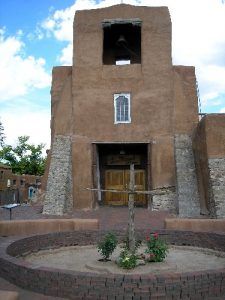
Mission of San Miguel – The oldest church still in use in the United States, this simple earth-hue adobe structure was built around 1610 by the Tlaxcalan Indians of Mexico, who came to New Mexico as servants of the Spanish. Though badly damaged in the 1680 Pueblo Revolt, the sturdy adobe walls remained unharmed. Stone buttresses later were added to strengthen the walls, the tower was remodeled and a modern façade was added. On display in the chapel are priceless statues and paintings and the San José Bell, weighing nearly 800 pounds, which is believed to have been cast in Spain in 1356. The bell was used in churches in Spain and Mexico before being brought to Santa Fe by oxcart in the early 19th century.

This old bell is said to have been the source of a miracle in the mid-1800’s when a blind man attended the church at around noon every day. His fervent prayers are said to have caused the bell to ring of its own accord and when it rang, the man regained his sight. Unfortunately, when the ringing stopped, he lost his sight again but was later able to accurately describe statues and icons inside the church.

The gift shop at the church, that once served as a private residence is reportedly haunted by a small child who died there in the 1940s.

Across the narrow street from the church is the oldest house in the United States, which is supposedly haunted by a malevolent presence. In fact, the entire block surrounding San Miguel dates back to the 1200s and was once the site of an ancient Indian Pueblo. For centuries, tragic and violent events have occurred within this block including the subjugation of the Pueblo Indians, the Pueblo Revolt against the Spanish in 1680, executions of convicted criminals and much more. Not only is the church and the oldest house said to be home to a ghost or two, but the entire block.

The church is located at 401 Old Santa Fe Trail.
Read more >>

Haunted St. James Hotel in Cimarron, New Mexico


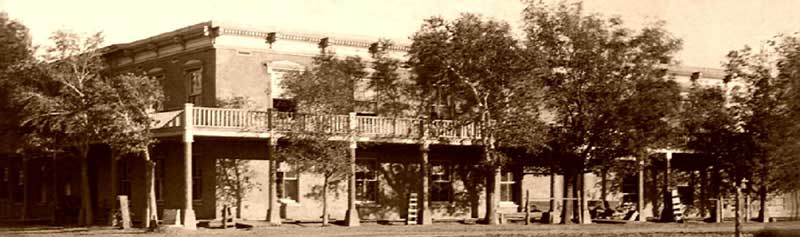
St. James Hotel, Cimarron, New Mexico in the late 1800s.

The St James Hotel in Cimarron, New Mexico was built in 1872 by Henri Lambert (later changed to Henry) and was originally called Lambert’s Inn. Its saloon, restaurant, and 43 rooms were witness to at least 26 murders during Cimarron’s wilder days. Clay Allison, Black Jack Ketchum, Jesse James, and Buffalo Bill Cody have all left their mark on the St. James, as attested by the numerous bullet holes in the ceiling of the main dining room.
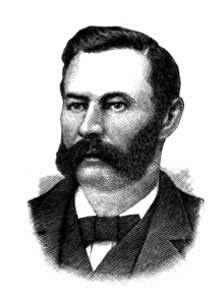

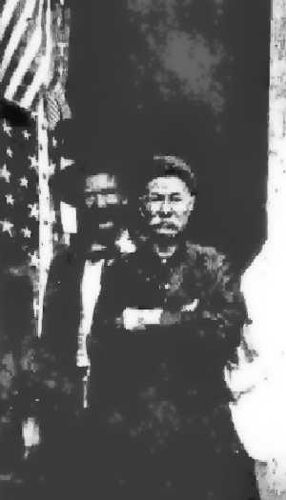
Henry Lambert

Before Henry made his way to New Mexico, he was the personal chef to President Abraham Lincoln, upon the recommendation of Ulysses S. Grant. He continued to hold the position until the president was assassinated in 1865. Before long, Henry made his way west in search of gold. Finally settling in Elizabethtown, New Mexico, he opened a saloon and restaurant instead of finding gold.

At this time Elizabethtown, Cimarron, and much of the surrounding was owned by Lucien B. Maxwell. The Maxwell Land Grant was the largest land grant ever made in the United States. When Maxwell sold the grant in 1870, the new Land Grant Company men discovered that the French chef, Henry Lambert, was working in Elizabethtown and enticed him to come to Cimarron.

The Lambert Inn, as it was called at the time, started business in 1872. Built during a time when law and order was non-existent, the saloon quickly gained a reputation as a place of violence, where it is said that 26 men were shot and killed within its adobe walls. The first question usually asked around Cimarron in the morning was: “Who was killed at Lambert’s last night?” Another favorite expression following a killing was: “It appears Lambert had himself another man for breakfast.”
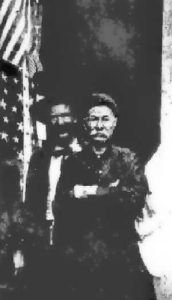

Henry Lambert when older.

The saloon was wildly popular to cowboys, traders, miners and the many travelers of the Santa Fe Trail. The saloon did so well that Henry added guest rooms in 1880, and the hotel was soon considered to be one of the most elegant hotels west of the Mississippi River

Many well-known people stayed there over the years. Wyatt Earp, his brother Morgan, and their wives spent three nights at the St. James on their way to Tombstone, Arizona. Jesse James stayed there several times, always in room 14, signing the registry with his alias, R.H. Howard. Jesse James’ nemesis and would-be killer, Bob Ford, also stayed at the St. James.

Buffalo Bill Cody, who was a goat ranch manager for Lucien Maxwell for a short time, met Annie Oakley at the hotel and began to plan and rehearse their Wild West Show. When Henry’s son Fred was born, Buffalo Bill nicknamed him “Cyclone Dick” because he was born during a blustery snowstorm, and he was soon asked to be Fred’s godfather.

As Fred Lambert grew older, Buffalo Bill would be one of the first to give him instruction in the use of guns. Fred Lambert would spend his entire life upholding the law as a Cimarron Sheriff, a member of the tribal police and a territorial marshal. When Buffalo Bill and Annie Oakley left Cimarron to take their show on the road, they took an entire village of Indians from the Cimarron area with them.
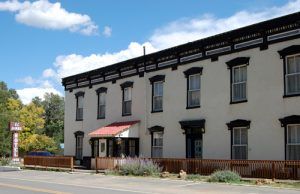

St James Hotel in Cimarron, New Mexico

Other notables who have stayed at the historic inn include Bat Masterson, train robber Black Jack Tom Ketchum, General Sheridan, Doc Holliday, Billy the Kid, Clay Allison, Pat Garret, artist Fredrick Remington, Governor Lew Wallace, and writer Zane Grey. The Hotel was later renamed the St. James and continues to cater to travelers today.

When the railroads came through, the Santa Fe Trail died, and soon after, the gold in the area began to play out. Cimarron’s population began to dwindle and the elegant St. James Hotel fell into disrepair.

When Henry Lambert’s sons, Fred and Gene, replaced the roof of the Lambert Inn in 1901, they found more than 400 bullet holes in the ceiling above the bar. A double layer of heavy wood prevented anyone from sleeping upstairs from being killed. Today, the ceiling of the dining room still holds 22 bullet holes.

Henri Lambert died in 1913. His wife, Mary E. Lambert died in 1926. Through the years, the old hotel was, at many times, uninhabited and passed from owner to owner. However, in 1985 the St. James Hotel was restored to its former luxury.
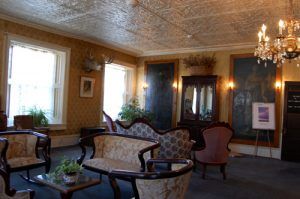

St. James Hotel Lobby

The St. James Hotel is said to remain host to several restless spirits. Both the owners and the guests of the hotel will tell you that it is haunted by many unexplained events. Several psychics have visited the hotel and specifically identified three spirits, as well as many others who just pass through to relive their experiences.

The second floor of the hotel is the most active, with stories of cold spots and the smell of cigar smoke lingering in the halls (smoking is not allowed in the hotel.) A prior manager said that “you never see them, but you do feel and hear them.” Another report from a former owner, states that she walked into the dining room and saw a pleasant-looking cowboy standing behind her in the mirror on the front of the bar. The spiritual activity of the hotel has been featured on the popular television shows Unsolved Mysteries and A Current Affair.

Room 18 at the hotel is kept locked because it houses the ghost of an ill-tempered Thomas James Wright, who was killed at his door just after winning the rights to the hotel in a poker game. Having been shot from behind, Wright continued on into the room and slowly bled to death.

Wright’s angry, malevolent ghost continues to haunt the room and he does not like company. One former owner said she was pushed down while in the room and, on another occasion, saw a ball of angry orange light floating in the upper corner. The room holds only a bed frame without a mattress, a coat rack, a rocking chair and bureau which has been made a shrine to the Old West. Sitting atop the bureau is a Jack Daniels bottle, a basin and pitcher, a hand of cards, an Ace Copenhagen tin, and several shot glasses. On the wall is a bad painting of a half-naked woman.

This room is considered by the staff to be the most haunted and people are rarely allowed to enter the room, much less sleep in it. Rumors abound that when the room was rented, a number of mysterious deaths occurred there.

Room 17 is the epicenter of sightings of Henry’s second wife Mary Elizabeth, who is said to remain at the hotel as a protector. Mary gave birth to her children in the hotel and died there herself in December 1926. Allegedly, Mary’s rose-scented perfume can often be smelled in her old room. Sometimes, an insistent tapping is heard when the window is open and will not stop until the window is closed. On other occasions, a milky transparent woman can be seen in the hallways.
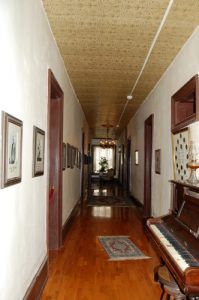

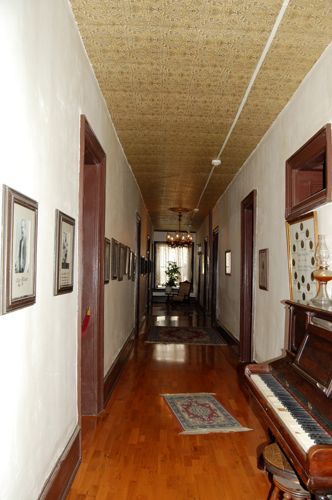
St. James Hotel Hallway

Another “dwarf-like” old man has also been seen at the hotel. Nicknamed the “Little Imp” by hotel staff, the spirit is said to be very mischievous, constantly playing tricks and laughing at the staff. On one occasion, he was said to have stuck a knife into the floor between two owners of the old inn. Most often, however, he is blamed for objects that mysteriously disappear, only to be found later in locations that they absolutely don’t belong.

Other, unknown entities are also said to roam the hotel, creating a host of paranormal activities. Staff report that items constantly fall off walls and shelves and electrical equipment at the front desk behaves unpredictably. Others have reported cold spots throughout the historic inn, lights that seemingly turn on by themselves, feelings of being watched by unseen eyes, and cameras that cease to work inside the hotel, strangely return to normal after leaving the St. James.

Kody Mutz, a college student, who has worked summers at the hotel, reported that in 2002, as he was working at the front desk, he heard a high pitched shriek coming from the far corner of the lobby.

Looking up abruptly from his work, he was dumbfounded to see absolutely no one on that side of the room. Quickly looking around, his eyes rested on three other quests mingling at the other side of the lobby, apparently having not heard the loud scream, they were completely unphased.

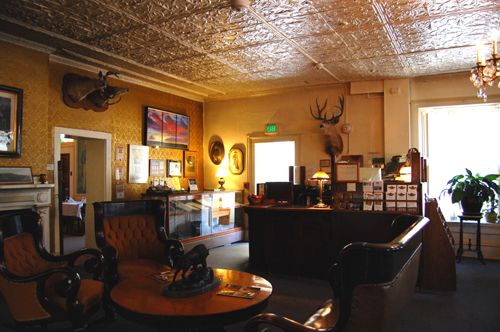
The hotel features 13 historic rooms, named for the famous and infamous people who once stayed there. An annex was also added to the hotel that houses an additional 10 rooms. The hotel retains its historic ambiance with antique chandeliers, velvet drapes, thick carpets covering its old wooden floors, brocade wallpaper, and many of the original furnishings of the hotel.
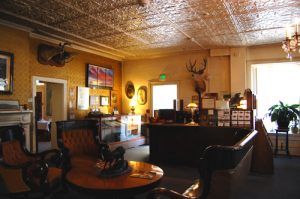

Old registers in the St. James Hotel reflect the many historic characters who once stayed there

There are no phones, radios, or televisions in the 14 rooms of the main hotel; however, the 10 room annex has all the amenities of a modern hotel. The old saloon, which is now used as the hotel’s dining room, still holds the original antique bar, as well as twenty-two bullet holes in the pressed-tin ceiling.

In the hallway of the hotel is a plaque that commemorates Clay Allison and the roster of 19 men he was said to have killed, as well as photographs of the many famous guests that have stayed at the historic inn. Also in the hallway is the original headstone of Parson Franklin J. Tolby, the beloved minister of Cimarron, who was killed during the Colfax County War.

Checking into this historic place will make you feel as if you have stepped back in time, as mounted deer and buffalo stare down at you from the lobby walls, you view the old hotel ledgers signed by its many famous guests, and imagine the sound of tinny music coming from the antique piano in the corner. Perhaps you too will be lucky or unlucky enough, depending upon your point of view, to run into one of the hotel’s many unearthly guests.

I then looked into the mirror to see if I might see the reflection of something other than myself. Nope, nothing but me. Then I touched the mirror on the lower corner, holding it to the wall, before slowly taking my finger off. The rocking stopped. Before going to the shower, I looked at the mirror and said out loud, with a smile on my face, “What’s the matter, are you tired of playing?” The mirror went, click, click and stopped.

Over the next few months, I had several more opportunities to stay at the St. James. In fact, I would plan my trips so that the Cimarron area would be my last stop and always stayed in the Zane Gray room. However, nothing more happened until what turned out to be my last stay there.

Just down the hall from my room is another small circular room with a poker table. I always thought it would be great fun to play poker there but never had the chance.

On that night, I had gone to bed early, having to be in Colorado the next morning and needing to get an early start in order to get back to my home in Rio Rancho, New Mexico the next night.
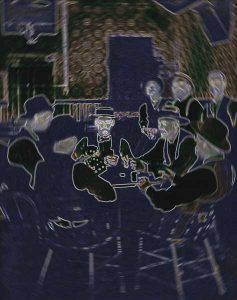

Phantom Poker Game

However, I was having trouble getting to sleep and as I tossed and turned, I began to hear the sounds of people talking down the hall. It was odd, as I was the only guest in the hotel that night. As I listened to the voices, it sounded as if they were calling poker games, such as “Jokers Wild,” or “Jacks or Better to Open.”

Curious, I got up, pulled on my pants, opened the door and looked down the hall. There, in the corridor was a lady in a bright red, ruffled, 19th century period dress. Looking a little annoyed, she was holding a round serving tray. I went back in my room, thinking this might be my chance to play a little cards in the circular room I had always wondered about. I put on a shirt, went back out, and walked down the hallway to the poker room. When I poked my head in, three men, all in period dress, were playing poker. One of them asked me if I wanted to get in, to which I responded: “What are the stakes?”

“$20.00 ante,” he replied.

Unfortunately, all I had with me was a $20 bill and a company credit card. Having to decline, I went back to my room and went to sleep. (For those of you who do not play poker, the “ante” is the price to get into the game. I would have needed more in order to bet.)

When I got up about 5:30 a.m., I got my stuff together and as I walked down the hall I looked in the poker room. It was spotless — no empty bottles, no cigarette butts, not even a dirty glass. I then went downstairs to the front desk to check out and asked the desk clerk, “Were there any big winners last night?”

“What do you mean?” she replied.

“Those guys playing poker upstairs last night,” I said.

Shaking her head, she said, “Mr. Jenkins, I’ve been here all night and you were the only one upstairs.”

I just stood there speechless. Feeling as though I had just been hit over the head, I then simply walked away, left the hotel, and have never had the opportunity to return.

I was absolutely sure that those people that I had seen the night before had been part of some kind of show or had been to a square dance or something, because of their dress. They seemed so much like “flesh and blood” people. But the desk clerk had said I was there alone and their no one is allowed upstairs at night unless they are guests of the hotel.

I don’t know what I experienced, but I wish I had stayed a while longer and talked to “them” more. Like so many other experiences that we have on a daily basis, I berated myself later for not having asked the men their names. What would have happened if I had asked them to leave? Would they have simply disappeared? Of course, I wouldn’t have asked them to leave — I truly thought they were “real” when I saw them.

As I write this, the hair on my arms is standing up. It’s a funny thing, I remember so much of that encounter as if it happened just yesterday. On the other hand, there are so many details that have totally escaped me. I compare my experience to a chance meeting of someone that you respect and look up to and not recognize them — only to find out later who they were. There are so many things I wish I would have said and done. If only I had …………

I don’t do drugs and I don’t drink. Nothing quite like this has happened to me before — except when I was seven, but that’s another story. ~SMILE~

Submitted by Tom Jenkins, October 2005. No longer installing payphones, Tom now pursues his love of wood carving full time. An award-winning sculptor, his custom art has been featured in newspapers, wood carving catalogs, and magazines across the nation. Today, Tom lives in Casa Grande, Arizona. See Tom’s fantastic art athttp://www.woodsculptureart.com

Ghost Hunters at the St. James


Photo courtesy St. James Hotel.

As ghost hunters, we were excited to stay in the second most haunted room of the St. James Hotel. The most haunted room, as told on the Unsolved Mysteries TV series, has been sealed for the protection of hotel employees and guests. The ghostly inhabitant still makes claim to owning the hotel as he won it in an Old West poker game on the very same night he was murdered in room 18. This hotel is full of Old West history, having guests such as Jesse James and Doc Holliday. We walked about the hotel using our EMF meters and found some strange readings. We also gathered some strange sounds from room 18 (the sealed room) which we are still analyzing.

As I was falling asleep I felt a tender touch on my back and then noticed that my wife was not lying near enough to have touched me. When I inquired if she had just touched me…she had not! Immediately after, she was startled by invisible fingers gliding over her hand.

Finally, we slept, until 3:00 a.m. when we were awakened by a strange scream coming from inside our room, the Mary Lambert room. I began taking photographs, one of which contained a vortex. Vortexes are funnels of energy that are associated with ghostly activity.

The strangest phenomenon was a picture I had taken of the second-story window. There is a face in the window…not a reflection, not someone looking in. A ghostly face staring back as I was walking past the forbidden room 18.

Even if you are not a ghost hunter, the history, the wonderful staff, and the great food makes St. James Hotel a wonderful vacation spot.

Submitted by Rick Smithson, May 2005 – Rick is a certified ghost hunter and member of the International Ghost Hunters Society.
Read more >>
Booking.com