This blog is the best for google chrome.
Download
Website Online Counter

Haunted Athens Asylum for the Insane, Ohio


Athens Asylum

Today, this complex, called the Ridges, is part of Ohio University, but these historic buildings once housed the Athens Lunatic Asylum. Not only are these buildings steeped in history, some are said to still “host” visitors from the past.

The historic hospital got its start in 1867 when the Ohio Legislature appointed a commission to find a site for an asylum in southeastern Ohio. A suitable site was found in Athens and Levi T. Scofield was chosen as the architect. The designs of the buildings and grounds were influenced by Dr. Thomas Story Kirkbride, a 19th-century physician who authored a book on mental hospital design. His designs were often recognizable for their “bat wing” floor plans and lavish Victorian architecture.

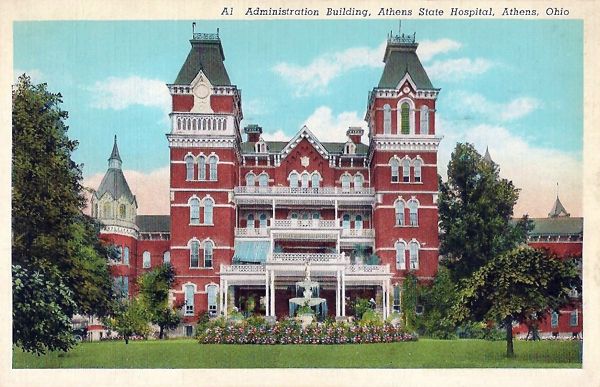
The original design included an administration building with two wings, one that would house the males and the other for the females. The building itself was 853 feet long, 60 feet wide and built with red bricks which were fired from clay dug on-site. Built onto the back were a laundry room and boiler house. Seven cottages were also constructed to house even more patients. There was room to house 572 patients in the main building, almost double of what Kirkbride had recommended which would eventually lead to overcrowding and conflicts between the patients.

The administrative section, located between the two resident wings, included an entrance hall, offices, and a reception room on the first floor, the superintendent’s residence on the second floor, and quarters for other officers and physicians on the 3rd and 4th floors. A large high ceiling amusement hall filled the 2nd and 3rd floors, and a chapel was included on the 4th floor. Behind and beneath the public and private spaces of the building were the heating and mechanical systems, kitchens, cellars, storerooms, and workspaces.

The site, which was first comprised of 141 acres, would eventually grow to 1,019 acres which included cultivated, wooded, and pasture land. The grounds were designed by Herman Haerlin of Cincinnati and would incorporate landscaped hills and trees, decorative lakes, a spring, and a creek with a waterfall. Not only would the patients enjoy the beautiful landscape but citizens also enjoyed the extensive grounds. Though the facility would never be fully self-sustaining, over the years the grounds would include livestock, farm fields and gardens, an orchard, greenhouses, a dairy, a receiving hospital, a Tubercular Ward, a physical plant to generate steam heat, and even a carriage shop in the earlier years.

The hospital, first called the Athens Lunatic Asylum, officially began operations on on January 9, 1874. Within two years, it was renamed the Athens Hospital for the Insane. Over the years, its name would be changed many times to the Athens State Hospital, the Southeastern Ohio Mental Health Center, the Athens Mental Health Center, the Athens Mental Health and Mental Retardation Center, and the Athens Mental Health and Developmental Center
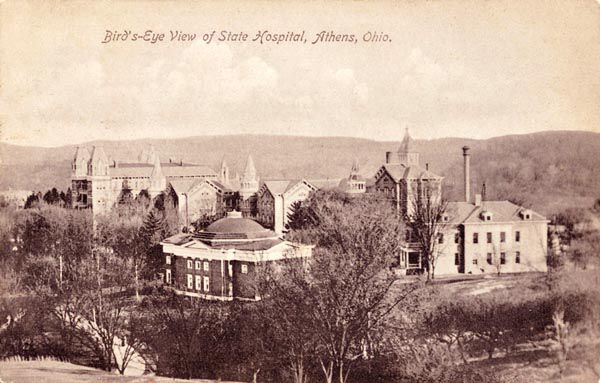

Bird’s Eye view of Athens, Ohio Asylum

During its operation, the hospital provided services to a variety of patients including Civil War veterans, children, the elderly, the homeless, rebellious teenagers being taught a lesson by their parents, and violent criminals suffering from various mental and physical disabilities. These patients, with diagnoses ranging from the slightest distress to severely mentally ill, were provided various forms of care, many of which have been discredited today. The asylum was best known for its practice of lobotomy, but also known to have practiced hydrotherapy, electroshock, restraint, and psychotropic drugs, many of which have been found to be harmful today.

More interesting are the causes listed for admission, which included epilepsy, menopause, alcohol addiction and tuberculosis. General “ill health” also accounted for many admissions, which included in the first three years of operation 39 men and 44 women. For the female patients hospitalized during these first three years of the asylum’s operation, the three leading causes of insanity are recorded as “puerperal condition” (relating to childbirth), “change of life”, and “menstrual derangements”. According to an 1876 report, the leading cause of insanity among male patients was masturbation. The second-most common cause of insanity was listed as intemperance (alcohol). Depending upon their condition, a patient’s treatment could range from full care to amazing freedom.

Over the years, numerous buildings were added including a farm office, a new amusement hall, additional wards and residences, laundry building, power plant, garages, stables, mechanics shops, a firehouse, therapy rooms and dozens of others. By the 1950s the hospital was using 78 buildings and was treating 1,800 patients.


Athens Asylum cemetery courtesy Encyclopedia of Forlorn Places

In the 1960s the total square footage of the facility was recorded at 660,888 square feet. It was also at this time that its population peaked at nearly 2,000 patients, over three times its capacity. However, the number of patients would begin to decline for the next several decades as de-institutionalization accelerated. As the numbers of people at the Asylum declined, the buildings and wards were abandoned one by one.

Comprised of three graveyards, burials began soon after the opening of the institution as there were deceased patients who were unclaimed by their families. Until 1943 the burials were headed only by stones with numbers, with the names of the dead known only in recorded ledgers. Only one register is known to exist today, which contains the names of 1,700 of the over 2,000 burials. In 1972 the last patients were buried in the asylum cemetery. Today the cemeteries continue to be maintained by the Ohio Department of Mental Health.

In 1977, Athens Asylum made news when it housed multiple personality rapist Billy Milligan. In the highly publicized court case, Milligan was found to have committed several felonies including armed robbery, kidnapping and three rapes on the campus of the Ohio State University. In the course of preparing his defense, psychologists diagnosed Milligan with multiple personality disorder, from which the doctors said he had suffered from early childhood. He was the first person diagnosed with multiple personality disorder to raise such a defense and the first acquitted of a major crime for this reason. Milligan was then sent to a series of state-run mental hospitals, including Athens. While at these hospitals Milligan reported having ten different personalities. Later 14 more personalities were said to have been discovered. After a decade, Milligan was discharged. He died of cancer at a nursing home in Columbus, Ohio on December 12, 2014, at the age of 59.

The next year, the hospital made the news again when a patient named Margaret Schilling disappeared on December 1, 1978. It wasn’t until January 12, 1979, 42 days later that, her body was discovered by a maintenance worker in a locked long-abandoned ward once used for patients with infectious illnesses. Though tests showed that she died of heart failure, she was found completely naked with her clothing neatly folded next to her body. More interesting is the permanent stain that her body left behind. Clearly, an imprint of her hair and body can still be seen on the floor, even though numerous attempts have been made to remove it.

By 1981 the hospital housed fewer than 300 patients, numerous buildings stood abandoned, and over 300 acres were transferred to Ohio University. In 1988, the facilities and grounds (excluding the cemeteries) were deeded from the Department of Mental Health to Ohio University.

The Athens Center officially closed in 1993 and the remaining patients transferred to another facility. The property stood vacant for several years before restoration began. The name of the property was changed to the “Ridges” and in 2001 renovation work was completed on the main building, which is known as Lin Hall. Today it houses music, geology, biotechnology offices, and storage facilities, as well as the Kennedy Museum of Art. Over the years, other hospital buildings were modeled and put to use by the University, although many others still sit abandoned.

It comes as no surprise that the buildings of this historic asylum are allegedly haunted. One of the most famous ghosts is said to be that of Margaret Shilling who left her body print upon the floor of the hospital. Her spirit is said to have appeared staring down from the window of the room where her body was found, has been seen attempting to escape, and has been known to wander various parts of the building at night. And, according to some, she is not alone. Other former patients are also said to remain in residence, with reports from visitors seeing strange figures standing in the empty wings of the former hospital, hearing disembodied voices and squeaking gurneys, seeing strange lights, and hearing screams echoing through the walls. More frightening, there are rumors of spirits of patients who remain shackled in the basement. These many spirits are thought to be those who died or suffered at the hands of staff in the asylum.

The cemetery is also said to be haunted by shadowy people and strange lights. In one area, the linear shapes of the graves form a circle, which is said to be a witches’ meeting point.
Read more >>

A Haunted Apartment in Woodstock, Ohio


Old Man Ghost

Several years ago in 2000, my husband and I moved into an old apartment building in Woodstock, Ohio with our four-month-old daughter. After a couple of months, we became aware of cold spots in the doorways and in the corner of the playroom. As our daughter grew a little older, we noticed that she would sit in this corner for hours, playing, talking, and laughing as though someone was there with her. I started asking her who she was talking to and she said, Tabby and Chuck, who lived there.

One night when we were laying in bed, I looked up and was startled to see a little boy and an adult man standing in the doorway. This continued to occur with such frequency that we started sleeping in the front room with the lights on. Often, the lights would suddenly get bright, then do dark, fluttering back and forth.

One night when my daughter woke up crying and screaming, I saw an older man staring at her. Quickly grabbing her, I covered both our heads, then when I looked back he was gone.

About a week later when we were upstairs visiting our neighbors, our daughter fell down the flight of 15 stairs. Running to the bottom, I was amazed to see that she had not a mark on her, not even a scratch. She kept saying that the boy saved her.

After this, the cold spots got worse and lights began to shoot across the rooms. When toxic mold began growing in the apartment, we moved. The people upstairs also had to move about a month later due to the mold. The last night we spent in the apartment was the worst of them all. As we slept on the living room floor, we listened to the sounds of screams throughout the night. When we look at photographs that we took while living in that apartment, they are filled with dark spots.
Read more >>

Ghost Hunting on Oregon’s Coast


Seaside, Oregon fog

The winds cut deeper and make progressively louder noises as the days shorten. Fog creeps in from the sea more often. And then Halloween shows up as if to really remind us of things otherworldly. It’s no wonder Oregon’s northern coast has a load of ghostly tales swirling about. It’s no wonder the remake of “The Fog” currently in release is set in a fictional North Oregon Coast town. From flying pots and specters who’ve moved from one building to another in Seaside, the ghostly legends of a hotel in the Nehalem Bay, to the myriad of hauntings in ancient Astoria – there’s plenty for the ghost-hunting tourist in this pristine and stunning area.

Sleepless In Seaside

Tales of things creepy abound in Seaside – but they’re hard to find. It’s almost as if they’ve been swept under the carpet.

For almost 100 years, the old Hotel Seaside (later named The Seasider) was a grandiose, beautiful building that was a sort of centerpiece to Seaside, at the Turnaround. So it’s no surprise that place acquired tales of apparitions and otherworldly guests over the years. There were numerous spirits that purportedly haunted it.

These days, the Shilo Inn sits in that spot. But when the old hotel was torn down, the spooks moved to Girtle’s Restaurant, just down the street on Broadway, according to owner Bob Girtle. He recounted numerous stories of otherworldly happenings in the restaurant, having seen them himself or coming from various employees who tell their own tales. They talk of seeing the mysterious shadows of feet walking behind the door of a closed-off area of the kitchen, visible from the small space between the floor and the door. This happens when it’s not possible anyone else is in there, say Bob and his crew. They don’t even check that room anymore when they see the shadows.

Then there is the notorious flying coffee pot in the galley area between the kitchen and the main dining room. Bob and others on his staff have experienced this more than once. Sometimes it moves a bit, others it literally flies across the hallway.

Bob said he inherited some employees of the old Seasider back in the 80’s, and at least one said they saw some of the same ghosts.

John Sowa, owner of the New Orleans-style eatery Lil’ Bayou, also related tales of moving objects in the kitchen and a strange sense of someone being near him while alone in his office. Kitchen utensils are found in different places than employees have left them, or an object suddenly falls off a hook or a shelf.

Lil’ Bayou lies in the historic Gilbert District of Seaside, which is filled with old buildings, almost all with upstairs areas that are often unused. The charming, atmospheric area has gone through a rebirth in recent years, and often there are whispers of ghosts coinciding with many of the renewed buildings.

The Seaside Aquarium may have a closet containing something – or rather, an upstairs that could be haunted. When the building was a natatorium back about 80 years ago, there were apartments on the top floor. That area isn’t used much at all now, but manager Keith Chandler says he’s heard whispers over the years the top floor is haunted. Various stories have been handed down over the years about noises coming from there.

Eerie And Not-So-Eerie On The Bay


Manzanita, Oregon , courtesy Oregon Cities

Manzanita, which caps the north end of the Nehalem Bay, is shrouded in mists and mystery, with Neahkahnie Mountain looming overhead and legends of a galleon and its buried treasures. Some versions of that tale contain atrocities, like purportedly burying their African slaves alive with the treasure to keep the natives away.

On its beaches, there are mysterious piles of rocks that have appeared over the years, apparently overnight. Sometimes they appear as single piles or stacks. No one has ever figured out who is responsible, creating speculation of an otherworldly artist.

In nearby Wheeler, facing the Nehalem Bay, Old Wheeler Hotel owner Winston Laszlo says he’s encountered several things in that old building he couldn’t really explain. Sometimes, he said, he believes he sees someone in the corner of his eye, only to discover there’s no one there.

Once, Winston was looking in a mirror in the hotel’s public area and saw the reflection of a man sitting in a chair behind him. Winston says he turned around to look at the man, whom he didn’t recognize as a guest, and there was no one there.

A pair of ghost hunters even came to the visit the place and took photos of what they believed could be “spirit orbs” just outside the basement area. Winston still has copies of these.

Winston and wife Maranne Doyle-Laszlo say the entire building seemed to be against them during the process of remodeling the ragged old construct into the first-rate hotel it is now. They had a nagging feeling a presence seemed to arrange one disaster and setback after another, such as when a window blew out in a storm. Then, one day, they say the building seemed to accept them, and reconstruction proceeded smoothly thereafter. (www.oldwheelerhotel.com. 877-653-4683.)

In an email just before her visit, ghost hunter Martina DeLude told Winston that made sense. “Ghosts that haunt residential and business locations become very threatened when someone starts changing things that they are accustomed to. Some spirits actually become incensed when furniture is moved around. Just like the living, most spirits do not like change. Possibly, as soon as they realized that it was once again going to become a hotel – perhaps something they may remember – they decided to help you along instead of stifling your efforts.”

In other tales, Wheeler Antiques owner Garry Gitzen says a Wheeler woman, descended from local tribes, actually burned down her own house in recent years because disturbing spirits haunted it. She did this in lieu of tearing the thing down, never rebuilding it, with rumors floating about that Native American children had died in a fire in that spot in ancient times.

Not all is creepy here. According to Winston and Garry, there is a host of well-meaning spirits there known as the “Good Spirits of Wheeler,” and Ekahni Books owner Peg Miller says the place is a sort of “spiritual vortex lite.” They all point to something they call a “Wheeler Moment,” where serendipity seems to suddenly rear its head. Locals talk of numerous circumstances where pleasant, happy coincidences popped up, assisting folks in some way. They all note various incidents where someone is discussing wanting to do something, and someone or some opportunity arises that helps things along – like the time the Garry and Winston were talking about creating a film festival, and they discovered a documentary filmmaker was staying in town.

Astoria – Or Ghostoria?


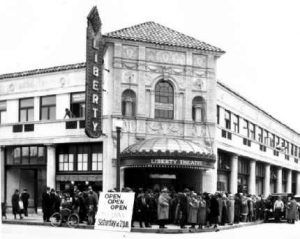
The Liberty Theater on opening night in 1925. in Astoria, Oregon

At the very tip of Oregon, Astoria is full of major ghost stories of one sort or another. That’s no surprise, considering it’s the oldest settlement west of the Mississippi.

The Liberty Theater is widely regarded as haunted. It was once a haven for the likes of Duke Ellington, Jack Benny, Guy Lombardo and supposedly even gangster Al Capone. Purportedly, it’s also occupied by someone named Paul. One employee was quoted as saying that Paul is “quite handsome,” giving him the nickname Handsome Paul. He apparently wears a “white tuxedo and a Panama hat,” according to the Clatsop County Historical Society.

Cast and crews over the years have talked about spotting him. While mostly just an apparition, he’s been known to slam doors and makes other unruly noises. Other tales from the theater include objects gliding through the air, knobs unscrewing themselves from appliances and utilities, as well as two or three other inhabitants from beyond.

Also famous for being haunted is the firehouse there, plus the town has a brutal history of men being “shanghaied” in the early part of the century.
Read more >>

Haunted Skirvin Hotel in Oklahoma City


Vintage Postcard, Skirvin Hotel, Oklahoma City, Oklahoma

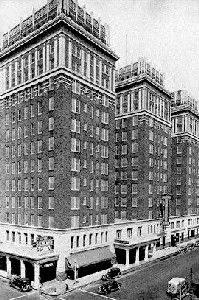
The Skirvin Hotel built in 1910 by oilman W.B. Skirvin, who was determined to have the finest hotel in the Southwest. Opening its doors in 1911, the plush hotel had two, 10-story towers containing 224 rooms, was one of the first buildings in Oklahoma City, Oklahoma to have air conditioning, then called “iced air,” had running ice water in each room, a ballroom that seated 500, and imported Austrian chandeliers that cost more than $100,000 each.

Skirvin’s daughter, Perl Mesta, brought the hotel a national reputation by being the ambassadress to Luxembourg, and then Washington’s “Hostess with the Mostess,” portrayed in the famed Broadway musical, “Call Me Madam.”

In 1930, a third wing was added, raising the structure to 14 stories and increasing capacity to 525 rooms.

The Oklahoma showplace became a popular speakeasy during Prohibition. It was during this time that W.B. Skirvin was said to have had an affair with one of the hotel maids. According to legend, the maid soon conceived and in order to prevent a scandal, she was locked in a room on the top floor of the hotel. The desolate girl soon grew depressed and even after the birth of her child; she was still not let out of the room. Half out of her mind, she finally grabbed the infant child and threw herself, along with the baby, out of the window.

The maid’s name remains unknown, but her ghost continues to haunt the Skirvin Hotel and she was nicknamed “Effie” by former employees. Though the old hotel closed in 1988, former guests would often report not being able to obtain a decent night’s sleep due to the consistent sounds of a child crying.


Skirvin Hotel Vintage Photo

Effie was apparently a woman of loose morals and many men who have stayed in the hotel have often reported being propositioned by a female voice while alone in their rooms. Others have seen the figure of a naked woman with them while taking a shower. One man even claimed he was sexually assaulted by an invisible entity during his stay.

Other strange noises and occurrences were reported by staff and guests including things seemingly being moved around by themselves, such as the maid’s cart being pushed down the hall when no one was there.

In October 1979 the hotel was listed on the National Register of Historic Places. When it closed in 1988 the building stood empty for more almost fifteen years. However, the historic hotel has now been fully restored and now open once again for guests.

The $46.4 million project included the original exterior finish, installation of historically accurate windows, reconfigured guest rooms, new guest elevators, an elegant lobby, restaurants, and state-of-the-art meeting rooms. Wherever possible, historical elements such as moldings, tiles, and ceiling treatments were incorporated into the design.

Despite the millions of dollars spent to renovate this historic hotel, Effie allegedly continues to reside there.

The Skirvin Hotel is located at 1 Park Avenue in Oklahoma City, Oklahoma.
Read more >>
Booking.com