This blog is the best for google chrome.
Download
Website Online Counter

Haunted Belvidere Mansion in Claremore, Oklahoma

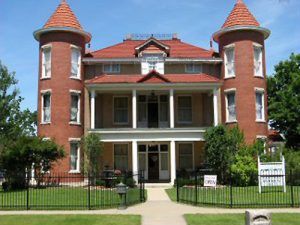
The Belvidere Mansion in Claremore, Oklahoma not only provides a peek at history but possibly, even a peek at a ghost or two.

Listed on the National Register of Historic Places, the three-story mansion was built by John M. Bayless starting in 1902. Bayless, who was instrumental in building the Cassville and Western (C&W ) Railroad, as well as the Arkansas & Oklahoma Railroad, moved his family to Indian Territory from Cassville, Missouri in 1901. The next year, he began to build the castle-like mansion for his wife, Mary Melissa Bayless, and his seven children. Belvidere was not only successful in the railroad business, but also in banking and land development.

The gothic-style brick home, complete with tile roof and four towers, provided for a portico on the north side for the guest carriages, as well as a large covered porch at the front entrance with a matching balcony directly above it. Inside, the floors were covered in tile, with wainscoted marble walls and pressed tin ceilings. Sliding pocket doors were used in several rooms and many had fireplaces. Much of the trim and woodwork used were brought from the 1904 World’s Fair in St. Louis. The third floor of the mansion was dedicated to a 2,400 square foot ballroom.
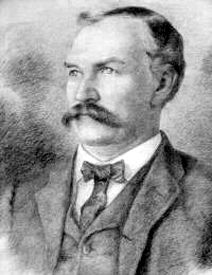

John M. Bayless

Due to its immaculate details, the mansion took several years to build. At the same time, Bayless was also building a three-story Opera House, the Sequoyah Hotel, and an athletic building with an indoor swimming pool. However, Mr. Bayless would never see the completion of his grand mansion. In 1907, just six months before it was completed, Bayless died following an operation for appendicitis. He was president of the Bank of Claremore at the time of his death.

Mary Bayless and her six surviving children finished the mansion after his death and continued to reside there until 1919. All of her children resided in Claymore, with her older sons becoming involved in the Bank of Claremore. Another became the local postmaster, and yet another went on to become a State Supreme Judge.

The building then changed hands several times and in the 1930’s was sold to an investor who turned it into apartments. Like other historic structures that become rentals, the mansion deteriorated over the years until it was purchased by the Rogers County Historical Society in 1991. Today, the beautiful old building has been restored to its former glory and is fitted with period furnishings.

Today, the mansion is open for tours and is also available for special events.

Of the buildings that Belvidere built, only the mansion remains.

Over the years, numerous people have reported that John Bayless and other members of his family; however, still continue to “reside” in the beautiful old home. These allegations tell of unexplained noises, actual sightings of hazy figures, toilets that flush by themselves, hot and cold spots, and feelings of being touched by someone when no one is there.

On several occasions paranormal groups have investigated the old mansion, seeming to find the most paranormal activity on the second floor. There, psychics have “seen” children playing, as well as “meeting” a distressed John Bayless, and a distraught young woman who allegedly committed suicide when she lived in the building as a tenant in the 1940’s.


Contact Information:

Belvidere Mansion
4th & Chickasaw
Claremore, Oklahoma 74017
918-342-1127
Read more >>

Ghosts of the Little Theatre, Tulsa, Oklahoma

Tulsa Little Theatre in Tulsa, Oklahoma

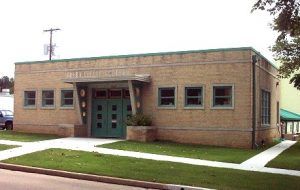
The Tulsa Little Theatre, located in an unassuming brick building at 15th and Delaware Streets in Tulsa, Oklahoma, is not only steeped in history but is also said to be home to several unearthly guests.

Built in 1932 by the Tulsa Little Theatre group, in an extremely plain art nouveau design, the first show produced in their new building was the Cradle Song.

In the beginning, the Little Theatre troupe had no permanent location when it started offering productions in 1922.

However, they were undeterred, maintaining that “the show must go on,” in any place they could find – large canvas tents, movie theaters and even at the American Legion, before they finally found built their permanent home at 15th and Delaware.

Workshops were held in the storage room of Palace Clothiers, which later became the location of the Ritz Theater. By 1925, the Little Theatre group numbered over 300 members and began to perform at the Alhambra Theater at 15th and Peoria. In 1929, the Little Theatre purchased the property at 15th and Delaware, which would be its home for the next 60 years. East Lynne, the first production at their new location was performed in a tent.

Despite the depression, the Tulsa Little Theatre continued its performances and in 1932 completed its permanent building. During the 1930s and ’40s, the Delaware Playhouse, as it became known, was the epicenter of Tulsa’s arts and entertainment scene. Over the years, the theater hosted hundreds of plays and entertainment events as it went through multiple directors and saw actors come and go.

In 1965, the theatre suffered a fire after its third performance of The Women, resulting in the destruction of stage props, furniture, and costumes. Just a year later, the theatre suffered yet another blaze during the production of South Pacific. Though the fire destroyed much of the upstairs property, the theatre persevered.

In 1974, the troupe changed its name to Theatre Tulsa, Inc. but remained in the art nouveau location. More than a decade later, in 1989, the group had outgrown their building and moved to the Tulsa Performing Arts Center, where it continues to be the resident company of the facility.

For the next two years, the old theatre building sat vacant until it finally sold. Over the next decade, the aging building changed hands several times and was utilized for several purposes, including a church, a nightclub, and a recording studio.

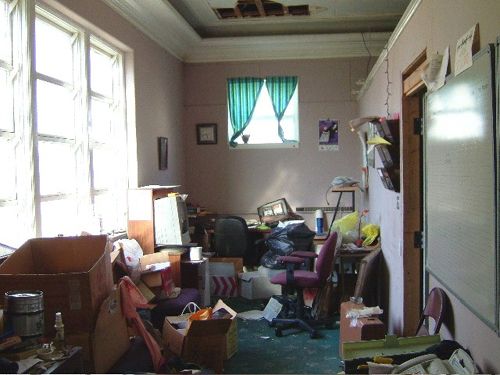
By 2004, the 10,000 square-foot building had fallen into serious disrepair and suffered from criminal neglect. It was at this time that attorney; Bryce A. Hill was looking for a midtown location for his law office. Though the site was ideal, near the historic Cherry Street district, Hill and his wife, Sunshine, thought long and hard before purchasing the dilapidated property.

When they did, the old building smelled of decay was filled with trash, and water seeped from the walls, floors, and ceilings.

For the next 14 months, the Hills renovated the building, restoring much of it to its original 1932 façade and revamping the front portion of the building to utilize as offices.


Tulsa Little Theatre trash

In addition to having a renovated new look and a brand new owner, the old theatre still retains a part of its past – most notably a couple of spirits that are said to have been hanging around the building for years.

Near the curtains on the old stage, a strange ball of light has often been seen bobbing around. Others on stage have reported seeing something standing behind them before mysteriously vanishing. Yet even more report having been touched by unseen hands and hearing strange noises coming from backstage when no one is there.

According to the legend, a one-time play director during the theatre’s heydays, died during a performance. Are these the signs of a director who has not yet finished his productions? Others allege that the spirit of a little girl is also said to lurk within the confines of the historic theatre. Employees of the law office also tell a number of odd occurrences within the building, including supplies that go missing and lights that turn on and off of their own accord.

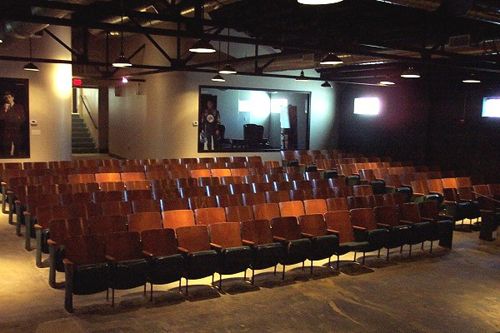
The theatre portion of the building can be rented for events and performances.


Inside the Tulsa Littel Theatre
More Information:

Tulsa Little Theatre
Law Offices of Bryce Hill
1511 S. Delaware Ave.
Tulsa, Oklahoma 74104
Read more >>

Ghostly Tales of Oklahoma 66


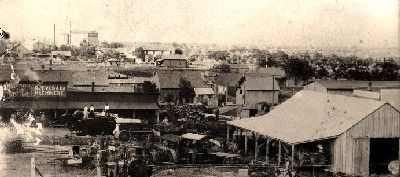
Historic Claremore, Oklahoma

Claremore, Oklahoma – Long ago a Native American student was attending the Military Academy at what would later become Rogers State University. Like we have unfortunately heard too many times in the past, the youth was accidentally killed during a hazing ritual. Obviously his spirit is not at peace as he is said to haunt the halls during the midnight hours. Baird Hall is where the Indian’s footsteps have often been heard in an otherwise empty building. Two janitors have reported hearing these odd footsteps as well as toilets flushing in empty bathrooms and other strange phenomena throughout the building.


El Reno, Oklahoma Vintage Postcard

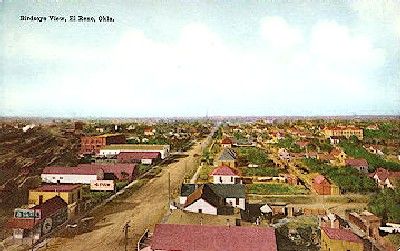
El Reno, Oklahoma – If you are traveling the Mother Road between Weatherford and El Reno, Oklahoma at night, keep your eyes open because legend has it that this part of the old Mother Road is haunted by an elderly humped back man. Said to appear in a brown trench coat, wearing a Bogie style hat pulled down over his eyes, he has often been spotted walking along the old highway, especially on foggy or rainy nights. Reportedly, one person picked this old figure up one wet evening and the eerie little man wouldn’t talk to him. Soon, the vagabond tried to jump out of the moving car. The driver immediately pulled over to the side and let him out, only to spot the man walking again several miles ahead of the driver on down the road. Another person said that they thought they had hit the man with their vehicle but when they stopped to check on him, no one was there. Do you believe it? Keep your eyes peeled.
Read more >>

Devil’s Promenade & the Hornet Spook Light


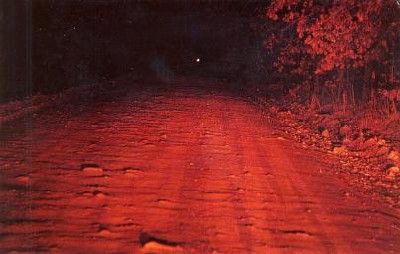
Hornet Spook Light near Joplin, Missouri.

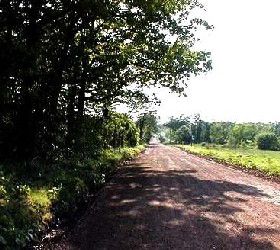
Bobbing and bouncing along a dirt road in northeast Oklahoma is the Hornet Spook Light, a paranormal enigma for more than a century. Described most often as an orange ball of light, the orb travels from east to west along a four-mile gravel road, long called the Devil’s Promenade by area locals.

The Spook Light, often referred to as the Joplin Spook Light or the Tri-State Spook Light is actually in Oklahoma near the small town of Quapaw. However, it is most often seen from the east, which is why it has been “attached” to the tiny hamlet of Hornet, Missouri and the larger better-known town of Joplin.

According to the legend, the spook light was first seen by Indians along the infamous Trail of Tears in 1836; however, the first “official” report occurred in 1881 in a publication called the Ozark Spook Light.

The ball of fire, described as varying from the size of a baseball to a basketball, dances and spins down the center of the road at high speeds, rising and hovering above the treetops, before it retreats and disappears. Others have said it sways from side to side, like a lantern being carried by some invisible force. In any event, the orange fire-like ball has reportedly been appearing nightly for well over a 100 years. According to locals, the best time to view the spook light is between the hours of 10:00 p.m. and midnight and tends to shy away from large groups and loud sounds.

Though many paranormal and scientific investigators have studied the light, including the Army Corps of Engineers, no one has been able to provide a conclusive answer as to the origin of the light.

Many explanations have been presented over the years including escaping natural gas, reflecting car lights and billboards, and will-o’-the-wisps, a luminescence created by rotting organic matter. However, all of these explanations all fall short of being conclusive.

As to the theory of escaping natural gas, which is common in marshy areas, the Hornet Light is seemingly not affected by wind or by rain, and how would it self-ignite? The idea that it might be a will-o’-the-wisp is discounted, as this biological phenomenon does not display the intensity of the ball of light seen along the Devil’s Promenade. Explanations of headlights or billboards are easily discarded, as the light was seen years before automobiles or billboards were made, and before a road even existed in the area.

One possible explanation that is not as easily discounted, but not yet proven conclusive, is that the lights are electrical atmospheric charges. In areas where rocks, deep below the earth’s surface, are shifting and grinding, an electrical charge can be created. This area, lying on a fault line running east from New Madrid, Missouri, westward to Oklahoma was the site of four earthquakes during the eighteenth century. These types of electrical fields are most commonly associated with earthquakes.


Devil’s Promenade near Joplin, Missouri

Other interesting legends also abound about the light that provides a more ghostly explanation. The oldest is the story of a Quapaw Indian maiden who fell in love with a young brave. However, her father would not allow her to marry the man as he did not have a large enough dowry. The pair eloped but were soon pursued by a party of warriors. According to the legend, when the couple was close to being apprehended, they joined hands above the Spring River and leaped to their deaths. It was shortly after this event, that the light began to appear and was attributed to the spirits of the young lovers.

Another legend tells of a miner whose cabin was attacked by Indians while he was away. Upon his return, he found his wife and children missing and is said to continue looking for them along the old road, searching with his lantern.

Others say the Spook Light is the ghost of an Osage Indian chief who was decapitated in the area and continues to search for his lost head, with a lantern held high in his hand.

Sightings of the Spook Light are common, sometimes even reported to be seen inside vehicles. A few people, who have been walking along the road at night, have even claimed to have felt the heat of the ball as it passed near them.

Reportedly, the moving anomaly, growing brighter and dimmer, larger and smaller, can be seen approximately 12 miles southwest of Joplin, Missouri. To get to Devil’s Promenade Road, take Interstate 44 west from Joplin but before you reach the Oklahoma border, take the next to the last Missouri exit onto Star Route 43. Traveling south for about four miles, you will reach a crossroads which is Devil’s Promenade Road.
Read more >>
Booking.com