Eastern State Penitentiary in Philadelphia,
Pennsylvania is well known for several reasons. It was one of the most expensive prisons ever built in the world, it utilized a radical
philosophy, it housed some of America’s most notorious criminals, and it is said to be the most haunted prison in the country.
The idea of a new type of prison system came about in 1787, just four years after the
American Revolution was over when important men were gathered at the home of
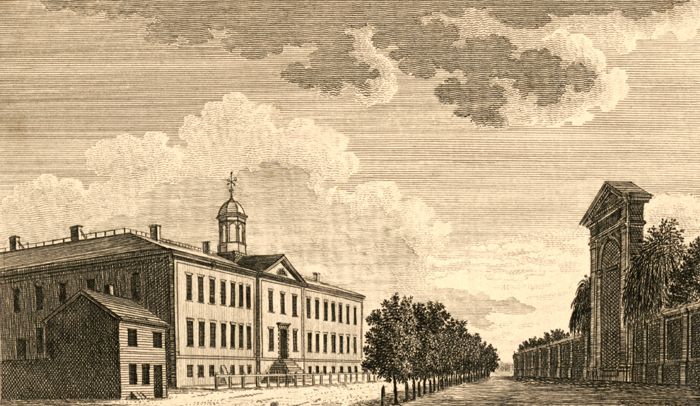
Benjamin Franklin to discuss prison reform. At that time, the Walnut Street Jail was located directly behind Independence Hall and the conditions there were terrible.
Men, women, and children who had committed all manner of crimes, from petty theft to murder, were jailed together on what amounted to little more than dirty pens, which were overcrowded, disease-ridden, cold, dangerous, and generally unsupervised. Abuse by both jailers and fellow inmates was common and food, heat, clothing or protection was only provided if the inmate could afford the price. Rape, robbery, and beatings were common practices and it wasn’t unusual for prisoners to die from cold or starvation.
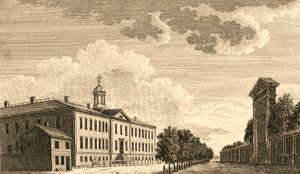
Walnut Street Jail in Philadelphia, Pennsylvania, 1789
These abuses led to the formation of the Philadelphia Society for Alleviating the Miseries of Public Prisons, which met at Benjamin Franklin’s house to discuss improvements and alternatives. One member, a prominent Philadelphia physician and signer of the
Declaration of Independence, named Benjamin Rush called for “a house of repentance” rather than prisons, which is where the name “penitentiary” came from. Rush proclaimed that radical change was needed and believed that crime was a “moral disease.” Further, he suggested that a “house of repentance” would be a place where prisoners could meditate on their crimes, experience spiritual remorse, and undergo rehabilitation. The plan was built around the idea of solitary confinement that would allow criminals to meditate on their crimes and involved no corporal punishment. The other men agreed and the method, which became known as the Pennsylvania System, would be utilized at Eastern State Penitentiary and other facilities throughout the world.
The Philadelphia Society for Alleviating the Miseries of Public Prisons survives today, now called the Pennsylvania Prison Society, which promotes correctional reform and social justice.
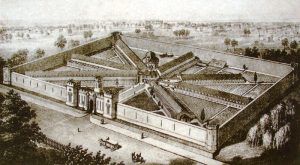
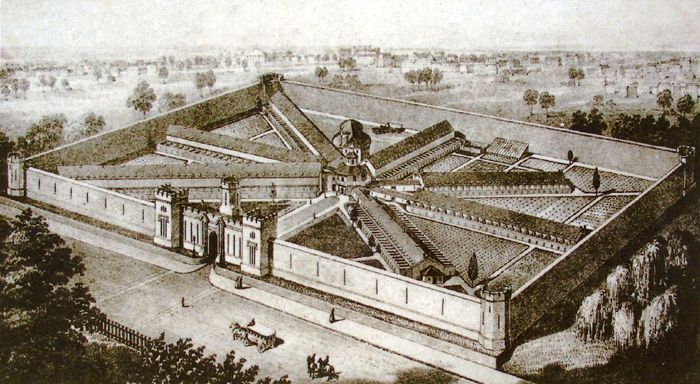
Eastern State Penitentiary by the Duval and Company
The men soon convinced the Commonwealth of Pennsylvania and started their work at the Walnut Street Jail. In 1790, a small “Penitentiary House” with 16 solitary cells was built. The inmates were segregated by sex and crime, vocational workshops were instituted to occupy the prisoners’ time, and much of the abusive behavior was abolished. But the facility was still overcrowded and as the population of the city increased, so did crime.
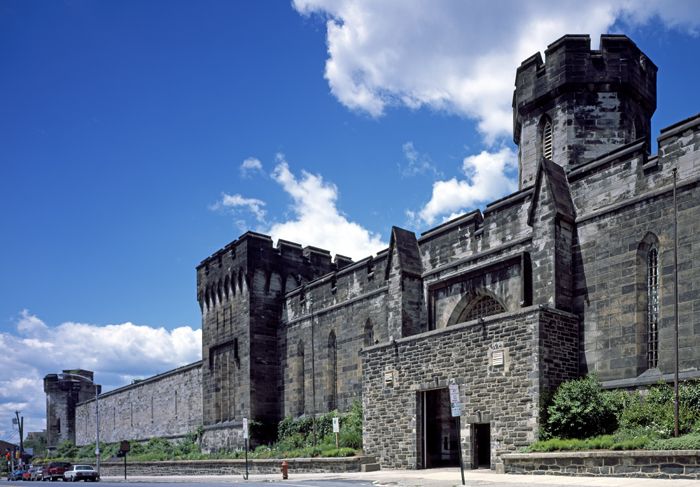
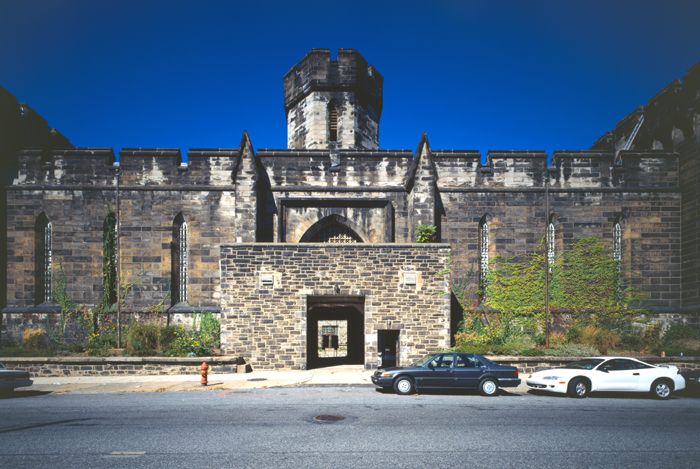
Though it would be decades before a new prison was built, ground was broken for the Eastern State Penitentiary in a cherry orchard outside the city in 1822. Designed by British-born architect John Haviland, the penitentiary would be unlike any seen before with seven single-level cell block wings radiating from a central surveillance hub, from which one guard could see down all of the cell blocks. Haviland was inspired by English prisons and asylums built beginning in the 1780s and gave it a neo-Gothic look. The building’s imposing facade was meant to be to be intimidating, although its battlements and windows were fake. Its interior was designed much like a church.
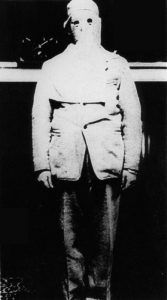
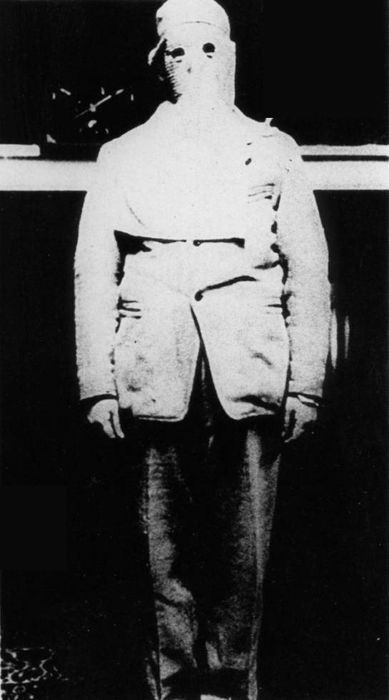
Hooded Inmate at Eastern State Penitentiary
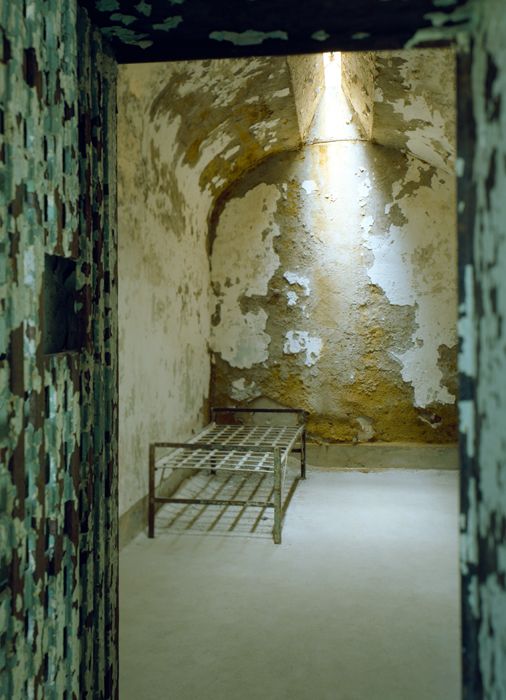
Though it was seven years before it would be completed, the penitentiary opened in 1829. With an initial capacity for 250 inmates, every prisoner would have his own 8 x 12-foot cell which featured central heating, a flush toilet, running water, a shower/bath, a skylight, and a private exercise yard.
From the minute the inmates entered the facility they were kept isolated. They were escorted into the prison with an eyeless hood placed over their heads. Afterward, the isolation continued so they could contemplate their crimes and read the Bible, which would lead to penitence and reformation.
To accomplish this goal, inmates could not mingle with other prisoners or continue relations with friends and family on the outside. When they were outside their cells, they were required to wear masks to hide their faces in their private exercise yards, which they were allowed to use one hour per day, with minimized interactions with the guards. During their time in their cells, they worked on prison projects such as shoemaking or weaving. Their only contact was with the warden, who was required to visit every inmate every day, and the overseers who were mandated to see each inmate three times a day. But even this communication was made through a small portal where meals and work materials were passed.
But just two years later, in 1831, it was already clear that the penitentiary would have to hold more criminals. Soon, second floors were added to all of the wings. This same year, the first female prisoner was confined in the penitentiary.
In 1832, the first inmate made his escape from the prison. For some reason, this inmate was not entirely confined to solitude and served as the warden’s waiter. He made his escape by lowering himself from the roof of the front building. He was later captured and returned but escaped in the same way in 1837.
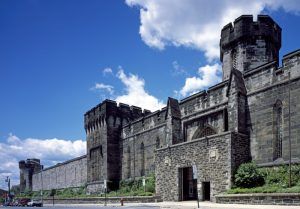
Eastern State Penitentiary in Philadelphia, Pennsylvania by Carol Highsmith.
By the time the original plan was completed in 1836, the building was the largest and most expensive public structure ever erected in the United States at a cost of $780,000, which would equate to more than $18 million today. At that time, its cost was believed to have been second only to that of the U.S. Capitol.
The Pennsylvania System was opposed to by the Auburn System, also known as the New York System, which held that prisoners should be forced to work together in silence, and could be subjected to physical punishment. This system was favored in the United States.
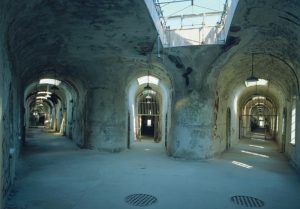
Eastern State Penitentiary Rotunda where guards could see down all the hallways.
Regardless of the cost and the disfavor by other systems, delegates from around the world came to study the radial floor plan and system of solitary confinement and it became the model for more than 300 prisons worldwide.
Some were not so convinced of the method. Charles Dickens, after a visit in 1842, wrote critically:
“I am persuaded that those who designed this system… do not know what it is they are doing… I hold the slow and daily tampering with the mysteries of the brain to be immeasurably worse than any torture of the body.”
By the 1870s, the prison needed more space and four new cell blocks were added in 1877 between the existing wings. Before long, the individual exercise yards were eliminated and inmates exercised together, but they were still required to wear masks and to be silent.
Though the reform plan of the Pennsylvania System called for no corporal punishment, this was not the case. Guards and councilors were known to have designed a variety of physical and psychological torture regimens for various infractions. One of these called the “water bath”, subjected inmates to being doused with water outside during winter months and then hung on a wall until ice formed on their skin. Another torture called the “mad chair”, in which prisoners were bound tightly for days until their circulation was cut off. The “iron gag” involved tying an inmate’s hands behind the back, with a chain trapped to an iron collar in the mouth, which caused the tongue to tear and bleed.
Under Block #14 was dug an underground cell that was called the “Hole.” Here, inmates would stay locked, sometimes for weeks, with no light, no human contact, with only bread and water to eat.
Due to overcrowding, the Eastern State Penitentiary eliminated the Pennsylvania System of isolation and penitence in 1913. Afterward, prisoners then shared cells, worked together, and even played in organized sports.
By the 1920s, the prison was housing some 2,000 prisoners and more cells were built including some below ground. The windowless cells then had nothing to do with penitence and everything to do with punishment. By this time, every cell was called home to 2-3 prisoners. In 1923, all female prisoners were removed and sent to the new prison at Muncy.
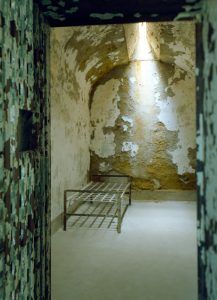
Cell at Eastern State Penitentiary
In July 1923, Leo Callahan and five accomplices armed with pistols successfully used a ladder they had built to scale the east wall after holding up a group of unarmed guards. All of Callahan’s accomplices were eventually apprehended, including one that made it as far as Honolulu, Hawaii. However, Callahan was never recaptured.
By this time, the prison was also housing violent criminals, as well as those sentenced to be executed. In 1933, a riot occurred in the prison over insufficient recreational facilities, overcrowding, and idleness. During this event, inmates set fires in their cells and destroyed workshops. The very next year, another riot occurred, this time over low wages. The prisoners short-circuited electrical outlets, started fires and caused other disturbances.
In April 1945, 12 men escaped through a 97-foot long tunnel that had been built by Clarence Klinedinst, who worked as a prison plasterer. The men were quickly recaptured and returned to the prison.
In 1959, a new cellblock was opened to house violent criminals. The last cell block to be built, it was the only one with electric doors. Though the prison housed those who were on “death row”, no executions ever took place at the prison.
In 1961, an inmate named John Klausenberg tricked a guard into opening the cell of another inmate and he and the other prisoner overpowered the guard to begin the largest riot in the prison’s history. It took several hours for a large force of police, guards, and state troopers to reclaim the prison.
The riot fueled discussions to close the Eastern State Penitentiary, which had since been renamed the State Correctional Institution at Philadelphia. In addition to overcrowding, the prison was badly deteriorating.

Death Row Cell Block of the Eastern State Penitentiary, courtesy Wikipedia
In January 1970 the prison closed and the inmates were sent to the State Correctional Institution at Graterford. After a riot at a prison in Holmesburg, the prison again housed some of those inmates. In 1971 it was officially closed forever.
Over the course of its 142 years, the penitentiary held some 75,000 inmates, including Prohibition-era gangster,
Al Capone, and notorious bank robber, Willie Sutton. During this time, more than 100 inmates escaped, but all were recaptured with the exception of Leo Callahan.
While the prison was operating, two guards and several inmates were murdered within the walls. Other prisoners committed suicide, and hundreds of others died from disease and old age.
Named a National Historic Landmark in 1965, the prison sat abandoned after it was closed during which time it was heavily vandalized and trees began to grow in the buildings.
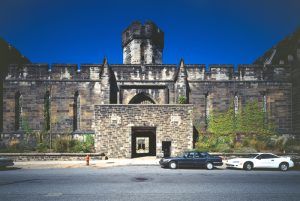
Eastern State Penitentiary Administration Building
The City of Philadelphia purchased the property with the intention of redeveloping it. Proposals included demolishing the building to use the site as a criminal justice center, a mall, or a luxury apartment complex. But in 1988, a task force successfully petitioned the city to stop pursuing development, and in 1994, the Pennsylvania Prison Society opened the prison for historic tours.
Today, the Eastern State Penitentiary, kept in a state of “preserved ruin” continues to operate as a museum and historic site. It is open year-round for tours and special events are held throughout the year.
In addition to its long history, the penitentiary is said to be the most haunted prison in the United States and for years, has been investigated by paranormal groups and has been featured in several television shows. These investigators, as well as staff and visitors, have reported dozens of paranormal activities and numerous sightings of ghostly entities.
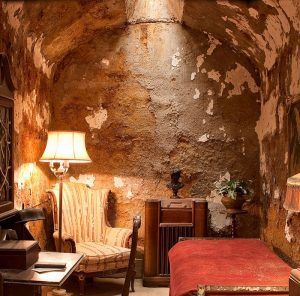
Al Capone’s Cell at Eastern State Penitentiary
One of the first stories told of ghostly activity was by famed Chicago gangster, Al Capone, who was housed in the prison for eight months in 1929-1930. Though he had the nicest cell in the prison, which included a desk, a lamp, paintings, and a radio, he said he was haunted by the ghost of James Clark, who was one of the victims of the St. Valentine’s Day Massacre in Chicago. Allegedly, Capone screamed every night in fright screaming at “Jimmy” to go away and leave him alone.
In the 1940s, both prisoners and guards began to have a number of unusual experiences and unexplained sightings. Many of these events involved spooky shadows and unexplained noises.
Today, many people have reported that Cellblock 12 is an area of high paranormal activity, where cackling and whispers are heard and the apparition of a prisoner is seen. In Cellblock 6, shadowy figures are often seen sliding along the walls and the sounds of whispers, screams, and laughter have been heard.
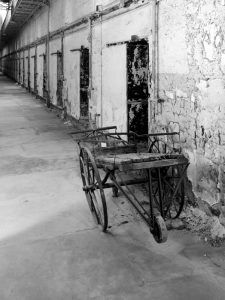
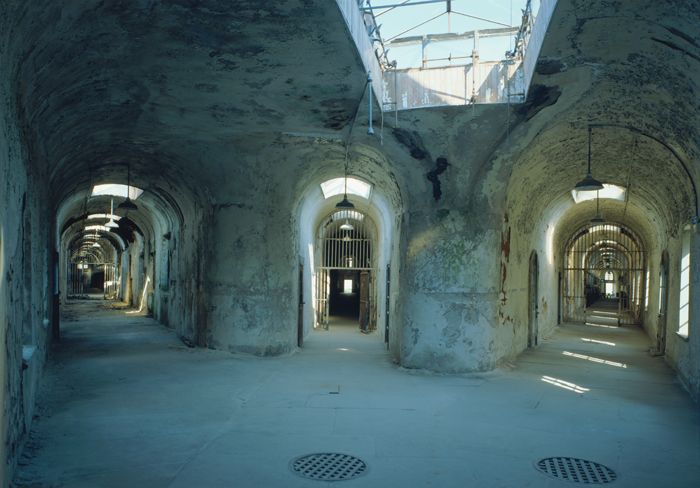
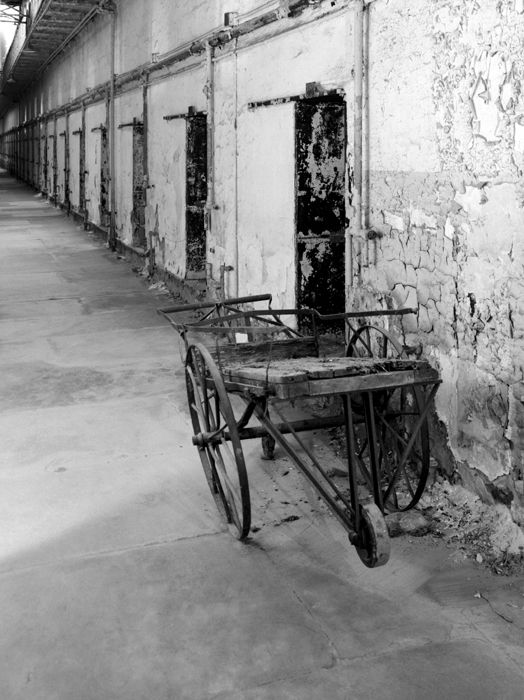
Cellblock 4 of Eastern State Penitentiary
In Cellblock 4, many have seen ghostly anguished faces and hearing loud whispers. On one occasion, a locksmith working in this area who was removing an old lock from a cell door had a vivid experience. He described having felt as if he was overcome by a massive force, and was unable to move or speak, while distorted forms swirled around the cellblock, one of which appearing to beckon to him.
Many people have reported seeing the silhouette of a guard in one of the watchtowers.
On the third floor of one cell block, numerous visitors say they’ve heard the sound of cell doors suddenly opening and then slamming shut.
The catwalk is an area where many paranormal events have occurred. Here, a shadow figure was caught on a video, people have felt extreme temperature fluctuations, and one visitor captured a male voice saying “I’m lonely” on an EVP.
Throughout the prison, visitors and staff report disembodied screams, cries of pain, sadistic laughter, and whispers. Others have reported the sounds cell door handles jiggling, furniture being dragged across floors, large objects rolling on the roof, and ghostly footsteps.
Many have seen sudden orbs or streaks of light appearing, felt unseen people tapping them on the shoulder, get overwhelming sensations of being watched, and in general have feelings of dread.
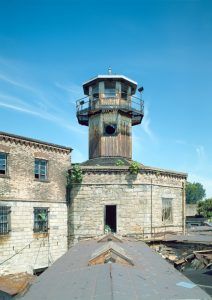
Watch Tower at Eastern State Penitentiary
More Information:
Eastern State Penitentiary
2027 Fairmount Avenue
Philadelphia, PA 19130
215-236-3300