This blog is the best for google chrome.
Download
Website Online Counter

The White Lady of Spring Canyon, Utah

Due west of Helper, in Carbon County, Utah is Spring Canyon, a one-time coal-mining mecca now filled with ghost towns. Here, along this rugged path, surrounded by mountains, boulders, mining remnants, and the crumbling remains of once thriving buildings, roams an ethereal white lady.

Before the mysterious “white lady” and the many coal miners who lived in this canyon, the area was long occupied by the Fremont Indians, who left behind numerous rock art panels. Other larger occupants, namely dinosaurs, also left their marks in abundant large footprints which have been found in many of the area coal mines.

Carbon County changed dramatically; however, when the Denver & Rio Grande Western Railroad began to seek a route from Denver to Salt Lake City in the 1880s.
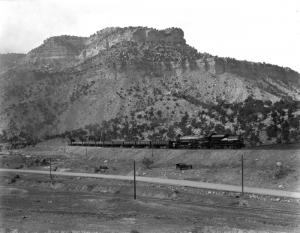

Utah Railroad in Spring Canyon, Utah by Harry Shipler, 1927.

As the railroad opened up the area, coal was discovered and by the late 19th century, the county was filled with coal mining camps. As prospectors continued to search the region for coal, more was discovered in Spring Canyon and the first mine in the district was established in 1895 at Storrs. Over the next several decades, numerous mines and small settlements sprouted up in the canyon, including Standardville, Rains, Peerless, Mutual, and Latuda.

Throughout the decades the Spring Canyon District was called home to over 2,000 miners, businessmen, and their families as the mines extracted almost 43 million tons of coal from the rugged hills through the 1960s. Though the mines brought people and prosperity to the region, it also brought tragedy and violence in mining explosions and major strikes. But, when Spring Canyon’s heydays were over, it left behind only memories, scattered mining remnants, fading ghost towns, and legends, the most famous of which is that of the White Lady.

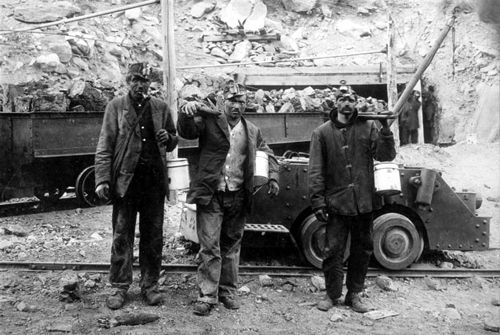
Persisting for years, the legend has numerous variations that have been told of who this mysterious woman might have been. Though her identity may always be in question, it is interesting to note that a century ago, women and mining equaled bad luck to virtually every miner in any type of mining camp. The superstition, having its roots in Europe, was very strong among immigrants, which tended to make up the vast majority of miners of the time. These miners believed that disaster and tragedy would follow if a woman visited a mine and could cite instance after instance of “true” stories that had occurred. Though outsiders believed these instances were purely coincidental, the miners didn’t think so and became extremely agitated if a female even got near a mine shaft, causing almost as much nervousness in the mine workers as did ghosts or Tommyknockers.
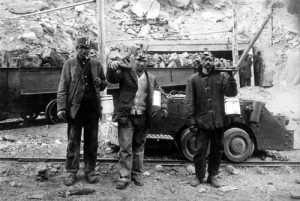

Carbon County, Utah Miners, 1919

Given the superstitious nature of the coal miners, it is not surprising that the legend of the “White Lady” has been told for so many years.

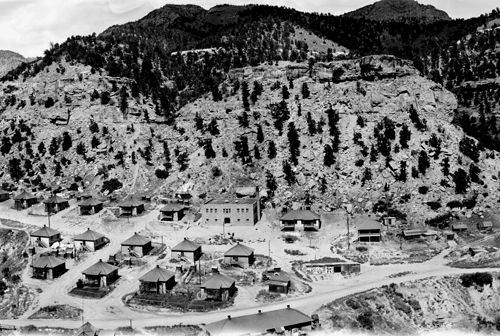
The woman was believed to have lived in Latuda, which is about seven miles west of Helper on Spring Canyon Road. The mining camp, which got its start in 1917 when the Liberty Mine went into production, once boasted numerous homes, a post office, a school, a company store, mining offices, and about 400 people.

One version of her history says that her husband was killed in the mine and his body was never found. Another says that both her husband and a son were killed in a mine accident, leaving her alone with an infant daughter. The tale continues that her baby was later kidnapped, thrown into a wash and drowned. Afterward, the woman lost her mind and soon died.

Yet another version alleges that she lived in Peerless, another mining camp situated just about three miles west of Helper that thrived from 1917 to 1930. This account says that after her husband died from blood poisoning and, as his death was not mining related, she and her infant child received no compensation and were destitute. Instead of allowing her baby to starve, she drowned it, lost her mind and was institutionalized in a mental facility. Later she escaped returning to Peerless, where she later died.
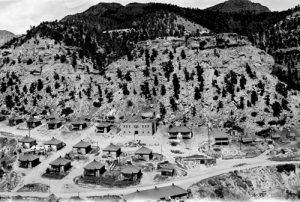

Latuda about 1940

Another report says that she herself was killed in a rockslide in Latuda, while an additional story says that her child was killed in an avalanche and she later committed suicide.

A final tale says that after her husband was killed in a mine accident that the company refused to give her full compensation and after a confrontation with mine officials, she was so angry and driving so fast, that she drove off the narrow road and was killed.

Though the truth of her life will probably never be known, for whatever reason, she continues to make her presence known in the canyon. Some say she seeks revenge against the mining company or against those who kidnapped her infant daughter. Dressed all in white, others say that she continues to search for her lost child, specifically in the canyon wash. Interestingly, this sounds very much like another popular legend – that of La Llorona, who has been seen haunting rivers and streams, also looking for her lost child, throughout the southwest for centuries.
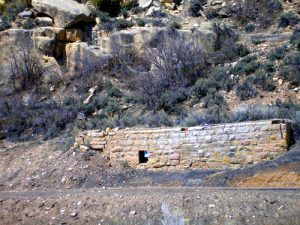

Various low walls and foundations dot the entire length of Spring Canyon

In any case, numerous sightings of the spectral lady in white have been reported throughout the years. Some of the earliest accounts say that she was known to float around the entrance to the mines, luring miners into their vast depths, ensuring certain disaster. Other tales are not so sinister, saying that instead of enticing them into the mines, she would appear to warn them to leave in order to avoid some kind of accident.

Allegedly, she has been seen several times around the Latuda mine entrance, inside the mine, and near the old Liberty Mine office. By the 1960s, the legend was so well known that teenagers often came to the Latuda mine office at night to tell ghost stories and catch a glimpse of the spectral lady. On one occasion, though there is no evidence that the ghost ever appeared, the teenagers’ visit resulted in disaster when one of them blew up the building, resulting in his imprisonment.
Read more >>

Trans-Allegheny Lunatic Asylum, Weston, West Virginia

Once known as the Weston State Hospital, the Trans-Allegheny Lunatic Asylum in Weston, West Virginia opened its doors to patients in 1864. Once it was a house of horrors with severe overcrowding, inhumane conditions, and rampant violence. Today, it comes as no surprise that is said to be extremely haunted.

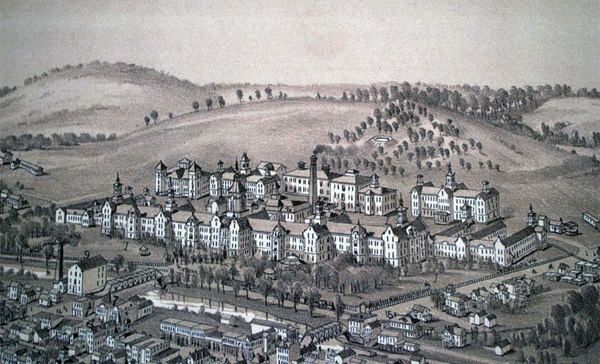
The hospital was authorized by the Virginia General Assembly in the early 1850s as the Trans-Allegheny Lunatic Asylum. Following consultations with Thomas Kirkbride, then-superintendent of the Pennsylvania Hospital for the Insane, a building was designed in the Gothic and Tudor Revival styles. The building followed the Kirkbride plan, which called for long rambling wings arranged in a staggered formation, assuring that each of the connecting structures received an abundance of therapeutic sunlight and fresh air and patients were allowed privacy.

Unlike those places constructed more for the purposes of security and safety, this establishment was to foster the best-known concepts of curing the patient. Following the “Kirkbride Plan,” the asylum was located in a rural area where patients would be housed among strangers only, discouraged from seeing anyone they knew. Patients were not even allowed to receive gifts or mail.

Construction began in late 1858, initially conducted by prison and slave laborers. Skilled stonemasons were later brought in from Europe.

Construction was interrupted by the outbreak of the Civil War in 1861 and the partially built hospital and surrounding grounds became Camp Tyler for the Union. The completed southern wing of the asylum was used as barracks and the main foundation served as a stable. Confederate raids in 1862 and 1863 temporarily dislodged the Union troops. Following the admission of West Virginia as a U.S. state in 1863, the hospital was renamed the West Virginia Hospital for the Insane. In 1864, Confederate raiders stripped the Asylum of all food and clothing intended for its first group of patients.


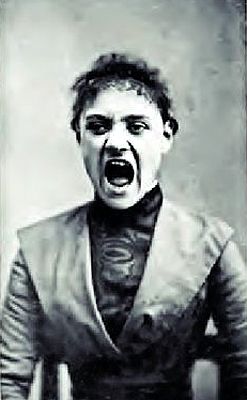
Hysterical Woman

The first patients were admitted in October 1864. The very first patient was a housewife who had “domestic trouble.” The first logbook used at the hospital lists reasons for patient admission and includes causes like grief, congestion of the brain, feebleness of intellect, seduction and novel reading.

In the early days, asylums were seen as repositories for more than just the insane. In many cases, people were committed for ridiculous reasons such as laziness, religious enthusiasm, menopause, superstition, domestic trouble, masturbation, and tuberculosis. Asylums were often the dumping ground for society’s unwanted. Interestingly, the asylum offered money to anyone who dropped off a patient … many of whom showed no signs of mental illness when they were first committed.

Its original construction was planned for 250 people. From the beginning, the hospital was largely self-sufficient. They raised their own vegetables, maintained a dairy herd, and operated an ice plant. A nearby coal mine supplied fuel for heat and there was a reservoir for water. All of the patient’s’ clothing, curtains, and fabrics were made at Weston, as well as fine quality mattresses and most of the institutional furniture, thus fulfilling the 19th-century ideal that institutions be self-sustaining and that mental patients learn a trade.

Lying on more than 600 acres, the land also included a cemetery for the many that passed away at the asylum over the years.

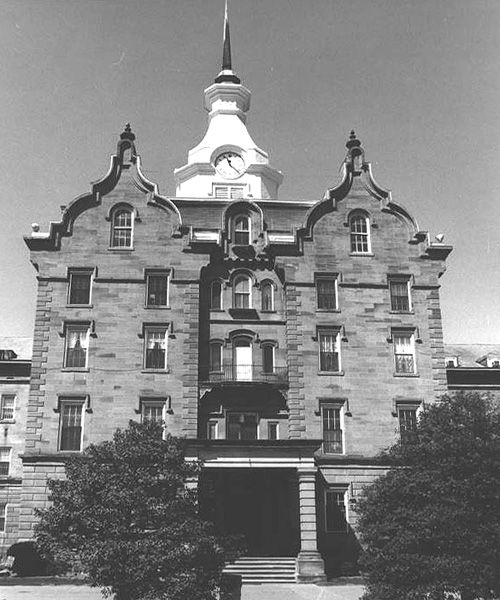
The 200-foot central clock tower was completed in 1871. The center unit is four stories high with a great cupola and the clock tower. This section was originally designed to house offices and personnel and at one time even had such features as a large ballroom.

Separate rooms for black people were completed in 1873.


Trans-Allegheny Lunatic Asylum, Weston, West Virginia

Construction would continue into 1881 when the original plan was complete. The total cost was $725,000 — more than $300,000 over the original budget. At that point, more than 700 patients were housed in the building, which was 1,295 feet long, and contained two-and-a-half miles of hallways. The walls were two-and-a-half feet thick, dense enough to muffle the screams of even the most tormented soul.

Nineteenth-century healing tactics were barbaric, some of which included bloodletting and insulin coma therapy. Seclusion cells and confinement cribs were utilized to control violent patients. Unfortunately, there were innocent victims of the asylum due to misdiagnosed conditions and unfortunate situations. Many spent their entire lifetime at the asylum, only to end up in an unmarked grave on a lonely hillside.

Changes were constantly being made. A Women’s Auxiliary was built in 1890 and two years later the 20-acre front lawn was enclosed by a Victorian wrought iron fence. A gas well was drilled on the grounds in 1902, making the facility even more self-sufficient.

The hospital’s name was again changed to the Weston State Hospital in 1913.

In the early 20th century overcrowding, a developing attitude that treatment should be directed more to maintenance than to the attempt to rehabilitate, and a continual lack of funds plagued the hospital for many years. New buildings were filled as soon as they were completed.

Over the years, several auxiliary buildings have come and gone. A tuberculosis building was established in 1930. A large 3.5 story brick unit was constructed around 1935.

Several fires were set by patients over the years including a large fire in October 1935 which ravaged the fourth floor of the hospital. Remarkably, no one was killed in the blaze, and the wing was rebuilt for $155,000 by the Works Progress Administration.

In 1938 the asylum was called home to 1,661 patients. That year a survey reported that the hospital housed epileptics, alcoholics, drug addicts and non-educable mental defectives among its population.

In 1949, the hospital had some 1,800 residents. That year the Charleston Gazette reported that the facility had poor sanitation and insufficient furniture, lighting, and heating in much of the complex.

At its peak in the 1950s, the hospital’s population reached 2,400 patients, more than ten times the number it had been built to accommodate. In the rear of the main unit are several brick structures that housed service units such as kitchen and dining facilities, laundry, shops, a forensics building, and storage. Many of these were built during this time. This was likely one of the worst times for patients at the hospital with the overcrowded and understaffed conditions. It, no doubt, could make even the most sane of souls lose their minds. Anyone who complained or acted out was subjected to solitary confinement, chained to the walls of an empty room for months on end.


Icepick Lobotomy

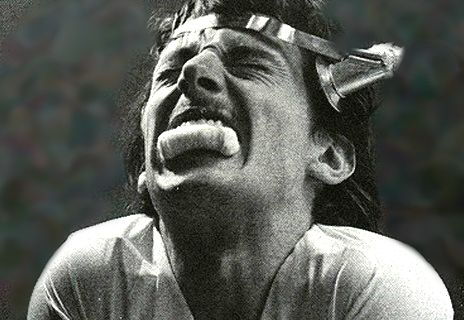
During these many years, a number of medical practices such as ice water baths, seclusion cells, electroshock therapy, and lobotomies were commonly used on patients. At one point, one of the “favored” procedures that were used extensively was the “ice-pick” (transorbital) lobotomy. This crude procedure utilized a one- or two-pronged device which was driven through the orbital socket of the eye and into the brain with a sharp blow. The permanent damage caused was thought to relieve some of the patient’s more severe symptoms. In 1952, one doctor alone performed 228 such lobotomies during a two-week period in West Virginia. They aptly named it “Operation Ice Pick.”

But, the real problem as overcrowding. Inability to handle the large population led to an increase in violence. There were several cases of patients killing other patients. In one instance two patients hanged one of their fellow patients using a set of bed sheets. When he did not die, the pair cut him down and used a metal bed frame to crush his head.

Even the staff were not immune to the violence and several female employees were raped. Many former employees reported being attacked while on duty. One evening a nurse went missing, her rotting body was found two months later at the bottom of an unused staircase.

In order to deal with some of more violent, uncontrollable, and severely mentally ill, it is said that many of them were kept in cages.

In 1960 a Medical Center, which included a morgue, was built.


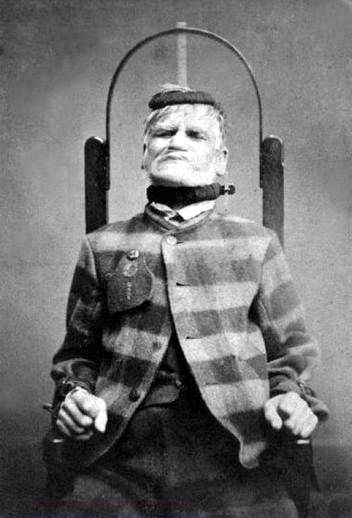
Restraint Chair

In 1985, the Charleston Gazette once again exposed the asylum, reporting that court-appointed inspectors found the asylum to be “dirty and unkempt,” with many patients left naked and “confined to dirty wards with bathrooms smeared with feces.”

Seven years later, in 1992, even more bad news rocked the asylum when the Charleston Gazette again decried that horrendous conditions inside of the asylum. That same year a patient named George Edward Bodie died after a fight with another patient. Another patient, Brian Scott Bee, committed suicide and his badly decomposing body was not found for eight days.

The hospital was forcibly closed in 1994 due to changes in treatments of patients and the physical deterioration of the facility.

Afterward, the building stood vacant for years.

The hospital was auctioned off in August 2007 and Joe Jordon bought the 242,000-square-foot building for $1.5 million. Today, it is open for guided historic and paranormal tours as well as evening ghost hunts.

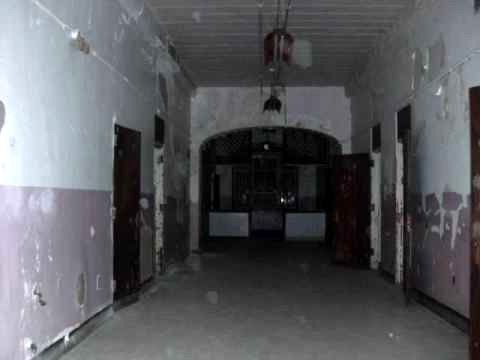
The central section, directly under the 200 ft high clock tower, contains a museum and several faithfully restored period rooms from the 1870’s to the 1960’s. One of the patient wards has been restored but the remaining 23 are largely untouched. The endless decayed hallways and vacant patient rooms, including isolation cells with rusted rings once used to chain the most violent, create an extremely eerie atmosphere.

Trans-Allegheny Lunatic Asylum has been featured in a number of paranormal television shows. The building was listed on the National Register of Historic Places in 1990. It is the largest hand-cut stone masonry building in North America, and is purportedly the second largest in the world, next to the Kremlin.


Weston, West Virginia Asylum

Hauntings

The tales of hauntings and unearthly spirits lurking within the building and on the grounds started long before it ceased to be a hospital. After a few decades, the reports of hauntings and the sounds of restless souls became commonplace. In fact, some workers were said to have stayed only a few days, quitting after hearing inexplicable noises, such as the squeaky wheels of gurneys rolling along a tiled hallway.

Thousands were committed to the asylum over the years, and many unfortunately died here. Over 2,000 people are buried in the cemetery.


The spirits are numerous and range from Civil War era ghosts to children, to ex-patients and staff.

Murders, rapists, and other violent offenders are said to continue to dwell in the building along with others whose only crime was depression or substance abuse.

Sightings include staff and visitors seeing ghostly figures walking through the hallways at night and glimpsing shadowy figures at all hours. One doctor even reported that a spirit followed her home and continues to trouble her to this day. Others have reported seeing a ball of light moving in a hallway and spying apparitions dressed in white.

On the first floor of the building, which is called the Civil War Wing, and is the oldest part of the hospital, is said to lurk a former patient by the name of Ruth. Though it is unknown the reasons why Ruth apparently hated men and had a practice of throwing things at them. Today, her spirit still wanders in the hallways, where people have been pushed up against walls and have heard whistling sounds emanating in the hallways.

In Ward 2 of the second floor, a couple of violent events occurred. In one room, a man was stabbed 17 times by another patient. In another room, two patients committed suicide by hanging themselves from curtain rods. Here, shadowing figures have often been seen and on at least one occasion, an EVP captured someone saying “Get out.”


The third floor is where two patients tried to hang another patient and when he didn’t die, bludgeoned him to death. The ghost of the murdered man is said to continue to haunt the room in which he was killed. Another ghost by the name of Big Jim is also said to maintain a presence on this floor as well as a nurse called Elizabeth. Other occurrences on this floor include doors that close by themselves, fleeting glimpses of apparitions, shadowy figures, and a number of strange noises which have been caught on EVPs.

Located on the fourth floor is another well-known spirit – a child named Lily, who sits patiently in a room filled with toys, waiting for someone to play with her. Wearing a white dress and said to be about nine-years-old, Lily likes to play games with visitors and staff, as toys move around of their own accord and a music box turns on by itself.

Legend has it that Lily was a little girl who spent all or most of her short, sad life inside the walls of the asylum. One story says she was dropped off at the hospital by her parents, while a second tale states that she was born there to a committed mother. She died of pneumonia at the age of nine and has never left the only home she had ever known.


Asylum Hallway

Though Lily appears to be pleasant enough, other more sinister spirits seem to linger on the fourth floor including a black mass like object and a strange apparition called the “creeper” that crawls along the floor. The sounds of something or someone banging on pipes is often heard here.

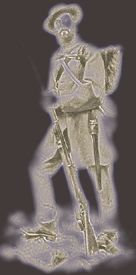
Another ghost on the fourth floor who many have seen is a soldier who they call Jacob who is said to stroll the hallways.

Numerous unearthly sounds have also been heard including screams coming from inside the electro-shock room, banging, mysterious slamming doors, throaty moans, ominous breathing and hysterical laughter coming from empty rooms.

Other paranormal activity includes objects that seemingly move of their own accord and visitors’ reporting the feeling of being watched.

More Information:

Trans-Allegheny Asylum
71 Asylum drive
Weston, West Virginia 26452
304-269-5070

Read more >>

Ghostly Legends of Cheyenne, Wyoming


Cheyenne, Wyoming, 1868

Cheyenne, Wyoming got its start in July 1867, when General Grenville M. Dodge and his survey crew platted the site now known as Cheyenne Wyoming in anticipation of the construction of the Union Pacific Railroad through the territory. By the time the first track was built some four months later, 4,000 people had already migrated to the new city. The railroaders and first settlers were quickly joined by gamblers, saloon owners, thieves, opportunists, prostitutes, miners, and cowboys, as well as legitimate businessmen. The fledgling city, busting at the seams, was a wild and lawless place during its first days so it should come as no surprise that it is said to be one of the most haunted places in Wyoming. In the days preceding Halloween, a Cheyenne Trolley offers two tours per night for ghost hunters hungry for the tales. Here are but a few of the legends we’ve picked up along the way.


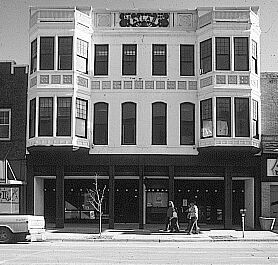
Atlas Theatre

Atlas Theatre – Built in 1887, this three story building originally held a confectionary shop on the lower level and the upper floors were utilized as office space. However, in 1907, architect William Dubois was hired to convert the first floor into a theatre. The next year, the Atlas Theatre opened and continued to operate until 1929. Closed for a couple of months, it was then reopened as the Strand. By the mid-1950s, the building sat abandoned until 1961, when it reopened as the Pink Pony night club. Remaining open for only two short years, the building again sat idle until in 1966, when the Cheyenne Little Theatre Players began to use the Atlas for live theater productions. In 1971, the theater company purchased the Atlas, and two years later it was placed on the National Register of Historic Places. Though little is known about them, the historic theatre is said to be called home to two active ghosts. The Atlas Theatre building is located at 211 W. 16th Street.

Deming Elementary School – Built in 1945, the school is allegedly haunted by a man he was killed in the furnace room years ago. At night lights are said to be seen flickering in the building and clanking noises are heard. Legend also has it that if you look into a window at night, you will not only see your own shadow but another next to it that is seemingly cast by an unknown entity. The school is located at 715 West 5th Avenue.


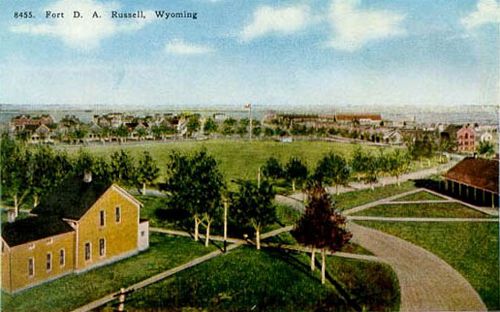
Fort Russell Postcard

Francis E. Warren Air Force Base – Located three miles west of Cheyenne, this Air Force base was first established as Fort D.A. Russell in 1867. Named in honor of Civil War Brigadier General David A. Russell, it is the oldest continuously active military installation in the Air Force. Over the years it served the U.S. Army and Cavalry in protecting the frontier and served through the Spanish-American War, and both World Wars. In 1949, 80 years after its founding, the fort became Francis E. Warren Air Force Base. Today, the base is home to the 90th Space Wing and Headquarters and is one of four strategic missile bases in the United States. Though modern facilities make up the base today, many of the historic structures still remain. Along with these old buildings, legends are told that many of the old cavalry soldiers also continue to linger, often seen walking upon the grounds or in the dormitories. Another story tells of a spirit that is said to harass female members of the security teams. Civilians are only allowed on base during periodic public tours or if “sponsored” by military personnel.


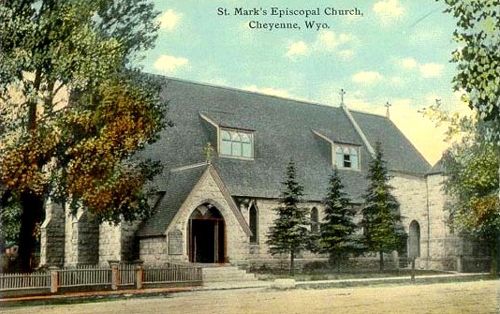
St. Mark’s Episcopal Church, before the bell tower was completed.

St. Mark’s Episcopal Church – Cheyenne’s Episcopal congregation first held services in a small frame church in 1868. However, by 1886, the congregation, made up of a number of cattle barons and large ranchers, had begun to outgrow the small building and plans were made to construct a new one. However, the winter of 1886-87 with a very bad one and blizzards and severe cold killed many of the cattle. Without the prosperity of the ranchers, it would be more than two more years before the building was ready to hold services. Opened in 1888, it was still not entirely complete as the bell tower was not done and was simply capped off.

It would be years before the bell tower was finally completed in 1924. Skilled in old-world masonry, two Swedish men were hired to complete the tower. However, when it was forty feet high, the two masons simply disappeared. When new workers were hired they immediately began to complain of hearing strange tappings, the sounds of hammering, and whispers coming from the very walls of the tower.

Years later, a man came forward explaining that when the original masons were working on the tower, one of them slipped and fell to his death. The other panicked that he would be deported, entombed the man’s remains in the tower wall.

Though no longer the case, the church once allowed public tours of the tower around Halloween. A psychic who visited during this time reported sensing two spirits in the tower – one of whom was very upset, and the other, an elderly white-haired man who walked with a cane. The two spirits are thought to be the mason that fell to his death, and Father Rafter, who had hired the men.

Over the years, many people have claimed to have heard a church pipe organ, that was once located in the bell tower, even after it was removed from the building. Others have reported that the church bells have often been known to ring of their own accord, and allegedly whispers can still be heard within the church. The church is located at 1908 Central Avenue.
Read more >>

Haunted Ivy House Inn in Casper, Wyoming

The Ivy House Inn Bed & Breakfast, courtesy Ivy House Inn.

Casper, Wyoming is home to the Ivy House Inn a beautiful Cape Cod style inn that also apparently houses not only the ghost of its prior owner, but also her two Siamese cats, as well.

While no longer an Inn, it was built where the prairie meets the Rocky Mountains in 1916 by Mr. and Mrs. White, the roomy three story home was finally complete when two grand front porches were added in 1940.

Said to have been controlling in life, Mrs. White apparently continues her manipulating behavior in the after life by ensuring that guests do not drink or smoke in her place. However, Mrs. White doesn’t appear to limit her activities to only undesirable activities, she shows up all the time according to owners and guests of the historic inn.

At the age of 93, Mrs. White passed away in 1995 and the house was purchased by Tom and Kathy Johnson in 1996. Tom Johnson didn’t believe in ghosts when he bought the property, but that all changed as he began the work of renovating the home into a bed and breakfast inn.

Evidently, Mrs. White was not entirely happy with the renovations, as suddenly, when Johnson was using a power drill, it stopped working. As he turned around, the plug was hanging in mid-air for several seconds before it fell to the floor. On another occasion, a hammer simply got up and walked out the room.

To say the least, Tom Johnson is a believer today, so much so that he has since become a paranormal investigator. He also believes that the inn not only houses Mrs. White, but also several other spirits, including two Siamese cats. These two spectral felines have often been seen running throughout the building and one guest reported that a cat slept on the end the bed, purring contentedly.

Another apparition is that of a man that is often seen in the back parking area, where car alarms are set off regularly. Perhaps, this is Mr. White? Another guest reported seeing a male figure standing above her bed and heard a mail voicing saying, “Isn’t it funny how people get lost?”

Others, who have stayed in one of the downstairs rooms, have often reporting having had the same dream where a young man wanders back and forth from the sink to the closet.

With all the odd happenings at this former historic inn, it is still the controlling Mrs. White whose presence is most often shown. One regular occurrence is when smells of the past suddenly fill a room, such as old menthol cold medications, the aroma of baking chocolate, and the odor of a scouring pad on a skillet. Her face appears in mirrors and in windows and her shadowy body is often seen walking down the hall and through walls. Guests often reported someone knocking at the door, but when they answer no one appears. When they take too long to answer, the doorknob will begin to twist. Mrs. White has also been reported to have appeared in many photographs.

Paranormal investigators have researched the house on nine different occasions.

In 2009, the beautiful inn on South Ash Avenue in Casper was sold to Turning Point, Self Help Center, and is no longer an Inn/Bed and Breakfast.
Read more >>
Booking.com