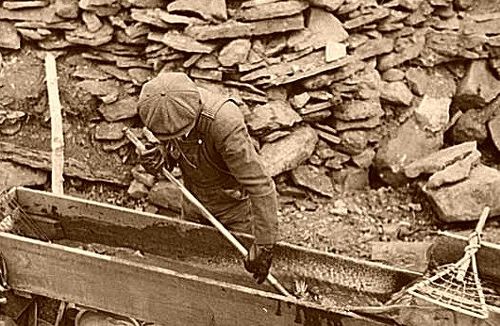
Central City
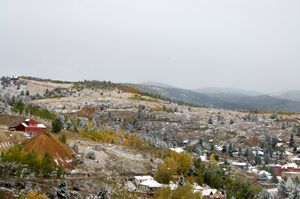
Central City, Colorado.
Founded in 1859, Central City quickly acquired the reputation of being in the middle of “the richest square mile on earth.” As many as 30,000 miners flooded the area in search of their fortunes but by the end of its second year, most of the placer gold was gone and hard rock mining began. The settlement’s population ebbed and flowed with the building of new mines and survived through the 1870s and 1880s.
However, by the early 1900s, Central City was becoming a virtual “ghost” as buildings were dismantled – the lumber and materials shipped to more thriving settlements.
By the 1920s the settlement had only about 500 residents. Struggling along as a tourist town for years afterward, the town regained some prosperity with the passing of legalized gambling in 1991.
However, the nearby town of Blackhawk, nearer to the highway, benefited most from the new law and Central City continued to struggle along. However, the benefit to Central City is that most of its historic buildings remain intact. Central City, although inhabited by the living, is also said to remain home to a number of lingering spirits.
Masonic Cemetery – Every April 5 and November 1, it is said that a beautiful woman in a black satin dress appears and lays flowers on the grave of John Edward Cameron. There are many different rumors for the connection between this ghost and Cameron, who died on November 1, 1887. At one time, twelve people gathered at Cameron’s grave on November 1 to see the ghost. They were not disappointed — at sunset, the woman appeared as always, but when two of the men tried to grab her, she flew off and vanished on a hill not far from the cemetery. The hilltop cemetery is north of the city.
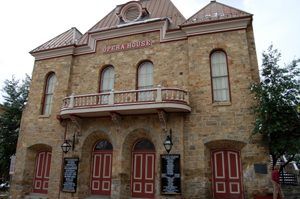
Central City Opera House.
The Opera House — One of the more famous landmarks in the old mining town is the Central City Opera House. Here, some of Colorado’s finest troupes of entertainers performed, and some have seemingly stayed on to perform long after the troupes have left. Built in 1878, the national historic Opera House has hosted performances for well over 100 years. Unfortunately, shortly after its opening, the Central City mines played out and the Opera House fell into disrepair. However, many years later the 550-seat Opera House was saved by a volunteer effort in 1932. Restoring the Opera House to its former grandeur, performances were brought back to the old Opera House for summer festivals that continue to this day.
Among the remaining troupes of the Opera House was s a miner turned stage performer by the name of Mike Dougherty, who was a favorite in 1865. Unfortunately, like many residents of this rough and tumble frontier town, Dougherty drank himself to death. Apparently, Mike’s love of the stage has caused him to linger.
Over the years, numerous back-stage visitors have reported being nearly overwhelmed with the strong (but fleeting) odor of alcohol, which is sometimes accompanied by a stout nudge on the shoulder, or by their hair being lightly ruffled from behind. While Dougherty seems to be a friendly ghost, the living are always considerably startled when they turn to look and realize that they are alone in the darkened corridor.
Other reported occurrences have included strange flickering orbs of light that seem to float across a darkened stage and then vanish into the wings. The distinct sound of footsteps is also heard in the balcony, thought to be those of a long-departed female patron, Occasional cold spots have been felt which move from one corner to the next backstage. Nearly all of these occurrences have been reported when the theater is dark and not in use for performances.
Teller House – This historic building is one of the few that survived the 1874 Central City fire. Built at a cost of $84,000 in 1872, the owners spent an additional $20,000 for furnishings, making it the finest hotel (outside of Denver) west of the Mississippi. In the beginning, the rate for this luxury hotel was 50 cents per night plus an additional $2.50 tariff. President Grant visited Central City and the Teller House in 1873 and again in 1876. For his 1873 visit, a path of silver ingots valued at $12,000 was laid from his carriage to the front door of the hotel as a “welcome mat.”
This building houses the famous and mysterious “Face on the Barroom Floor” painting, done by Herndon Davis in 1934. This lovely painting is carefully maintained today.

In Central City, Colorado this face draws back its long-dead artist time and time again.
Legend has it that the woman’s likeness was painted by a distraught miner when his wife died of consumption (tuberculosis.) As the story goes, the miner drank himself into a stupor and then proceeded to paint his wife’s portrait on the floor. Speaking tenderly of her, he painted long into the night and on past noon the next day. Once the artist was finished, he slept, never to wake again. Buried next to his beloved wife, witnesses say that on the anniversary of his death, the couple can be heard talking tenderly to each other through her portrait on the floor.
Unknown Cemetery – There are at least four cemeteries in Central City. One of these old cemeteries holds the remains of a woman who was determined to be a witch by her peers. If you can find the grave, it is said that if one stands just a few yards away, a green mist will surround the area. Further, witnesses purport that if the lighting is right, hundreds of maggots will cover the ground.
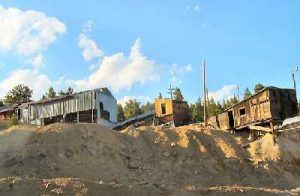
Old mines just outside of Central City
Gold Mine Road — Though “they” don’t give this road a name nor call it the “Gold Mine Road”, I called it that for lack of a better description. This is a personal experience as I traveled along this road southwest of Central City, past the cemeteries leading to Nevadaville, past Russell Gulch and on to Idaho Springs. My traveling companion on this trek was known to me to be a ”ghost magnet.”
Though he had shared many uncanny experiences with me about his insights and feelings; he himself was uncomfortable with his ability. As we traveled the road, I, of course, continued to insist that we stop for photo opportunities. Mesmerized by the beauty of the area and the history facing me, I could have spent an entire day.
The Haunted Mine
In the beginning, Central City was so filled with gold and silver that one could often just pick it up. But, as the surface minerals were gone, the dangerous work of hard-rock mining began. Many miners in the area suffered cave-ins, accidents with tools and explosives, and suffocation.
In one area mine that closed more than 85 years ago, the Pozo Shaft is said to still remain home to a number of ghostly miners. Many night-time trespassers have been frightened away by faint yellow lights coming from the old mine and the sounds of men working deep in the mine shaft far below.
In one area mine, the Pozo Shaft, it is said that many mischievous, night-time trespassers (usually acting on an ill-advised dare) have been frightened by faint but eerie yellow lights and the sounds of heavy tools and men working deep in the mine shaft below.
Blackhawk
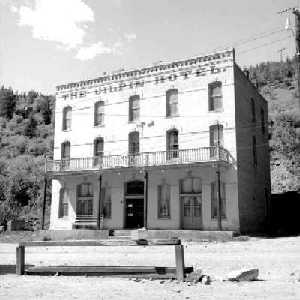
Blackhawk – Gilpin Hotel -1960
Gilpin Hotel and Casino – The original Gilpin Hotel in Blackhawk dates back to the late 1800s when the Central City/Blackhawk area was known as the richest square mile on earth. Back in those days, the hotel also housed a one-room school upstairs, with a teacher by the name of Lucille Malone. Lucille was in love with an area miner and was devastated when her lover was run over by a wagon in front of the hotel. Unable to deal with her grief, the distraught schoolteacher threw herself over the balcony of the hotel dying in the very same street as her former lover. However, Lucille seemingly remains at the hotel according to several guests.
Before the advent of gambling in Blackhawk, the Gilpin Hotel was just a small-town hotel catering to tourists and people living within the area. One of our readers, a man by the name of Thomas, was staying there with a girlfriend in the early 1990s.
His girlfriend, who was a bartender at the hotel, lived in one of the upstairs rooms. The old hotel was a little run down at the time and Thomas tells us that the only way to turn out the light in the bathroom was to twist the bulb.
Before retiring for the evening, he unscrewed the bathroom light and climbed into bed. However, at some point during the night, the light mysteriously turned back on. Getting up to unscrew the bulb again, Thomas was startled by a clatter from the first floor – the sound of pots and pans dropping from the wall. Fearing an intruder, he grabbed a baseball bat and crept down the stairwell, only to find the kitchen fully engulfed in flames.
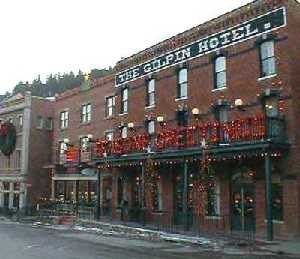
The Gilpin Hotel in 2003
Thomas raised an alarm and the eight to ten guests quickly began to evacuate the hotel. Our hero, Thomas, returned to the hotel, covering his nose with a sock to retrieve one person who had collapsed from smoke inhalation. Unfortunately, he also tells us that one guest returned to the hotel to get some papers, never to come out again.
Thomas is convinced that Lucille provided a warning when the mysterious light bulb turned back on in the middle of the night.
After the fire, the hotel was refurbished and today it is the Gilpin Hotel and Casino. Employees and guests report sightings of the ghostly Lucille. One manager reported that he saw a woman entering a second-floor room, but when he approached, no one was there. Today, one of the casino’s restaurants bears Lucille’s name.
Haunted Mine Shaft off Colorado Highway 119
Between Blackhawk and Eldora, Colorado’s Highway 119 twists and turns through the small villages of Perigo, Rollinsville and Nederland before reaching Eldora. Like the rest of Gilpin and Boulder counties, this is old gold mining country where dozens of back roads lead off the highway, revealing old mining shafts and tumbling buildings. Both rugged and beautifully scenic, Julia and her husband loaded up their four-wheelers for a day of adventure along those awesome back roads. While they were navigating their four-wheelers along one of these many mountain paths, the road suddenly ended at a steep hillside, leaving only a trail leading up to an old mine shaft. Looking like yet another great adventure, Julia started up the trail when she suddenly felt overwhelmed and pushed back. A self-described ghost magnet, Julia couldn’t catch her breath and told her husband she didn’t feel like continuing up the trail. Her husband, a non-believer in any kind of afterlife, other than heaven and hell, only scoffed and continued up the path to the mine shaft.
Ghost Towns: America’s Lost World DVD. At Legends’ General Store.
Julia watched as her husband struggled up the mound of dirt to the mine shaft, but after several minutes of attempting the climb to the mine entrance, he turned back. When they returned to their Jeep he told Julia he didn’t feel good and that something was making him feel funny. Though he didn’t want to talk about it, Julia is sure that an old miner was killed at those diggings. Experiencing paranormal phenomena and seeing ghostly apparitions since she was three years old, Julia sensed that the old miner didn’t want anyone around his findings, even in death. She describes the whole area as being very bizarre and filled with spirits of the past.
Central City, Colorado.
Founded in 1859, Central City quickly acquired the reputation of being in the middle of “the richest square mile on earth.” As many as 30,000 miners flooded the area in search of their fortunes but by the end of its second year, most of the placer gold was gone and hard rock mining began. The settlement’s population ebbed and flowed with the building of new mines and survived through the 1870s and 1880s.
However, by the early 1900s, Central City was becoming a virtual “ghost” as buildings were dismantled – the lumber and materials shipped to more thriving settlements.
By the 1920s the settlement had only about 500 residents. Struggling along as a tourist town for years afterward, the town regained some prosperity with the passing of legalized gambling in 1991.
However, the nearby town of Blackhawk, nearer to the highway, benefited most from the new law and Central City continued to struggle along. However, the benefit to Central City is that most of its historic buildings remain intact. Central City, although inhabited by the living, is also said to remain home to a number of lingering spirits.
Masonic Cemetery – Every April 5 and November 1, it is said that a beautiful woman in a black satin dress appears and lays flowers on the grave of John Edward Cameron. There are many different rumors for the connection between this ghost and Cameron, who died on November 1, 1887. At one time, twelve people gathered at Cameron’s grave on November 1 to see the ghost. They were not disappointed — at sunset, the woman appeared as always, but when two of the men tried to grab her, she flew off and vanished on a hill not far from the cemetery. The hilltop cemetery is north of the city.
Central City Opera House.
The Opera House — One of the more famous landmarks in the old mining town is the Central City Opera House. Here, some of Colorado’s finest troupes of entertainers performed, and some have seemingly stayed on to perform long after the troupes have left. Built in 1878, the national historic Opera House has hosted performances for well over 100 years. Unfortunately, shortly after its opening, the Central City mines played out and the Opera House fell into disrepair. However, many years later the 550-seat Opera House was saved by a volunteer effort in 1932. Restoring the Opera House to its former grandeur, performances were brought back to the old Opera House for summer festivals that continue to this day.
Among the remaining troupes of the Opera House was s a miner turned stage performer by the name of Mike Dougherty, who was a favorite in 1865. Unfortunately, like many residents of this rough and tumble frontier town, Dougherty drank himself to death. Apparently, Mike’s love of the stage has caused him to linger.
Over the years, numerous back-stage visitors have reported being nearly overwhelmed with the strong (but fleeting) odor of alcohol, which is sometimes accompanied by a stout nudge on the shoulder, or by their hair being lightly ruffled from behind. While Dougherty seems to be a friendly ghost, the living are always considerably startled when they turn to look and realize that they are alone in the darkened corridor.
Other reported occurrences have included strange flickering orbs of light that seem to float across a darkened stage and then vanish into the wings. The distinct sound of footsteps is also heard in the balcony, thought to be those of a long-departed female patron, Occasional cold spots have been felt which move from one corner to the next backstage. Nearly all of these occurrences have been reported when the theater is dark and not in use for performances.
Teller House – This historic building is one of the few that survived the 1874 Central City fire. Built at a cost of $84,000 in 1872, the owners spent an additional $20,000 for furnishings, making it the finest hotel (outside of Denver) west of the Mississippi. In the beginning, the rate for this luxury hotel was 50 cents per night plus an additional $2.50 tariff. President Grant visited Central City and the Teller House in 1873 and again in 1876. For his 1873 visit, a path of silver ingots valued at $12,000 was laid from his carriage to the front door of the hotel as a “welcome mat.”
This building houses the famous and mysterious “Face on the Barroom Floor” painting, done by Herndon Davis in 1934. This lovely painting is carefully maintained today.

In Central City, Colorado this face draws back its long-dead artist time and time again.
Legend has it that the woman’s likeness was painted by a distraught miner when his wife died of consumption (tuberculosis.) As the story goes, the miner drank himself into a stupor and then proceeded to paint his wife’s portrait on the floor. Speaking tenderly of her, he painted long into the night and on past noon the next day. Once the artist was finished, he slept, never to wake again. Buried next to his beloved wife, witnesses say that on the anniversary of his death, the couple can be heard talking tenderly to each other through her portrait on the floor.
Unknown Cemetery – There are at least four cemeteries in Central City. One of these old cemeteries holds the remains of a woman who was determined to be a witch by her peers. If you can find the grave, it is said that if one stands just a few yards away, a green mist will surround the area. Further, witnesses purport that if the lighting is right, hundreds of maggots will cover the ground.
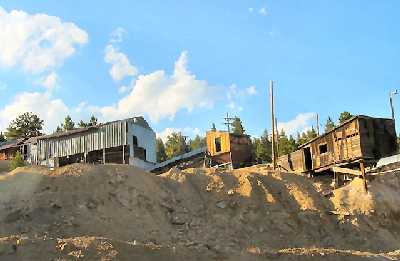
Old mines just outside of Central City
Gold Mine Road — Though “they” don’t give this road a name nor call it the “Gold Mine Road”, I called it that for lack of a better description. This is a personal experience as I traveled along this road southwest of Central City, past the cemeteries leading to Nevadaville, past Russell Gulch and on to Idaho Springs. My traveling companion on this trek was known to me to be a ”ghost magnet.”
Though he had shared many uncanny experiences with me about his insights and feelings; he himself was uncomfortable with his ability. As we traveled the road, I, of course, continued to insist that we stop for photo opportunities. Mesmerized by the beauty of the area and the history facing me, I could have spent an entire day.
The Haunted Mine
In the beginning, Central City was so filled with gold and silver that one could often just pick it up. But, as the surface minerals were gone, the dangerous work of hard-rock mining began. Many miners in the area suffered cave-ins, accidents with tools and explosives, and suffocation.
In one area mine that closed more than 85 years ago, the Pozo Shaft is said to still remain home to a number of ghostly miners. Many night-time trespassers have been frightened away by faint yellow lights coming from the old mine and the sounds of men working deep in the mine shaft far below.
In one area mine, the Pozo Shaft, it is said that many mischievous, night-time trespassers (usually acting on an ill-advised dare) have been frightened by faint but eerie yellow lights and the sounds of heavy tools and men working deep in the mine shaft below.
Blackhawk
Blackhawk – Gilpin Hotel -1960
Gilpin Hotel and Casino – The original Gilpin Hotel in Blackhawk dates back to the late 1800s when the Central City/Blackhawk area was known as the richest square mile on earth. Back in those days, the hotel also housed a one-room school upstairs, with a teacher by the name of Lucille Malone. Lucille was in love with an area miner and was devastated when her lover was run over by a wagon in front of the hotel. Unable to deal with her grief, the distraught schoolteacher threw herself over the balcony of the hotel dying in the very same street as her former lover. However, Lucille seemingly remains at the hotel according to several guests.
Before the advent of gambling in Blackhawk, the Gilpin Hotel was just a small-town hotel catering to tourists and people living within the area. One of our readers, a man by the name of Thomas, was staying there with a girlfriend in the early 1990s.
His girlfriend, who was a bartender at the hotel, lived in one of the upstairs rooms. The old hotel was a little run down at the time and Thomas tells us that the only way to turn out the light in the bathroom was to twist the bulb.
Before retiring for the evening, he unscrewed the bathroom light and climbed into bed. However, at some point during the night, the light mysteriously turned back on. Getting up to unscrew the bulb again, Thomas was startled by a clatter from the first floor – the sound of pots and pans dropping from the wall. Fearing an intruder, he grabbed a baseball bat and crept down the stairwell, only to find the kitchen fully engulfed in flames.
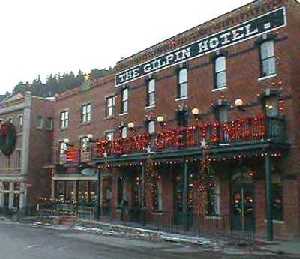
The Gilpin Hotel in 2003
Thomas raised an alarm and the eight to ten guests quickly began to evacuate the hotel. Our hero, Thomas, returned to the hotel, covering his nose with a sock to retrieve one person who had collapsed from smoke inhalation. Unfortunately, he also tells us that one guest returned to the hotel to get some papers, never to come out again.
Thomas is convinced that Lucille provided a warning when the mysterious light bulb turned back on in the middle of the night.
After the fire, the hotel was refurbished and today it is the Gilpin Hotel and Casino. Employees and guests report sightings of the ghostly Lucille. One manager reported that he saw a woman entering a second-floor room, but when he approached, no one was there. Today, one of the casino’s restaurants bears Lucille’s name.
Haunted Mine Shaft off Colorado Highway 119
Between Blackhawk and Eldora, Colorado’s Highway 119 twists and turns through the small villages of Perigo, Rollinsville and Nederland before reaching Eldora. Like the rest of Gilpin and Boulder counties, this is old gold mining country where dozens of back roads lead off the highway, revealing old mining shafts and tumbling buildings. Both rugged and beautifully scenic, Julia and her husband loaded up their four-wheelers for a day of adventure along those awesome back roads. While they were navigating their four-wheelers along one of these many mountain paths, the road suddenly ended at a steep hillside, leaving only a trail leading up to an old mine shaft. Looking like yet another great adventure, Julia started up the trail when she suddenly felt overwhelmed and pushed back. A self-described ghost magnet, Julia couldn’t catch her breath and told her husband she didn’t feel like continuing up the trail. Her husband, a non-believer in any kind of afterlife, other than heaven and hell, only scoffed and continued up the path to the mine shaft.
Ghost Towns: America’s Lost World DVD. At Legends’ General Store.
Julia watched as her husband struggled up the mound of dirt to the mine shaft, but after several minutes of attempting the climb to the mine entrance, he turned back. When they returned to their Jeep he told Julia he didn’t feel good and that something was making him feel funny. Though he didn’t want to talk about it, Julia is sure that an old miner was killed at those diggings. Experiencing paranormal phenomena and seeing ghostly apparitions since she was three years old, Julia sensed that the old miner didn’t want anyone around his findings, even in death. She describes the whole area as being very bizarre and filled with spirits of the past.