This blog is the best for google chrome.
Download
Website Online Counter

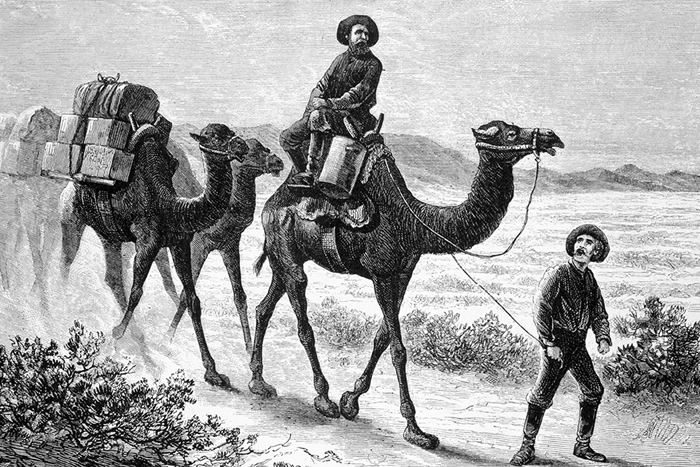
Ghost Camels in the American Southwest

In 1848, the importation of camels for military purposes in the southwest was suggested to the War Department by Henry Wayne, a Quartermaster Major. Two years later, Secretary of War and Mississippi Senator, Jefferson Davis, tried to persuade the Senate to look into the use of camels for the U.S. Army.

During this time period, the southwest territory of the United States was greatly expanding and it was thought that camels could be used to carry at least twice the amount of weight as horses or mules, and might also be used in tracking and pursuing Indians, as they could travel without water or rest for much longer than horses. It was also suggested that the camels might carry the mail and that fast camel passenger trains might be developed to run from Missouri River points to the Pacific Coast.

Initially, the Senators voted the idea down, but after California newspapers began to promote the idea, they finally agreed in 1854, passing a bill to appropriate $30,000 for the camel experiment.
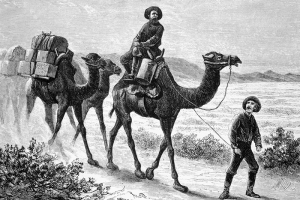

Camels in the Southwest.

Some 72 camels arrived in the country in the early part of 1857 and were put to work carrying supplies in the southwest. However, though the camels proved to be well-suited to travel through the region, their unpleasant disposition, a habit of frightening horses, and tendency to wander off during the nights, made them very unpopular among the soldiers. Still, they continued to be used until the Civil War broke out, at which time; they were sold at auction or turned loose into the desert.

For years afterward, wild camels continued to be spied roaming in the desert, especially in southern Arizona. Along with these real sightings, a number of legends and tales began regarding these ugly beasts of burden. The most popular is the tale of a camel known as the Red Ghost.

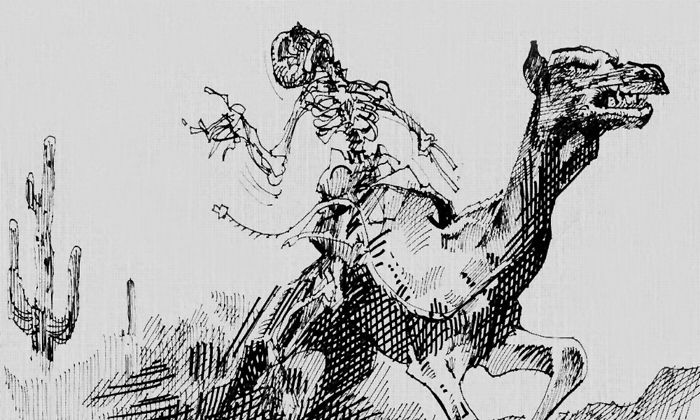
In 1883, a woman was found trampled to death and, on her body and a nearby bush, were clumps of reddish fur. Large hoof prints were found in the area, but locals were perplexed. A short time later, a large animal careened into a tent in which two miners lay sleeping. Though they were unable to identify the beast, again, large hoof prints and tufts of red hair were left behind. After more incidents occurred, the locals finally recognized the large animal as a camel. Soon, people began to report seeing the camel, who one rancher said carried a rider, though the rider appeared to be dead. The next report came from a group of prospectors who saw the camel and while watching him, spied something falling from its back. As the beast moved on, the prospectors went to see what had fallen and discovered a human skull. For the next several years, numerous others spied the camel, who by this time had been dubbed the “Red Ghost,” carrying its headless rider. However, in 1893, when an Arizona farmer found the red camel grazing in his garden, he shot and killed the beast. By this time, the large camel had shaken free of its dead rider, but still bore the saddle and leather straps with which the corpse had been attached.
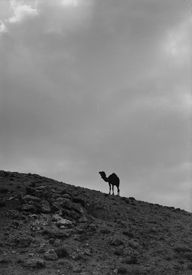

Camel in the desert, about 1900

There was much speculation as to who the mysterious dead rider the camel had carried for several years might have been. One tale alleges that the rider was a young soldier, who was afraid of the camels, and therefore, was having much difficulty in learning how to ride them. In order to teach him how, his fellow soldiers tied him to the top of the beast, determined that he would get over his fear. They then hit the camel on the rump and the beast took off running. Though the soldiers pursued the camel and his rider, the red beast easily outpaced them and escaped into the desert. Neither the camel nor his helpless rider were ever seen again.

Though the abandoned beasts of the Camel Corps roamed for decades, they soon disappeared altogether. In 1907, a prospector reported that he had seen two wild camels in Nevada and other reports continued to come in sporadically. However, in April 1934, the Oakland Tribune reported: “The Last American Camel Is Dead.” The camel, dubbed “Topsy,” was last seen trekking across the desert of Arizona into California. When she made her way to Los Angeles, she was taken to Griffith Park to live. However, sometime later, she became so crippled with the paralysis, the zoo attendants were forced to put her down.

Seemingly, all the “real” army camels have long passed. However, legends continue to abound of people sighting a giant red camel, carrying a headless rider, in the deserts of Arizona. It sounds as if “Red Ghost,” may very well be living up to his name.

Yet another legend of a ghostly camel also persists. This camel belonged to a prospector named Jake, who had purchased three camels from the Army at the public auction. Though his camels were every bit as ornery as the soldiers had described them, he spent much time caring for them and had nothing but praise for his beasts of burden.

After Jake hit pay dirt, he led his gold-laden camels into town to sell his ore. Afterward, he headed to the local saloon to celebrate. Unfortunately, in the crowd was a man named Paul Adams, who listened with much interest to Jake’s story of his gold find. When Jake left to return to his mine, he didn’t go directly to his claim, knowing that he might be followed. Though he was careful and took a circuitous route, the man named Paul Adams followed him. When Jake encamped for the night, Adams, thinking that he was at the mine’s location, murdered him. Trying to protect his owner, one of the camels attacked Adams, and for his efforts, was shot by a scoundrel, but not before he had viciously bit him.
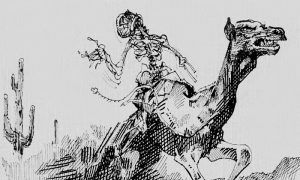

Ghost Camel

Adams then began to search in earnest for Jake’s mine, until one night the ghost of Jake riding upon the dead camel, approached his camp and chased the scoundrel all the way into town, straight to the sheriff’s office. Frightened beyond belief, Paul Adams then made a full confession.

Whether Jake and his loyal camel continue to roam the desert is unknown.
Read more >>

Haunted Fort Jackson

The oldest standing brick fortification in Georgia and a National Historic Landmark, Old Fort Jackson not only provides a wealth of history but is also allegedly haunted.

Officially called Fort James Jackson, this restored 19th-century fort was built when President Thomas Jefferson authorized the construction of eight forts in the area to defend the Savannah area. One of these fortifications included Fort Jackson which was named for James Jackson, a British native who fought In the American Revolution and rose to the rank of colonel. When he was just 25 years old, he accepted the surrender of the British in Savannah at the close of the revolution. He was later a U.S. Representative, U.S. Senator, and Governor of Georgia.

The fort was built between 1808 and 1812 over the site of a 1776 earthen battery from the American Revolution. It was originally built as a six-gun fort with three, two gun batteries facing the water. The back of the fort was open and unfortified.


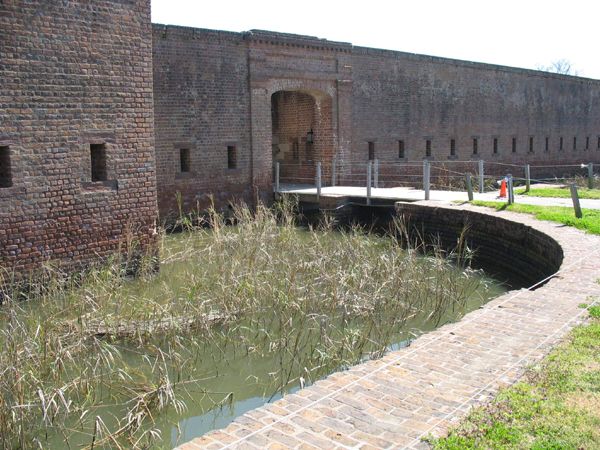
Fort Jackson, Georgia

In the War of 1812, local militias and U.S. troops saw active duty at Fort Jackson. After the war, two periods of construction followed at the fort. A moat, drawbridge, brick barracks, privies, a rear wall, and another powder magazine were added.

During the Civil War, Fort Jackson, along with nearby Fort McAllister and Fort Pulaski, defended Savannah from Union attack. In 1862, Fort Jackson was shelled from a ship captained by an escaped slave named Robert Smalls. The fort was commanded by Colonel Edward Clifford Anderson and would become the Confederate Headquarters for the Savannah River defenses, including the Confederate Navy. The fort was held by the Confederates until December 1864 when it was evacuated as General Sherman approached. The departing Confederates set the fort afire, spiked the guns and destroyed everything of military value. Union troops occupied the fort until the end of the war. The Confederate forces retreated to South Carolina where they joined other forces and continued to fight until April 26, 1865, when they surrendered to General Sherman’s army at Durham, North Carolina.

After the Civil War, the fort was placed in caretaker status and was renamed Fort Oglethorpe in 1884 and carried that name until it was decommissioned in 1905. It was purchased by the city of Savannah in 1924 for park purposes but not fully restored until the 1970s.

As to the ghosts of Old Fort Jackson, the one most often sighted is thought to be that of a Confederate private by the name of Patrick Garrity. Garrity apparently had a problem with his superior, Lieutenant George Dickerson. One night when Garrity was on guard duty near the drawbridge, he was approached by Lieutenant Dickerson and for reasons unknown, the private bludgeoned his superior with his musket, breaking both his musket and the officer’s skull in four places. Private Garrity then fled the scene by jumping into the moat, but his escape was not to be effective, as he drowned in the moat. Lieutenant Dickerson survived the beating but was unable to remember the attack. He never fully recovered and was forced to step down from his command.

Today, there is a ghostly specter that is often spied at the site of the attack, believed to be that of Patrick Garrity. Said to be dressed in a Confederate uniform, the soldier is seen walking along the parade ground or standing near the drawbridge. Some reports say that the apparition appears only from the waist up.

Evidently Garrity is not alone, another silhouette of a soldier has been reported standing on the casement walls above the parade ground. Other fallen soldiers are also seen in various areas, some walking leisurely and others intensely manning their posts with a watchful eye. On one occasion when a cleaning lady reportedly heard strange noises, she turned around to come face to face with a Confederate soldier standing in a doorway. After glaring at her, the spirit vanished.

Many who visit the old post describe feeling unsettling energy or eerie feelings just before they glimpse a darting shadow or a full-fledged apparition of a historic soldier. Others report hearing phantom footsteps and other strange sounds.

Situated on the Savannah River, two miles east of the city of Savannah, Fort Jackson is located at 1 Fort Jackson Road. The old fort is owned by the state of Georgia and operated as a museum by the Coastal Heritage Society. Fee for admission.
Read more >>

Mummies — Giants — Underground Caverns!

So said a San Diego, California newspaper in describing an event in Death Valley in 1947.

A land of extremes, Death Valley is one of the hottest, driest and lowest places on earth. With summer temperatures averaging well over 100 degrees and a long history of human suffering in the vast desert, the valley appears to be aptly named. But people have been calling this rugged and desolate land home for as long as 9,000 years.

Trace of Giants Found in Desert:

In early August 1947, a man named Howard E. Hill of Los Angeles, California spoke before the city’s Transportation Club and told a sensational story. The tale described the work of a man named Dr. F. Bruce Russell, who claimed to have discovered a series of complex tunnels deep below Death Valley in 1931. Russell, a retired Cincinnati, Ohio physician, along with a colleague named Dr. Daniel S. Bovee, who he had worked with on archaeological excavations in Mexico several years earlier, allegedly stumbled upon these caves quite by accident. Russell, who had reportedly moved west for his health, decided to check out mining opportunities. According to the tale, while Russell was sinking a shaft for a mining claim, he fell into a cave when the soil gave way and discovered a catacomb of tunnels leading off into different directions.

When Russell and Bovee began to explore the caverns, they followed one tunnel where they were extremely surprised to find the mummified remains of three gigantic men who were 8-9 feet tall. The giants were clothed in garments consisting of a medium length jacket and trousers extending slightly below the knees. The texture of the material was said to resemble gray dyed sheepskin, but they believed it to be taken from an animal unknown today. The room also held a number of artifacts that resembled Egyptian and American Indian designs and hieroglyphics were chiseled on carefully polished granite. The explorers believed they had found the burial place of the tribe’s hierarchy.

Following another tunnel, they came across what they described as a “ritual hall” of these ancient people. Here, they once again found artifacts and marking as well as the well-preserved remains of animals, including dinosaurs, elephants and tigers. Later, it was suggested that perhaps these bones belonged to ancient saber-tooth tigers and mammoths.

Further, Russell had described to Hill that he and Bovee had only touched the surface of their discovering, stating that there were at least 32 tunnels and estimating that they ran across 180 square miles across Death Valley and parts of southern Nevada.

Professional archaeologists were skeptical of the story and Los Angeles County Museum scientists pointed out that dinosaurs and saber-tooth tigers appeared on earth 10 to 13 million years apart. No one in the professional world of archeology was interested enough in the story to personally check it out.

Despite the disinterest of scientists, Dr. Russell and a group of investors created a corporation called  “Amazing Explorations, Inc” to handle the release, and hopefully profit, from this remarkable find. But, in the constantly shifting sands of the deceiving desert, Russell was unable to find the site the next time he tried to show his friends. Afterward, Russell disappeared. Months later, Russell’s car was found abandoned, with a burst radiator, in a remote area of Death Valley. His suitcase was still in the car. Of Dr. Bovee, he seemingly disappeared into the shadows far away from this mystery.

Nothing but a hoax perhaps?

But that is not the end of the story — nor is it the beginning.

The Kingdom of Shin-au-av:

For centuries, legends of an underground city and an ancient race in Death Valley have been told in the Paiute Legend of the Kingdom of Shin-au-av. This place, meaning “God’s Land” or “Ghost Land” is a sacred place to the Paiute.

According to the legend, thousands of years ago an important Paiute chief lost his wife. Devastated, the leader was so overcome with grief and sorrow, he began to think that life without her was not worth living. He soon came to the decision to take his earthly body into the land of the dead. Following the trail of brave Indian spirits through endless underground passages, the journey was a long and difficult one. As he traveled he was besieged by evil spirits, fierce beasts, and supernatural demons. Finally, though, his brave journey was rewarded by glorious sunlight at the end of the trail. But, he had yet one more ordeal — crossing an extremely narrow rock bridge that arched over a bottomless canyon. But, he could see the beautiful green meadows of the Spirit Land across the way and determinedly made his way across safely.

Entering the great kingdom ruled by Shin-au-av he was welcomed by a beautiful maiden who was the daughter of Shin-au-av. The princess took the hand of the brave chieftain and led him to a large natural amphitheater. There, the chief looked upon thousands of dead and happy Paiute dancing in a huge circle. Though he was no doubt pleased to see that the dead were happy, he bemoaned “I will never find my wife in the crowd.” But, the princess promised him that he would and instructed him to sit at the edge of the circle watching until his wife would pass. She then left him momentarily returning with food and drink to make him comfortable. When she returned, she left him with one more directive: “When you see your beloved wife, carry her off quickly without either of you making a backward glance. Then travel back the way you came.”

The chief agreed and sat patiently waiting to see his wife dance by. After several days, he had seen a number of people that he had known in the past including friends and enemies, but had not yet seen his beloved wife. Just as he was beginning to despair he saw her approaching late on the third night. He ran to her with his arms spread wide, grabbed her, and the two then fled the valley hand in hand moving towards the ribbon bridge that crossed the great chasm. But for all his bravery and determination, the chief risked a quick look back at the beautiful valley. In that brief moment, he was suddenly standing alone.

In the end, he made his way back to his people where he spent the rest of his life telling the story of the wonders and beauty of the Kingdom of Shin-au-av. And thus, the legend was born, to be passed down from one generation to the next for years to come.

Many years later, in the 1920s, a prospector named White claimed he had fallen through the floor of an abandoned mine, at Wingate Pass in the southwest corner of Death Valley, into an underground tunnel. Going deeper into the labyrinth, he came to a group of rooms where he found hundreds of leather-clad human mummies that were surrounded by gold bars and other treasures. The rooms, as well as a tunnel that extended deeper into the catacombs, were lit with a pale greenish-yellow light of unknown origin. However, White did not follow the tunnel deeper into the unknown.

White claimed he had explored the catacombs two more times after his initial find. During his second visit, he was accompanied by his wife, and on the third, by his prospector partner, Fred Thomason.

In the meantime, after hearing about about White’s find, a Paiute Indian named Tom Wilson, who worked as a trapper and guide, told a story that was somewhat similar. Wilson claimed that his grandfather had discovered the below ground caverns of Death Valley many years before. As he told the tale, his grandfather had gone into a cave which led to numerous tunnels and large rooms beneath the valley floor. After wandering for miles, his grandfather had come to an underground city where he found a group of fair-skinned people that spoke an unknown language and wore leather-like clothing. He also said that the people had horses, were sustained by the food he had never seen before and that their “city” was illuminated by pale greenish-yellow lights.

The Indian, after having been missing for some time, finally returned home to tell his people of his discovery. Upon hearing his story, most of them were dubious about the authenticity of his adventure. But, his grandson, Tom Wilson, absolutely believed the tale.

Prospector White agreed to lead Tom Wilson and a group of archeologists to the entrance of the underground city, but, on this trip, White was unable to locate the cavern. However, they did locate a curious dead-end tunnel that had been carved out of solid rock. No doubt, they were all disappointed. But, that didn’t stop Tom Wilson, who spent the rest of his life searching for the underground city until his death in 1968.

The area around Wingate Pass was eventually absorbed into the China Lake Naval Weapons Center and is now closed to the public.

Interestingly, another tale with remarkable similarity was told by an old prospector by the name of Bourke Lee in his book Death Valley Men, published in 1932. Lee also tells of an underground city located in the Panamint Mountains of Death Valley. In his story, two men by the names of Jack and Bill were exploring near Wingate Pass when one of them fell through the bottom of an old mine shaft. His partner obviously followed into what was described as a natural underground cavern. The pair allegedly followed a tunnel some 20 miles northward into the heart of the Panamint Mountains.

These two men eventually arrived at large ancient underground rooms where they reportedly found several perfectly preserved human mummies which were adorned with thick armbands and held gold spears. Further, they said that the cavern rooms were illuminated by a system of lights fed by subterranean gases and the rooms were filled with treasure. This time, however, the report of the riches were more descriptive, with the men claiming to have found large statues of solid gold, stone vaults, and drawers filled with gold bars and gemstones, and a beautifully polished round table. Further, the story describes perfectly balanced heavy stone wheelbarrows and huge stone doors which were almost perfectly balanced by counter-weights.

After having found this incredulous room, the two men carried off a few artifacts and some of the treasure before continuing their journey through the tunnel which inclined upwards to a point that opened about half-way up the eastern slope of the Panamint Mountains. When the two men returned they displayed the treasures they had brought down which they hoped might lure archeologists to the site. But, in this tale, like so many others involving hidden riches, there would be a twist in the plan. Allegedly a “friend” made off with the artifacts and when the two men tried to lead experts to the mine opening, once again, they were unable to locate it. Jack and Bill claimed that a recent rainstorm had altered and rearranged the terrain.

Like the former discoverers, these two were also determined to find the entrance to the cavern and were allegedly last seen preparing to climb the east face of the Panamint Mountains. After which, they were never heard from again.
Read more >>

Legends of Fort Mountain, Georgia

Part of the Cohutta Mountains, a small mountain range at the southern end of the Appalachian Mountains, Fort Mountain takes its name from the remnants of a stone formation located on the peak.

This ancient 885 feet-long zigzagging rock wall was built from stones that are from the local area around the summit. It is up to 12 feet thick and up to seven feet high, but generally rises to a height of two or three feet. The wall, which is scattered with 29 pits, cairns, small cylinders, stone rings, and ruins of a gateway, is said by some sources to have been built around 400-500 AD, while other sources say that the date has not been determined.

There are several theories as to who might have built this wall. Early visitors referred to the formation as a fort, speculating that it was built by Hernando de Soto to defend against the Creek Indians around 1540. However, this theory was contradicted as early as 1917, when a historian pointed out that de Soto was in the area for less than two weeks.

Two other legends say that the wall was built either by the Moon-eyed people according to Cherokee lore or is contributed to a Welsh prince who was said to have made his way to America in 1170.

According to Cherokee tradition, the moon-eyed people lived in the lower Appalachia region before the Cherokee came to the area during the late 1700s. The people were said to be called “moon-eyed” because they saw poorly during the day and could see very well at night. They were also described as being small in stature, the men bearded, light-eyed, and having pale white skin. One early historian described them as albinos who were possibly the ancestors of the Kuna people of Panama, who have a high incidence of albinism.

The Cherokee, who drove them out of the region, say that these people built the ancient structures in the area. Supposedly, a temple had once stood inside the fortification which contained a giant stone snake with ruby eyes.

The moon-eyed people were first mentioned in a 1797 book by Benjamin Smith Barton. Later documentation tells of similar accounts, such as an 1823 book, The Natural and Aboriginal History of Tennessee, which tells of  of a band of white people who were killed or driven out of Kentucky and West Tennessee.

Who were these moon-eyed people? Some say they might be of Welsh descent. This story tells of a prince named Madoc (or Madog) ab Owain Gwynedd, who fled his homeland after the death of his father, which had created a Civil War among his seven sons. The sons were to fight to determine who would rule their father’s lands.

To avoid the bloodshed, Madoc set sail with his brother Rhirid and a few followers in 1170 and was said to have landed somewhere around Mobile Bay, Alabama. Some time later, Madoc returned to his native country and recruited more followers who returned on ten ships to settle in America. After setting sail, they were never heard from in Wales again. Some speculate it was these colonists that built the fortress wall. Allegedly, the Fort Mountain stone work wasn’t the only one they built. Legend also attributes one near DeSoto Falls, Alabama, which is said to be nearly identical to the setting, layout, and method of construction of Dolwyddelan Castle in Wales, the birthplace of Madoc.  Minor fortifications in the Chattanooga, Tennessee area are also attributed to these Welsh people.

In an 1810 letter, former Tennessee governor John Sevier wrote that the Cherokee leader Oconostota told him in 1783 that local mounds had been built by white people who were pushed from the area by the Cherokee. According to Sevier, Oconostota confirmed that these were Welsh from across the ocean. Madoc’s travels, first told in print about 1584, had also been told in Welsh songs and stories since the twelfth century.

Were these descendants of Madoc’s colonists the Moon-eyed people?

Many generations of explorers, archaeologists, geologists, and historians have wondered about the identity of the unknown builders and the purpose of their handiwork. Some believe that the wall had a a ceremonial function since it lacks certain characteristics necessary for defensive purposes, such as its relatively low height and the lack of water within the wall.

However, nobody knows which of the many legends and theories is true and which are false. The true answer still lies buried somewhere in antiquity and may never be unearthed

Current legends tell that the sounds of distant drums, flickering lights, and the images of men wearing bearskins have been encountered along the collapsed wall.

Today, the mysterious peak is part of the Fort Mountain State Park, which is also known for its unique scenery, a mixture of both hardwood and pine forests and several blueberry thickets. In addition, the park contains a 17-acre mountain lake.

It is located which is seven miles east of Chatsworth, Georgia off GA 52.
Read more >>
If these ghost stories kept you up at night, buy me a coffee to stay awake too!
Booking.com